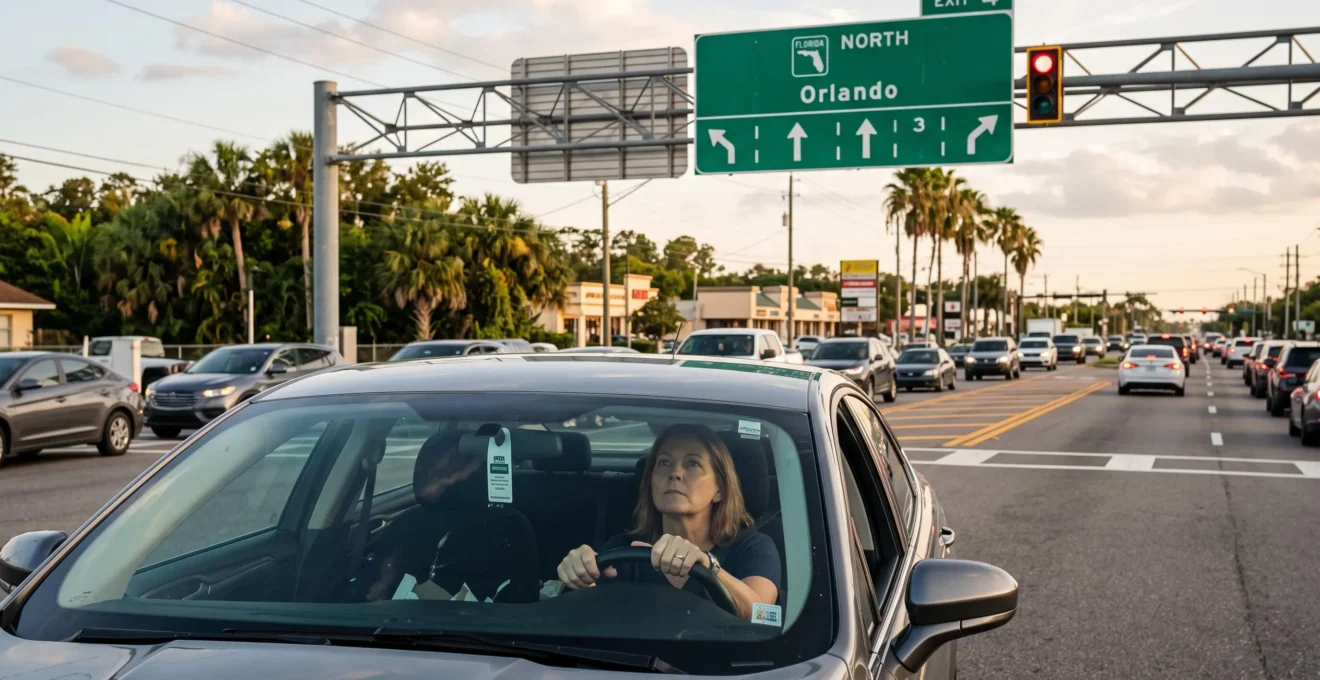
Out-of-state drivers visiting Florida should first understand the state’s pedestrian right-of-way requirements, school bus stopping rules, Move Over law, passing lane restrictions, and conditions for turning right on red. Knowing how electronic toll collection works is equally important when traveling on unfamiliar highways or driving a rental car.
Although Florida follows national traffic control standards, familiar signs and road layouts can require drivers to reconsider habits developed elsewhere. The physical design of a median, for example, determines whether approaching traffic must stop for a school bus. Similarly, passing a disabled vehicle on the shoulder can trigger specific legal obligations.
The Chapter 316 of the Florida Statutes establishes the state’s principal traffic regulations. Understanding how these requirements apply to everyday driving situations helps visitors distinguish mandatory actions from defensive driving recommendations, particularly around busy tourist districts, residential communities, and major highway interchanges.
Florida driving rules every visitor should know
- Follow pedestrian right-of-way requirements and complete all legally required stops before proceeding through intersections.
- Stop for school buses unless the specific divided-highway exception applies to your direction of travel.
- Move right when required by Florida’s lane discipline rules and follow the Move Over law near qualifying roadside vehicles.
- Turn right on red only when permitted, after stopping completely and yielding to other road users.
- Confirm transponder compatibility before entering express lanes, and never attempt to reverse after missing a freeway exit.
- Why Do Out-of-State Drivers Misinterpret Florida Road Signs?
- How to Yield Safely at Florida Crosswalks and Pedestrian Intersections?
- Florida Passing Lane Rules: When Should Drivers Move Right?
- When Must Drivers Stop for a School Bus on Florida Roads?
- What Should Visitors Do When Approaching a Florida Emergency Vehicle?
- How to Make a Legal Right Turn on Red at a Busy Florida Intersection?
- Express Lanes or General Lanes: Which Should Florida Visitors Use?
- How to Drive Safely on Florida Freeways When You’re Unfamiliar With the Roads?
Why Do Out-of-State Drivers Misinterpret Florida Road Signs?
Out-of-state drivers can misinterpret Florida road signs when they associate familiar traffic symbols with driving habits developed in their home state. Although traffic signals and many road signs follow national standards, local intersection configurations, pedestrian crossing controls, toll lane restrictions, and posted instructions determine how drivers must respond in each situation.
A flashing yellow arrow is a useful example. Under the national standards described in MUTCD Part 4 on highway traffic signals, a flashing yellow arrow permits a turning movement subject to applicable yielding requirements. It does not provide the same protected movement as a green arrow.
Visitors should distinguish standardized signal meanings from the way traffic controls are installed and combined at particular Florida intersections. A familiar signal may operate alongside unfamiliar lane restrictions, pedestrian markings, or turn prohibitions.
Before driving, identify which established habits could cause problems:
- Turning habits: assuming an illuminated directional arrow always gives priority over conflicting traffic.
- Crossing habits: expecting pedestrians to cross only at signalized intersections.
- Toll road habits: assuming every electronic toll lane accepts license plate billing.
- Lane selection habits: following navigation instructions without checking overhead signs and pavement markings.
Review the traffic signs, signals, and pavement markings in the Official Florida Driver License Handbook before your first trip. Rental car representatives can explain their company’s toll arrangements, while navigation applications can assist with route selection. Neither replaces the instructions displayed on the road.
Misinterpreting a sign does not remove the obligation to obey it. Florida permits automated enforcement of certain red-light violations, and officers may use radar to enforce applicable speed restrictions. Visitors should not assume that an unfamiliar intersection is unenforced simply because no officer is visible.
Pay particular attention to crossing signs and pedestrian signals, where understanding the traffic control is only part of determining who has the right of way.
How to Yield Safely at Florida Crosswalks and Pedestrian Intersections?
To yield safely at Florida crosswalks, drivers must follow the applicable traffic signals, crossing signs, and pedestrian right-of-way requirements. Florida law recognizes both marked crosswalks and unmarked crosswalks at intersections. Whether a driver must stop or yield depends on the crossing controls, the pedestrian’s position, and the potential conflict with approaching traffic.
Florida Statutes § 316.130 distinguishes between several crossing situations. At signalized intersections, drivers must respect pedestrians crossing with the applicable signal. Where crossing signs require vehicles to stop, drivers must stop as required. At other qualifying crosswalks, drivers must yield to pedestrians occupying the relevant portion of the roadway or approaching closely enough to create a conflict.
Unmarked crosswalks at intersections deserve particular attention. The absence of painted stripes does not automatically eliminate a pedestrian’s right of way. Near beaches, shopping districts, and retirement communities, anticipate people approaching crossings from sidewalks, transit stops, parking areas, and bicycle facilities.
Multi-lane roads introduce an additional danger: a stopped vehicle can conceal a pedestrian from drivers in an adjacent lane. Section 316.130(9) prohibits overtaking and passing a vehicle stopped at a qualifying crosswalk to allow a pedestrian to cross.
When approaching a crossing with restricted visibility, use the following decision sequence:
- Reduce speed early enough to respond to someone emerging from behind a vehicle or roadside obstruction.
- Identify the crossing signals, signs, and pavement markings.
- Stop or yield as legally required, even if traffic in an adjacent lane continues moving.
- Check for additional pedestrians and cyclists before proceeding.
Do not wave pedestrians into another lane where approaching traffic may not see them. Your decision to stop does not establish that every other driver will do the same.
Marked mid-block crosswalks and raised crossings can also require attention away from conventional intersections. A raised road surface is a reason to approach cautiously, but the applicable signs and crossing markings determine the specific legal requirements. Outside marked crosswalks or unmarked intersection crosswalks, pedestrians generally must yield to vehicles, although drivers still have a duty to avoid collisions.
Similar awareness of surrounding traffic becomes essential on multilane highways, where remaining in the wrong lane can create unnecessary conflicts between vehicles traveling at different speeds.
Florida Passing Lane Rules: When Should Drivers Move Right?
Florida drivers should move right when traveling more slowly than the normal flow of traffic or when being overtaken in the far-left lane, subject to statutory exceptions and safe lane-changing conditions. On multilane highways, using the left lane primarily for passing is a practical way to maintain traffic flow without treating it as an unrestricted high-speed lane.
Florida Statutes § 316.081 addresses both slower-moving traffic and drivers being overtaken in the leftmost lane. These requirements are related but do not mean that every left lane on every road is exclusively reserved for passing under all circumstances.
A driver accustomed to selecting a lane and maintaining a constant speed throughout a highway journey should pay closer attention to surrounding traffic in Florida.
The following situations help distinguish appropriate left-lane use from unnecessary lane occupation.
| Driving situation | Recommended response |
|---|---|
| Temporarily overtaking a slower vehicle | Complete the pass within the legal speed limit and return right when adequate clearance exists. |
| Vehicles approaching from behind in the far-left lane | Prepare to move right safely unless an applicable exception permits remaining there. |
| Approaching an upcoming left turn | Position the vehicle appropriately for the intended turn. |
| Traffic merging from an entrance ramp | Adjust spacing or change lanes safely when appropriate, then reassess lane position. |
| Heavy congestion across all lanes | Maintain a safe following distance and avoid unnecessary lane changes. |
Several vehicles accumulating behind you can indicate that your lane position needs reassessment. Do not accelerate beyond the posted limit to accommodate faster drivers. Instead, identify a suitable opening, signal, check mirrors and blind spots, and change lanes safely.
Failing to comply with Florida’s lane-use requirements can result in a traffic citation. Unnecessary left-lane occupation may also encourage other motorists to undertake avoidable passing maneuvers on the right.
During congested holiday travel, safe lane changes take priority over forced movement. When the right lane is occupied, wait for adequate space rather than attempting to squeeze between vehicles.
Lane position is not the only road-layout feature that determines a driver’s obligations. When approaching a stopped school bus, the presence and construction of a median become legally significant.
When Must Drivers Stop for a School Bus on Florida Roads?
Florida law requires drivers approaching a school bus displaying its stop signal to stop and remain stopped until the signal is withdrawn. Traffic in both directions must generally stop on undivided roads. The principal exception applies to drivers traveling in the opposite direction on a divided highway with a qualifying unpaved separation, raised median, or physical barrier.
Under Florida Statutes § 316.172, drivers must distinguish a legally qualifying divided highway from a road that simply contains multiple traffic lanes. Painted markings, including double yellow lines and center turn lanes, do not create the divided-highway exception.
Yellow warning lights should prompt drivers to prepare to stop. When the bus displays its stop signal, identify its direction of travel relative to yours and determine whether a qualifying physical separation exists.
5 feet
The minimum width of an unpaved separation that allows opposite-direction drivers to proceed past a stopped school bus under Florida’s divided-highway exception. A qualifying raised median or physical barrier can also establish the exception.
Florida Legislature, Florida Statutes § 316.172(2).
The distinction is particularly important on wide suburban roads. Use the following comparison to determine whether stopping is legally required when a school bus displays its stop signal.
| Road configuration | Traffic traveling in the bus’s direction | Opposite-direction traffic |
|---|---|---|
| Two-lane undivided road | Must stop | Must stop |
| Multilane road without a physical median | Must stop | Must stop |
| Road with a paved center turn lane | Must stop | Must stop |
| Divided highway with an unpaved separation at least five feet wide | Must stop | May proceed cautiously |
| Divided highway with a raised median or physical barrier | Must stop | May proceed cautiously |
Opposite-direction drivers who qualify for the exception should remain alert for children without making an unnecessary abrupt stop. Drivers traveling in the same direction as the bus cannot use the median exception to justify passing it.
Once stopped, wait until the school bus stop signal is withdrawn. Check that children have cleared your intended path before moving. The statutory condition is withdrawal of the stop signal, not necessarily movement of the bus itself.
Illegally passing a stopped school bus can result in substantial financial penalties and driving-record consequences. Florida also authorizes school bus infraction detection systems, so enforcement is not limited to violations witnessed directly by police officers. Camera availability varies between jurisdictions and school districts.
The same habit of identifying roadside conditions early helps drivers comply with another important Florida regulation: the requirement to provide space for emergency and other qualifying stopped vehicles.
What Should Visitors Do When Approaching a Florida Emergency Vehicle?
Visitors approaching a qualifying stationary emergency vehicle in Florida must leave the nearest lane when they can do so safely or reduce their speed as required by the Move Over law. When an authorized emergency vehicle approaches with the applicable emergency signals activated, drivers must instead yield the right of way and safely clear its path.
Florida Statutes § 316.126 establishes distinct obligations for moving emergency vehicles and qualifying vehicles stopped along the roadside. Seeing flashing lights on the shoulder should therefore prompt an immediate assessment of lane position, speed, and surrounding traffic.
The roadside protections cover specified emergency vehicles, tow trucks, utility service vehicles, and other qualifying service vehicles under the conditions established by the statute. The expansion effective in 2024 also brought certain disabled vehicles within the Move Over requirements, including vehicles displaying hazard warning lights or specified warning devices and vehicles with people visibly present.
This expansion does not mean that every parked vehicle automatically triggers the law. The vehicle’s circumstances and the statutory conditions matter.
Use this decision sequence when approaching a qualifying roadside vehicle:
- Identify the occupied shoulder or roadside area and check surrounding traffic.
- On a highway with multiple lanes traveling in your direction, move out of the closest lane when it is safe to do so.
- If a safe lane change is unavailable, reduce speed to the applicable statutory requirement.
- On a two-lane road, follow the required speed reduction rather than crossing into opposing traffic.
- Remain attentive to roadside workers, vehicle occupants, and unexpected movement until you have passed safely.
20 mph
The required reduction below the posted speed limit when a qualifying Move Over situation requires slowing instead of changing lanes and the posted limit is at least 25 mph.
Florida Legislature, Florida Statutes § 316.126(1)(b)2.
On a two-lane road with a posted speed limit of 20 mph or less, the statute specifies a speed of 5 mph in the applicable circumstances.
In heavy traffic, begin slowing progressively rather than waiting until you are alongside the stopped vehicle. Never force an unsafe lane change to satisfy the Move Over requirement. Early observation and adequate following distance provide the room needed to comply without abrupt braking.
For an approaching authorized emergency vehicle using the applicable audible or visual signals, the general requirement is to yield, move toward the right-hand edge or curb, clear intersections, and stop until the vehicle has passed, unless directed otherwise by a law enforcement officer.
Move Over violations are subject to traffic enforcement. A driver’s familiarity with a narrower version of the law in another state does not change the requirements that apply in Florida.
Recognizing the correct response before reaching a conflict point is equally valuable at intersections, especially when considering a right turn against a red signal.
How to Make a Legal Right Turn on Red at a Busy Florida Intersection?
A right turn on a steady circular red light is generally legal in Florida after a complete stop, provided no posted restriction prohibits the turn and the driver yields to pedestrians and conflicting traffic. The turn is optional, not mandatory. A steady red arrow requires separate attention and must not be treated automatically as permission to turn.
Florida Statutes § 316.075 establishes the conditions governing turns at red traffic signals. Visitors accustomed to jurisdictions with more restrictive right-turn rules should understand Florida’s conditional permission without interpreting it as an unrestricted right of way.
At a busy intersection, perform each of the following steps before turning:
- Identify the signal controlling your lane and check for signs prohibiting or restricting right turns on red.
- Stop completely at the marked stop line. If no stop line exists, stop before entering the near-side crosswalk or at the legally applicable position before the intersection.
- Check the crosswalk and nearby sidewalks for pedestrians.
- Look for approaching vehicles, bicycles, and other road users whose paths could conflict with your turn.
- Proceed only when the turn is permitted and sufficient clearance exists.
Drivers should exercise particular caution when looking left for a gap in cross traffic. A cyclist, scooter rider, or pedestrian may approach from the right while the driver’s attention is directed elsewhere.
Wide intersections can also make pedestrian movement difficult to assess. Where pedestrian signals provide an advance crossing interval, someone may enter the crosswalk before adjacent vehicle traffic begins moving. Check the crossing again immediately before accelerating.
A complete stop means the vehicle ceases moving. Slowing almost to a stop and immediately turning does not satisfy the underlying stop requirement.
Florida’s automated red-light enforcement provisions contain specific conditions and limitations, including provisions concerning careful and prudent right turns at permitted locations. These limitations should not be confused with permission to disregard statutory stopping requirements. Cameras are not installed at every intersection, and their enforcement scope should not determine whether a driver follows the law.
If visibility remains poor, traffic is continuous, or another road user could be endangered, remain stopped until a signal permits movement and the path is clear. Pressure from a driver waiting behind you is not a reason to turn unsafely.
While intersection signals determine whether a movement is permitted, highway entrance signs can establish an additional condition for using a particular lane: eligibility to pay its electronic toll.
Express Lanes or General Lanes: Which Should Florida Visitors Use?
Florida visitors should use general-purpose lanes when they are uncertain about toll payment compatibility, express lane access restrictions, or upcoming exit locations. Express lanes may be useful when congestion threatens a time-sensitive journey and the driver has an accepted transponder. Their value depends on the displayed toll, available access points, and expected travel conditions.
Florida express lanes are optional managed lanes located on certain interstates and toll roads. According to the FDOT Statewide Express Lanes documentation, their tolls may be fixed or variable depending on the facility. Electronic signs communicate information such as toll amounts and lane availability.
The critical distinction is that Florida express lanes require an active, properly installed SunPass or another accepted interoperable transponder. Cash and TOLL-BY-PLATE are not accepted in express lanes. An out-of-state license plate does not exempt a vehicle from toll requirements.
Compare the following travel situations before deciding whether to enter an express lane.
| Travel consideration | Express lanes | General-purpose lanes |
|---|---|---|
| Time-sensitive airport journey | Consider if congestion, access points, and the displayed toll justify entry. | Prefer when an upcoming exit is not accessible conveniently from the express lanes. |
| Off-peak recreational trip | The additional toll may offer limited practical benefit. | Often suitable when traffic is moving steadily. |
| Uncertain transponder compatibility | Do not enter until eligibility is confirmed. | Use these lanes, checking whether the underlying road itself charges tolls. |
| Short trip with an upcoming exit | Limited entry and exit points may make these lanes unsuitable. | Generally more practical for accessing nearby exits. |
On corridors such as I-4 and I-95, an express lane can be worth considering during congested periods. However, paying an additional toll does not guarantee a particular time saving. Check the route, available exits, and current conditions before committing.
Rental vehicles require particular care. According to Florida’s Turnpike information for rental vehicles, rental companies offer different toll-payment arrangements and fee structures. The agency also explains that rental customers cannot directly rely on TOLL-BY-PLATE as their payment option.
Visitors using a personal SunPass PRO should follow the official rental vehicle instructions, including associating the rental license plate with their account for the applicable rental period. Drivers with E-PASS or another transponder should confirm its acceptance and account status before entering a managed lane.
Check whether the rental company’s toll program covers express lanes specifically. Where ordinary toll facilities permit plate billing, an invoice may be sent to the registered vehicle owner, potentially resulting in charges under the rental agreement.
Some managed facilities may impose additional vehicle eligibility or access restrictions. Do not assume that occupancy requirements from another state’s high-occupancy toll lanes apply universally in Florida. Read the facility-specific signs and never cross prohibited markings to escape an unintentionally entered express lane.
Choosing the appropriate lane before reaching its entrance reduces both navigation pressure and the likelihood of unexpected toll-related charges.
Key takeaways
- Choose your highway lanes according to legal access, upcoming exits, and available space rather than reacting to navigation instructions at the last moment.
- Establish your toll-payment arrangements before departure, particularly when combining a rental vehicle with a personal transponder.
- Allow additional travel time when an unfamiliar route involves complex interchanges, limited-access managed lanes, bridges, or changing weather conditions.
How to Drive Safely on Florida Freeways When You’re Unfamiliar With the Roads?
Safe freeway driving in Florida requires planning the route before departure, selecting lanes early, maintaining a lawful speed appropriate to conditions, and allowing enough space to respond to changing traffic. If a driver misses an exit or enters the wrong lane, the safest recovery is to continue legally and reroute from the next suitable exit.
Review your route while parked, paying attention to highway numbers, interchange layouts, toll facilities, and the final approach to your destination. A navigation instruction to exit does not necessarily mean the required lane is immediately adjacent to your vehicle.
Where frontage roads, service roads, or parallel ramps serve an interchange, identify whether your destination requires remaining on the main highway or transferring to another roadway. Early lane selection gives you time to make safe decisions without abrupt braking or crossing multiple lanes.
Maintain a speed compatible with surrounding traffic where lawful and safe, but never exceed the posted speed limit simply to match faster drivers. If another motorist follows closely or attempts to pass aggressively, create more space ahead and allow a safe passing opportunity where appropriate.
Heavy rainfall can change visibility and available tire traction quickly. Increase following distance, reduce speed progressively, use headlights as required, and avoid relying on cruise control when road conditions make consistent speed unsuitable.
Visitors should also distinguish Florida’s Turnpike from toll-free interstate segments. The Turnpike is a separate toll highway system, while certain interstate corridors contain optional express lanes. Navigation settings and rental toll arrangements should reflect this distinction.
On long bridges and causeways, crosswinds can affect vehicle stability, especially when driving a high-profile vehicle. During hurricane-related travel, check current official road closures, evacuation instructions, and weather advisories rather than assuming an ordinarily available route remains suitable.
When an exit is missed, continue to the next legal exit. Never reverse on a freeway, stop unnecessarily in a travel lane, or cross a prohibited separation to recover the original route. Use navigation to calculate an alternative once it can be operated safely.
Five checks before your first Florida freeway trip
- Review the entire route while parked and save a navigation itinerary showing the intended highways and exits.
- Identify any toll roads or express lanes and confirm a compatible active transponder or applicable rental toll arrangement.
- Review Florida’s traffic signs and signal meanings, then prepare a short personal reference covering any unfamiliar controls.
- Check official weather and road condition information and establish a departure plan with sufficient additional travel time.
- Adjust mirrors, locate the headlight and windshield wiper controls, and complete a stationary vehicle familiarization check before entering traffic.
Before your next Florida journey, review the applicable traffic rules, confirm your route and toll arrangements, and complete the pre-drive checks while safely parked. Once underway, prioritize legal movements, clear visibility, and predictable driving over saving time or following a navigation instruction at all costs.
Does Florida require headlights during daytime rain?
Yes. Florida Statutes § 316.217 requires the use of applicable vehicle lighting during rain, smoke, or fog. This requirement can apply during daylight hours. Drivers should verify that their vehicle’s headlights are operating rather than assuming automatic daytime running lights provide all the required lighting.
Can visitors hold a phone while driving through a Florida school zone?
Florida Statutes § 316.306 restricts handheld wireless communications device use while operating a motor vehicle in designated school crossings and school zones, as well as qualifying active work zones. Statutory exceptions apply. Visitors should configure navigation before departure and avoid handling a phone while driving through these areas.
Can a Florida law enforcement officer’s instructions override a traffic signal?
Yes. Under Florida’s traffic control laws, drivers must follow lawful instructions from authorized officers directing traffic, even when those instructions differ from the ordinary signal indication. This can be relevant during collisions, road closures, special events, and emergency traffic management.
Are all Florida highway speed limits the same?
No. Speed restrictions vary according to the roadway, posted limits, and applicable traffic regulations. Construction areas and other locations may have different restrictions. Florida Statutes § 316.183 also requires drivers to maintain a reasonable and prudent speed under existing conditions, which may be lower than the posted maximum.
Can out-of-state drivers assume their home-state traffic rules apply in Florida?
No. Drivers operating a vehicle in Florida must comply with applicable Florida traffic laws and local traffic controls regardless of where their driver’s license was issued or their vehicle was registered. National signage standards provide a common foundation, but state legislation and location-specific restrictions determine the applicable driving obligations.