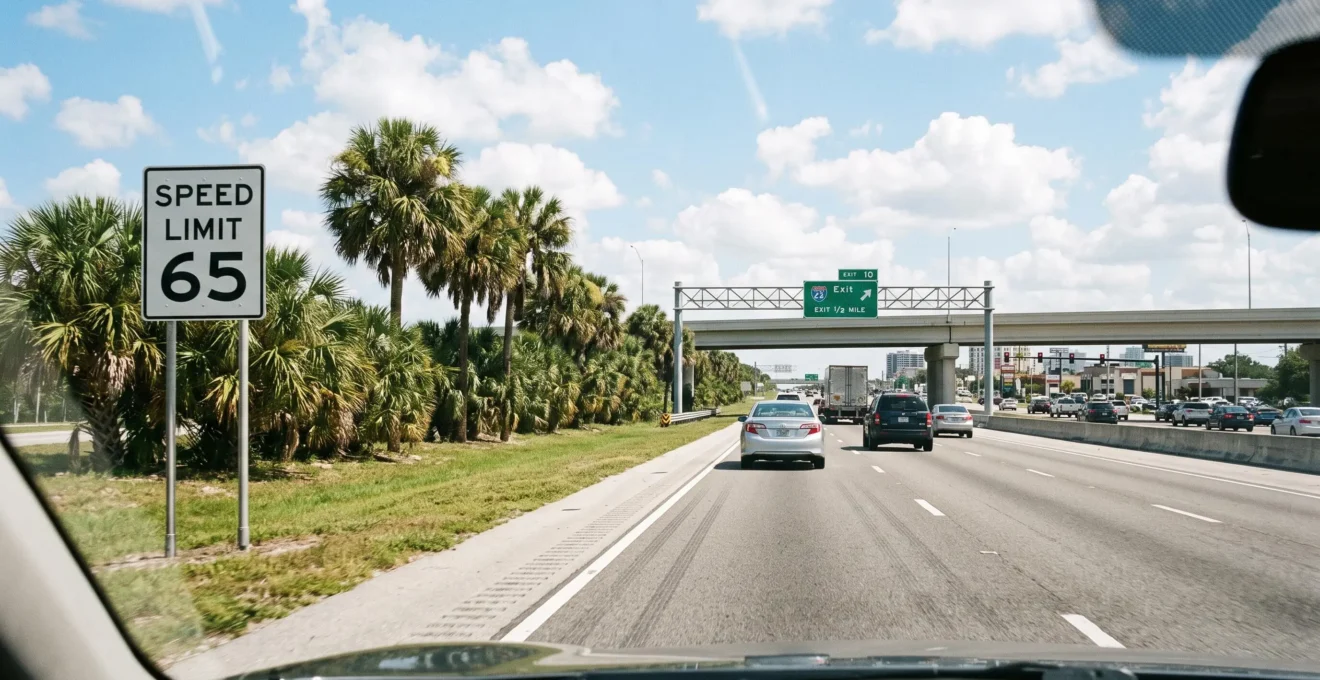
Florida speed limits depend on the type of road, its location, posted restrictions, and driving conditions. A residential street may have a 20, 25, or 30 mph limit, while a major limited-access highway may permit speeds up to 70 mph. Between these environments, drivers encounter school crossings, construction zones, multilane urban roads, and toll facilities with their own traffic controls.
For visitors renting a vehicle, understanding these differences is essential. A familiar-looking highway may have a lower posted limit than expected, while a quiet neighborhood can carry a legally enforceable speed restriction even when a sign is not immediately visible.
Under Florida Statutes Chapter 316, the general maximum is 30 mph in business or residential districts and 55 mph elsewhere, subject to authorized exceptions and posted limits. Qualifying limited-access highways may be posted up to 70 mph, and certain rural divided highways may be posted up to 65 mph. These figures are legal benchmarks, not permission to disregard signs or hazardous conditions.
Florida speed limits at a glance
- City and residential driving: The general statutory limit is 30 mph in business or residential districts, but qualifying local residential roads may have 20 or 25 mph limits.
- Highways and interstates: The general statutory limit outside those districts is 55 mph, with authorized higher limits reaching 65 or 70 mph on qualifying highways.
- Special conditions: School zones, work zones, heavy rain, and traffic hazards can require substantially lower speeds. The posted limit never overrides the obligation to drive safely.
- Why Are Speed Limits Lower Around Florida Residential Neighborhoods?
- How to Identify Speed Limit Changes on Unfamiliar Florida Roads?
- Posted Speed or Safe Speed: Which Should Guide Driving in Heavy Rain?
- Which Speeding Mistakes Occur Most Often in Florida Work Zones?
- When Do Reduced School Zone Speed Limits Apply in Florida?
- How to Join a Busy Florida Interstate Without Sudden Lane Changes?
- Florida Passing Lane Rules: When Should Drivers Move Right?
- How to Drive Safely on Florida Freeways When You’re Unfamiliar With the Roads?
Why Are Speed Limits Lower Around Florida Residential Neighborhoods?
Florida residential streets generally have lower speed limits because drivers must share the road environment with pedestrians, cyclists, children, parked vehicles, and frequent driveway traffic. The statewide statutory limit in residential districts is 30 mph, but qualifying local streets may have limits of 20 or 25 mph. These restrictions reflect the greater potential for unexpected conflicts.
Unlike highways, residential roads often contain multiple access points within short distances. A vehicle may reverse out of a driveway, a pedestrian may approach a crossing, or a cyclist may enter the travel lane. Lower speeds give drivers more time to recognize these hazards and respond without abrupt steering or braking.
Florida law distinguishes between the general statutory speed limit and a lower limit lawfully established by a county or municipality. Under Section 316.183, a local government may establish a 20 or 25 mph maximum on qualifying residential streets following the required investigation. The broader framework appears in Florida’s statutory traffic rules.
The absence of a speed limit sign does not mean that no limit applies. When a local road has no clearly visible posted restriction, drivers must still comply with applicable statutory rules and any valid local traffic controls.
When entering an unfamiliar neighborhood, several physical characteristics should prompt extra attention to speed:
- Narrow travel lanes: Limited lateral clearance makes passing parked vehicles and meeting oncoming traffic more demanding.
- Frequent driveways: Residential access points create opportunities for vehicles to enter or leave the roadway unexpectedly.
- Sidewalks and crosswalks: Visible pedestrian infrastructure indicates that drivers should anticipate people near or crossing the road.
- On-street parking: Parked vehicles can conceal pedestrians and reduce the available travel space.
Florida also has numerous retirement communities, residential developments, and gated neighborhoods. Drivers should not assume that every private community road is subject to identical traffic enforcement rules. Applicability can depend on the roadway’s legal status and any relevant arrangements for enforcement. Posted controls and local instructions remain important.
The safest approach is to identify the applicable limit before accelerating and maintain a speed that allows an appropriate response to nearby people and vehicles. That same awareness becomes important when transitioning out of a neighborhood onto an unfamiliar arterial road.
How to Identify Speed Limit Changes on Unfamiliar Florida Roads?
To identify speed limit changes on unfamiliar Florida roads, watch regulatory speed limit signs and anticipate transitions between residential streets, urban arterials, interchanges, and highways. GPS speed displays can provide advance awareness, but posted signs and applicable law control. Road appearance alone cannot establish a legal limit, and drivers should slow before entering a clearly designated lower-speed area.
Florida’s road network can change character quickly. A street bordered by homes may connect directly to a multilane commercial corridor. That corridor may then lead to an interstate ramp or toll highway, where higher speeds are possible only when authorized and posted.
Use the following comparison as a general legal reference, not as a substitute for checking the roadway’s actual signs.
| Road environment | Statutory reference | What drivers should check |
|---|---|---|
| Business or residential district | 30 mph general maximum | Local restrictions and posted signs |
| Qualifying local residential street | 20 or 25 mph when lawfully established | Neighborhood entry signs and local traffic controls |
| Other roads under the general rule | 55 mph maximum | Whether a different limit is legally authorized and posted |
| Qualifying rural divided highway | Up to 65 mph | Actual highway speed limit signs |
| Qualifying limited-access highway | Up to 70 mph | Posted maximum and any segment-specific restrictions |
A statutory highway ceiling is not the posted speed limit on every road in that category. A limited-access highway can legally carry a lower maximum because of road design, traffic operations, or an authorized restriction.
Navigation applications such as Google Maps and Waze may display the expected speed limit. Their databases can nevertheless contain outdated values, particularly where construction or traffic-management changes have occurred. Treat the display as a secondary reference rather than legal confirmation.
Florida toll roads introduce another consideration. The Florida Turnpike and express-lane facilities can have separate access arrangements, toll requirements, and operational controls. Entering an express lane does not automatically establish a different speed limit. FDOT guidance for Southeast Florida express lanes describes the same minimum and maximum speed limits as the adjacent general-use lanes, although drivers must verify signs on their particular route.
Visual cues such as tighter curves, more intersections, toll infrastructure, or denser development should trigger a search for signs and greater caution. They are not themselves proof that the limit has changed.
When approaching a posted reduction, begin slowing in a controlled manner as soon as the upcoming restriction is visible, so that the vehicle is compliant when the lower limit begins. Avoid abrupt braking unless a hazard demands it.
Once the legal limit is identified, the next decision is whether road conditions actually permit driving at that speed. Florida’s sudden thunderstorms make this distinction especially important.
Posted Speed or Safe Speed: Which Should Guide Driving in Heavy Rain?
In heavy Florida rain, the safe speed must guide driving, even when it is substantially below the posted limit. State law requires motorists to travel at a speed reasonable for existing hazards, including weather and road conditions. A driver may therefore violate Florida’s reasonable-speed requirement without exceeding the numerical speed limit displayed on a sign.
Section 316.183 establishes this distinction between the legal maximum and the speed reasonably appropriate to the conditions. Its requirements apply alongside posted limits, rather than replacing them.
Florida’s tropical downpours can produce rapidly changing visibility and standing water on major roads. A highway that is manageable at its posted speed in dry weather may become unsafe at that same speed during a sudden afternoon storm.
Hydroplaning is a particular concern. Water can separate a tire from the road surface, reducing available traction and compromising steering and braking. The risk depends on several factors, including water depth, tire condition, and vehicle speed.
Another less obvious hazard appears when rain follows an extended dry period. Oil and other roadway residues can accumulate between storms. Early rainfall may make the pavement particularly slippery before those residues are dispersed.
Drivers should make speed decisions using three practical observations:
- Forward visibility: Can the driver see far enough ahead to recognize a stopped vehicle or other hazard and respond safely?
- Road surface: Is water collecting in wheel tracks, low areas, or near lane edges?
- Traffic behavior: Are nearby vehicles braking unpredictably, producing heavy spray, or moving at significantly different speeds?
The Florida Department of Highway Safety and Motor Vehicles explains wet-weather traction hazards and following-distance practices in Florida’s driver handbook, 2018 edition. This archived edition recommends at least four seconds of following distance in normal conditions and more when weather reduces safety.
For visiting drivers, the four-second principle offers a more useful reference than counting vehicle lengths. Choose a fixed roadside point and count the time between the vehicle ahead passing it and your vehicle reaching it. Increase the interval substantially when rain, spray, or reduced traction makes stopping more difficult.
There is no single reduced speed that guarantees safety in every storm. If visibility becomes inadequate, seek a lawful, safe place away from moving traffic rather than continuing at a speed that exceeds your ability to respond.
Rain may also conceal lane markings and temporary construction controls. Drivers should be especially attentive when poor weather and active roadway work occur together.
Which Speeding Mistakes Occur Most Often in Florida Work Zones?
The main speeding errors to avoid in Florida work zones are missing a temporary speed limit, maintaining normal highway speed through a restricted section, braking too late, and accelerating before the restriction ends. Florida law makes posted work-zone maximums enforceable even when workers are absent. Doubled construction-zone speeding fines, however, depend on specific statutory conditions.
Road construction can alter normal driving expectations. A familiar highway section may temporarily contain narrower lanes, shifted traffic paths, reduced shoulders, or equipment near moving vehicles. Drivers who rely on the speed they remember from a previous trip may miss restrictions that apply during current work.
Florida Statutes Section 316.183 prohibits exceeding the posted maximum in a work-zone area. This restriction is not conditional on seeing construction workers.
The penalty rule is more specific. Under Section 318.18(3)(e), scheduled speeding fines are doubled when the required construction-zone signs notify drivers of the limit and doubled penalties, and construction personnel are present or operating equipment on the roadway or immediately alongside it.
The distinction matters: an enforceable temporary limit does not automatically mean every speeding violation qualifies for doubled fines. These conditions come from statewide legislation, not independently varying municipal penalty formulas.
“No driver of a vehicle shall exceed the posted maximum speed limit in a work zone area.”
To navigate a work zone, recognize the sequence of warnings. Advance signs identify upcoming changes. Cones, barricades, and channelizing devices guide the travel path. Flaggers may direct vehicles where normal traffic arrangements cannot operate safely.
Once a temporary limit applies, maintain it until the relevant restriction ends or another valid speed limit takes effect. Do not assume that passing the last visible worker automatically ends the work zone. Likewise, avoid remaining unnecessarily slow after normal conditions return if doing so would obstruct traffic.
Before traveling on major routes such as I-75, I-95, or the Florida Turnpike, checking available roadwork and traffic information can help identify likely delays. Construction schedules and lane restrictions may change, so roadside instructions remain authoritative.
Work-zone signs require attention at all times, while school-zone restrictions introduce an additional factor: legally designated periods when reduced limits apply.
When Do Reduced School Zone Speed Limits Apply in Florida?
Reduced Florida school-zone speed limits apply during the legally designated periods shown on school-zone signs or communicated through approved flashing signals. They are not automatically in effect throughout the entire day. Florida law ties these periods to scheduled student arrival, breakfast programs, and school departure, with defined timing limits around those activities.
Under Section 316.1895, a school-zone speed limit generally cannot be below 15 mph unless a lower limit is established by local regulation. In urbanized areas, it cannot exceed 20 mph.
The statute permits reduced school-zone limits during specified periods extending up to 30 minutes before, during, and 30 minutes after applicable scheduled student arrival or departure activities. The actual enforcement periods depend on the school’s approved arrangements and posted traffic controls.
Permanent signs must clearly identify when the restrictive limit applies. Where approved flashing beacons are used, drivers should follow the corresponding regulatory signs and signals.
Visitors should pay particular attention when a school is located along a higher-speed arterial. A road ordinarily posted at 45 mph, for example, may transition into a 15 or 20 mph school zone during designated periods. The actual restrictions must be established by the signs at that location, not inferred from the example.
Speed enforcement can also be more consequential near schools. Florida provides doubled scheduled fines for qualifying school-zone speeding violations, while exceeding a legally posted school-zone limit by up to 5 mph carries a statutory $50 fine.
Some jurisdictions operate authorized automated school-zone speed enforcement under Section 316.1896. This system can apply during designated school-session periods when the ordinary posted speed limit, rather than the reduced arrival-or-departure limit, is in force. Qualifying camera-enforced violations carry a separate statutory $100 penalty.
School-zone camera operating periods and reduced-speed periods are not necessarily identical. A driver should therefore comply with the normal posted limit even when the special reduced limit is not active.
Florida’s official penalty provisions are detailed in Florida’s statutory speeding penalties. These statutory fine amounts do not necessarily represent the total financial consequences of a citation, which may include applicable costs or surcharges.
School-zone limits are primarily designed around predictable student activity. On interstate highways, by contrast, safe driving often depends on managing large differences in traffic speed while entering or changing lanes.
How to Join a Busy Florida Interstate Without Sudden Lane Changes?
Joining a busy Florida interstate safely requires using the acceleration lane to build an appropriate speed, identifying a suitable gap, signaling, and yielding to traffic already on the highway. The goal is to merge smoothly without forcing another vehicle to brake. Drivers should never assume that maintaining a particular highway speed guarantees a safe opening.
On interstates such as I-95 and I-75, traffic may be moving near posted highway speeds while an entering driver is still accelerating. This difference creates a challenge: entering too slowly can disrupt traffic, but accelerating beyond a safe or legal speed is not an acceptable solution.
There is no universal 60–70 mph merging requirement. The appropriate speed depends on the posted restriction, ramp geometry, available merging space, existing traffic, weather, and the capabilities of the vehicle.
For a practical merge, follow this sequence:
- Observe the highway traffic while approaching the acceleration lane, looking for a suitable space between vehicles.
- Accelerate progressively within legal and safe limits, adjusting your speed to facilitate entry.
- Signal your intention and check mirrors and blind spots before moving laterally.
- Yield to vehicles already occupying the travel lane, entering only when there is sufficient space.
- After merging, establish an appropriate following distance and make additional lane changes only when necessary and safe.
Drivers should normally use the available acceleration lane rather than stopping unnecessarily at its beginning. However, if traffic leaves no safe opening, stopping may be necessary. The principle is safe yielding, not entering the highway at all costs.
Short ramps, high traffic volumes, and closely spaced exits can make the process more demanding. When an interchange offers limited visibility, avoid focusing on a single vehicle behind you. Assess the traffic pattern and the available road space before committing to a gap.
Florida’s toll express lanes add another complication. Some highway systems provide designated express-lane entrances or connectors, and drivers may face a different set of lane-access decisions from those on the adjacent general-purpose roadway. An express lane must not be entered by crossing prohibited lane markings.
If an intended entrance is missed, continue along the lawful route rather than making a sudden lane change across traffic.
After establishing a safe position on the highway, the next responsibility is using the appropriate travel lane without obstructing other vehicles or exceeding the posted speed.
Florida Passing Lane Rules: When Should Drivers Move Right?
On Florida multilane roads, drivers should move out of the far-left lane when they know, or reasonably should know, that a faster vehicle is overtaking them from behind, unless a statutory exception applies. Florida law also requires vehicles traveling below the normal speed of traffic to use the appropriate right-hand lane, subject to exceptions. Neither rule permits speeding.
Section 316.081 distinguishes between two obligations. Drivers moving more slowly than the normal traffic flow generally must remain to the right, except when passing or preparing for an authorized left turn. Separately, on a roadway with at least two lanes in the same direction, a driver may not continue in the far-left lane while knowingly being overtaken from behind by a faster vehicle, unless an exception applies.
These rules encourage predictable lane use and reduce unnecessary conflicts between vehicles traveling at different speeds.
The left lane is not an exemption from speed limits. A driver passing another vehicle must still comply with the applicable maximum. Similarly, a motorist approaching from behind does not acquire the right to demand an unsafe maneuver.
After passing, check the right-hand lane for sufficient clearance, signal, and move right when the maneuver can be completed safely. Avoid cutting closely in front of the vehicle being passed.
Express-lane facilities require additional attention. Toll express lanes may occupy the left side of an interstate, but their permitted entry and exit points are controlled separately. Drivers should not cross restricted express-lane markings simply to follow the general preference for right-lane travel.
On two-lane rural roads, passing becomes more restrictive because a maneuver may require entering the opposing traffic lane. Road markings, sight distance, approaching vehicles, and legal passing restrictions must all be considered. A clear straightaway does not automatically make passing lawful.
When traffic is dense, rapid lane weaving often creates more risk than remaining in an appropriate lane and maintaining a safe following interval. Predictability matters more than trying to advance around every slower vehicle.
Good lane discipline becomes particularly valuable when a visitor is navigating unfamiliar exits, express-lane access points, and interstate interchanges under time pressure.
Key takeaways before your next Florida freeway trip
- Determine the correct route and toll-lane access points before entering a high-speed roadway; some decisions cannot safely be reversed at the last moment.
- Separate speed management from route selection: changing lanes to reach an exit should never require abrupt braking, speeding, or crossing restricted markings.
- Have an alternative exit or stopping plan ready so an unexpected storm, closure, or missed turn does not become an emergency maneuver.
How to Drive Safely on Florida Freeways When You’re Unfamiliar With the Roads?
Driving safely on unfamiliar Florida freeways begins before entering the highway. Set the route, check toll and express-lane requirements, review likely exits, and identify possible delays. While driving, obey posted limits, maintain space around the vehicle, and avoid last-second maneuvers. If a planned exit is missed, continue to a lawful alternative instead of crossing lanes abruptly.
Florida’s major highway corridors connect busy metropolitan areas, suburban interchanges, and longer rural sections. Even when the posted speed remains unchanged, lane configurations, traffic density, visibility, and available exit distances may vary considerably.
For visitors, unfamiliarity creates an additional workload. A driver may be reading overhead signs, monitoring navigation instructions, comparing express and general-purpose lanes, and watching traffic simultaneously. Advance preparation reduces the number of decisions that must be made at highway speed.
The Florida Turnpike and several express-lane systems use electronic toll collection. Rental vehicles may have toll-payment arrangements that differ by rental company. Before departure, check whether the rental agreement includes a toll program, how charges are assessed, and whether additional registration or payment arrangements are necessary.
Do not assume that every toll facility accepts cash or that entering a managed lane is permitted at any point. Where express-lane entrances are controlled, use only authorized access locations and follow their posted signs.
Five checks before driving on a Florida freeway
- Confirm the route: Enter the destination into the navigation system before departure and identify the main highway numbers and intended exit.
- Check the speed environment: Review the general limits applicable to residential streets and highways, and make a note to verify actual posted limits along the route.
- Review toll arrangements: Check the rental agreement and identify whether the route uses toll roads or express lanes, leaving a clear record of the chosen payment arrangement.
- Check driving conditions: Review available weather and roadwork information, identifying any expected storms, closures, or alternate routes.
- Plan for interruptions: Identify a suitable rest stop or lawful alternative exit and decide what to do if visibility deteriorates or an exit is missed.
While traveling, use overhead signs early and maintain enough following distance to react to changing traffic. Avoid relying exclusively on a GPS voice instruction if road signs indicate that a maneuver would be prohibited or unsafe.
Suppose a visiting driver discovers that the intended exit is already passing on the right. The appropriate response is to continue to a subsequent lawful exit and allow navigation to recalculate, rather than braking sharply or crossing multiple lanes.
The same principle applies to express lanes. If an express facility is entered unintentionally, follow its restrictions and continue to a designated exit. Crossing a prohibited separator to return immediately to the general-purpose lanes creates an unnecessary hazard.
For a breakdown or sudden storm, prioritize a safe location outside active traffic. Highway shoulders are intended for emergencies, not routine route checks or navigation adjustments. If the vehicle cannot be safely driven farther, activate hazard warning lights as appropriate and seek emergency or roadside assistance based on the situation.
Maintaining additional following distance provides more time to interpret unfamiliar signs and traffic movements. It also reduces the pressure to respond abruptly when another driver changes lanes or traffic slows near an interchange.
For your next Florida drive, review the route and rental toll arrangements before departure, then let actual road signs and conditions determine your speed. Staying within the legal limit, leaving enough room to react, and accepting a missed exit are safer choices than attempting to recover lost time through sudden maneuvers.
What is the default speed limit when no sign is visible in Florida?
Florida’s general statutory maximum is 30 mph in business or residential districts and 55 mph elsewhere, subject to authorized exceptions. Qualifying residential streets may have lawfully established lower limits, and some highway categories permit higher posted limits. A missing or obscured sign does not automatically cancel an applicable restriction. Drivers must also use a speed reasonable for the conditions.
Is 70 mph allowed on every Florida interstate?
No. Florida law allows qualifying limited-access highways to have posted limits up to 70 mph, but this is a ceiling rather than a universal interstate speed limit. A particular segment may carry a lower limit, including near complex interchanges or in work zones. Drivers must follow the limit actually applicable to their roadway.
Does driving with the flow of traffic protect against a speeding ticket?
No. The speed of surrounding traffic does not authorize exceeding a legal maximum. Even if several vehicles are traveling faster than the posted limit, each driver remains responsible for obeying speed regulations. Drivers should maintain appropriate lane discipline and avoid unsafe attempts to match speeding traffic.
Do Florida interstate highways have minimum speed limits?
Yes. Under Section 316.183, highways that are part of the National System of Interstate and Defense Highways and have at least four lanes generally have a statutory minimum of 40 mph, increased to 50 mph where the posted maximum is 70 mph. However, Florida law also recognizes that reduced speeds may be necessary for safe operation. Minimum speed requirements do not compel drivers to maintain an unsafe speed during hazardous conditions.
Can a rental car driver receive a Florida speeding citation?
Yes. Drivers of rental vehicles must obey Florida traffic laws just like drivers of privately owned vehicles. A rental agreement does not exempt a visitor from posted speed limits, school-zone restrictions, work-zone rules, or other enforceable requirements. The handling of citations, administrative charges, and notices may depend on the type of enforcement and the rental contract.