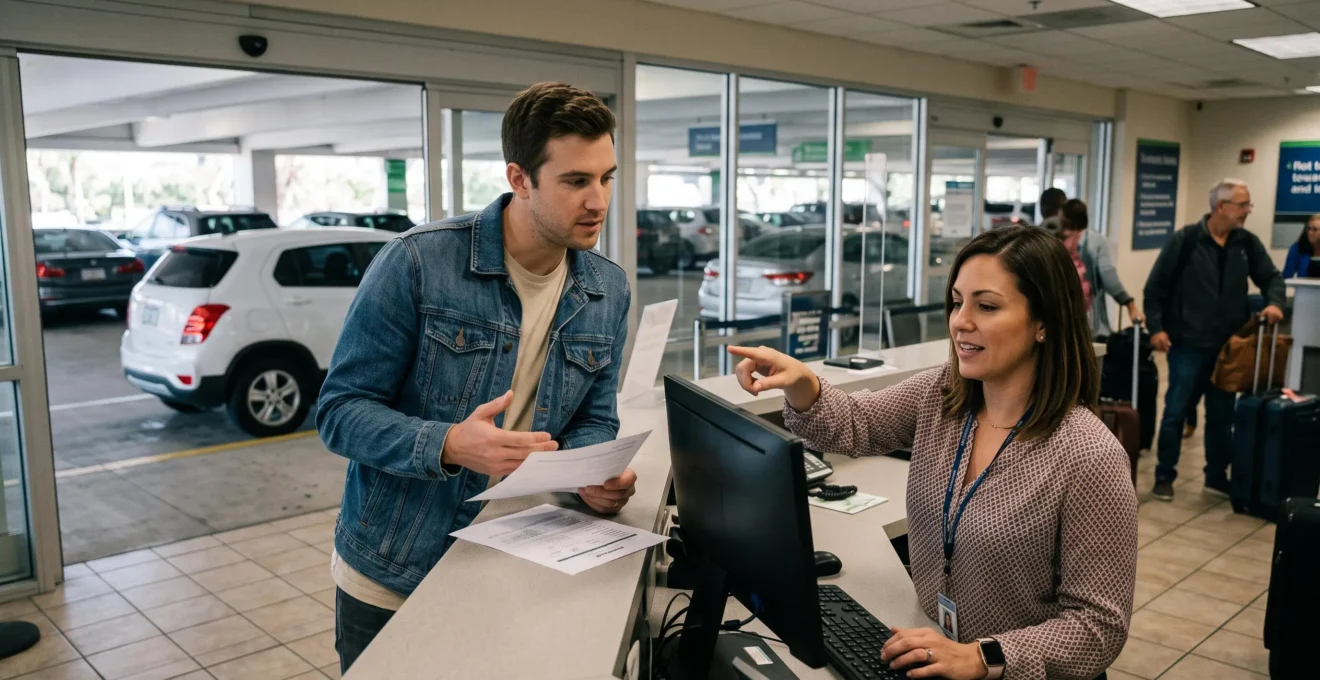
A rental car reservation can look straightforward until a delayed flight, unexpected charge, or vehicle problem requires someone to intervene. The quality of customer service becomes especially important when travelers need more than general information: they need an employee who can explain the situation, authorize a solution, and communicate what happens next.
To assess car rental customer service before booking in Florida, examine how an agency handles realistic questions about airport pickups, pricing, vehicle availability, and roadside problems. Compare the clarity and consistency of its answers, identify who has authority to resolve issues, and verify whether the promised assistance is available at the location and time you need it.
For travelers arriving at Miami, Orlando, or Fort Lauderdale, this assessment should also account for flight delays, electronic tolls, off-airport transportation, and the possibility of needing help outside normal business hours. A dependable rental experience is not defined by the absence of problems alone, but by whether the agency has understandable procedures for addressing them.
Car rental customer service: essential checks
- Verify operational availability: A 24/7 support number does not necessarily mean that vehicles can be collected or exchanged overnight.
- Test the agency before paying: Ask a realistic service question and evaluate the proposed solution, decision-making authority, and written follow-up.
- Protect your rental record: Confirm charges, document vehicle conditions, retain service communications, and know when to escalate unresolved issues.
- Why Does After-Hours Rental Support Matter for Late Arrivals?
- How to Evaluate a Rental Company’s Responsiveness Before Booking?
- How to Review a Car Rental Agreement Without Missing Important Costs?
- Phone, Chat, or Counter Support: Which Works Best During a Rental?
- When Should You Request a Correction Before Leaving the Rental Lot?
- Roadside Assistance or Travel Assistance: Which Helps in Each Situation?
- What Should You Record After a Rental Customer Service Call?
- When Should You Escalate an Unresolved Car Rental Complaint?
Why Does After-Hours Rental Support Matter for Late Arrivals?
After-hours rental support matters because a delayed arrival can leave travelers with a valid reservation but no practical way to collect their vehicle. Customer service availability and pickup availability are different services. Before booking, confirm whether the specific rental location can release a vehicle after closing, who can authorize exceptions, and what transportation alternatives exist.
At airports such as Miami International Airport, Orlando International Airport, and Fort Lauderdale-Hollywood International Airport, travelers should verify three separate arrangements: the rental counter’s operating hours, the availability of any required shuttle, and the hours during which reservation support can make operational changes.
A company might answer emergency calls overnight while its local counter remains closed. Likewise, an off-airport agency might provide telephone assistance after its final shuttle has departed. In either situation, speaking to an employee does not guarantee access to a vehicle.
Flight-delay policies also vary. According to Enterprise’s delayed-flight rental reservation policy, its U.S. airport reservations remain valid for 24 hours after scheduled pickup when flights are delayed. With valid flight information, an airport location may remain open for up to two hours beyond its posted closing time. These are Enterprise-specific conditions, not universal industry guarantees.
A useful late-arrival test is to describe a hypothetical flight landing after the counter closes. Ask whether the agency monitors flight numbers, how long it holds delayed reservations, and whether another branch can honor the booking. Establish who can approve a different pickup time or location and whether such a change could affect the price.
Specific instructions are more valuable than a general promise to help. Obtain written confirmation identifying the pickup location, collection procedure, and responsible contact. When late arrival could leave you without transportation, establish a backup option before traveling.
Once pickup continuity is established, the next test is whether the company responds effectively to ordinary service questions before receiving your payment.
How to Evaluate a Rental Company’s Responsiveness Before Booking?
Evaluate a rental company’s responsiveness by asking each shortlisted agency the same practical question and comparing the usefulness of its answer. Fast responses do not necessarily indicate problem-solving ability. Stronger indicators include a specific procedure, identification of the responsible team, consistency with published policies, and access to someone authorized to resolve the problem.
For example, ask: « If the reserved vehicle is unavailable when I arrive at Orlando airport, who decides whether I receive a replacement, and how will any price difference be handled? » This hypothetical scenario tests more than response time. It reveals whether the representative understands local operations and can explain the next step.
A chatbot may acknowledge your concern immediately without being able to modify a reservation. Similarly, a centralized telephone agent may describe a replacement policy but lack access to the pickup branch’s inventory. Ask how the issue reaches someone empowered to act, whether your case details will accompany the transfer, and how the final decision will be communicated.
Use a consistent comparison scorecard rather than choosing the agency that replies first.
| Evaluation criterion | What to test | Positive service indicator |
|---|---|---|
| Availability | Contact support during your expected pickup hours. | Relevant assistance is accessible when needed. |
| Answer clarity | Ask about unavailable vehicles or delayed arrival. | The representative explains a specific procedure. |
| Decision authority | Ask who can approve a replacement or adjustment. | The responsible person or department is identifiable. |
| Policy consistency | Compare answers with booking terms. | Explanations match the written conditions. |
| Written follow-up | Request confirmation of an important arrangement. | The agency provides a usable record or reference. |
Weight these criteria according to your itinerary. For a late-night airport arrival, pickup availability deserves greater attention than general chat convenience. For a prepaid booking, clear billing and modification procedures may matter more.
Location-specific reviews provide additional context, particularly when several customers independently describe missed pickups, unexplained charges, or unresolved substitutions. Examine the details of complaints and management responses, but recognize that reviews are incomplete accounts and do not establish how every rental will proceed.
An agency that explains procedures clearly should also be able to account for the amounts and obligations in its rental agreement.
How to Review a Car Rental Agreement Without Missing Important Costs?
Review a rental agreement by reconciling the advertised rate, reservation confirmation, location-specific conditions, and estimated counter payment. Identify mandatory, optional, conditional, and refundable amounts before authorizing payment. Customer service should be able to explain differences between these documents and clarify which fees may appear after the vehicle is returned.
The FTC consumer advice on renting a car warns that advertised rental rates may not reflect the final cost. Relevant charges can include airport fees, fuel, mileage, additional drivers, one-way returns, and late-return penalties. Prepaid reservations and cancellation conditions may also differ between providers.
Compare the documents line by line. A security-deposit hold, for example, affects the payment card’s available funds but is not automatically a final rental charge. Ask how the hold is calculated, when the agency releases it, and whether the card issuer controls the timing of restored availability.
Florida’s electronic toll roads add another important consideration. The official SunPass information on toll payments for rental vehicles explains that rental-company toll programs may impose service fees in addition to tolls. Eligible prepaid-account customers may be able to register a rental vehicle’s license plate and rental dates, subject to applicable conditions.
Before selecting a toll program, compare daily or per-use charges, administrative fees, and permitted alternatives. Confirm whether charges can post after return and which payment method prevents duplicate billing. Rental-company program rates and terms may change, so the current agreement takes precedence over an older published comparison.
Insurance-related products also require separate explanations:
- Collision Damage Waiver or Loss Damage Waiver: May limit financial responsibility for damage or loss involving the rental vehicle, subject to the agreement and exclusions.
- Supplemental liability coverage: Addresses specified third-party liability risks, subject to the applicable policy.
- Roadside assistance protection: May cover certain assistance costs, such as eligible lockout or tire-related services, depending on the product.
- Existing insurance or card benefits: May provide relevant protection, but eligibility, exclusions, deductibles, and claim conditions must be checked independently.
A product described as « protection » should not be assumed to cover every accident, mechanical failure, or inconvenience. Ask about unauthorized drivers, prohibited uses, required reporting procedures, and potential out-of-pocket costs.
Five agreement checks to complete before payment
- Compare the advertised quote with the reservation confirmation and save a copy showing the quoted total.
- Request an itemized estimate separating required charges, optional products, and refundable holds; retain the breakdown.
- Confirm the toll-payment arrangement and obtain its applicable fee terms in writing.
- Check protection exclusions, additional-driver rules, fuel conditions, and late-return penalties; save the relevant agreement provisions.
- Ask the agency to correct any discrepancy and obtain an updated agreement or written explanation before authorizing payment.
Also check whether a representative’s promise about an upgrade, waived fee, or modified return time appears in the applicable rental documentation. A verbal assurance that conflicts with the signed terms can complicate later review.
Understanding the agreement reduces uncertainty, but knowing which support channel can enforce or correct its terms is equally important during the rental.
Phone, Chat, or Counter Support: Which Works Best During a Rental?
Phone support is generally most useful for urgent operational problems, while chat or email helps preserve explanations and requests in writing. Counter staff are often best positioned to inspect vehicles and correct pickup paperwork. The most effective channel depends on the action required and whether the representative has authority to complete it.
Instead of choosing a channel solely for convenience, identify what must happen: information must be supplied, a decision must be approved, or a physical vehicle must be examined.
| Situation | Preferred initial channel | Essential follow-up |
|---|---|---|
| Breakdown or urgent vehicle problem | Telephone or designated emergency assistance line | Confirm dispatch, safety instructions, and case reference. |
| Fee explanation or contractual question | Written chat or email | Retain the explanation and applicable policy. |
| Visible damage at pickup | Rental counter or authorized lot employee | Obtain an acknowledged inspection correction. |
| Vehicle replacement | Branch staff or designated operational support | Confirm replacement availability and revised terms. |
| Post-rental billing dispute | Billing department or designated customer relations team | Request a case number and documented review. |
Communication access and decision-making authority are not interchangeable. A central support employee might initiate a request without being authorized to release another vehicle. Conversely, local counter staff may be unable to reverse a charge controlled by a corporate billing department.
When a chatbot repeatedly provides irrelevant responses, request escalation to an employee who can perform the required action. If a phone agent directs you to a counter that is about to close, explain the timing constraint and ask for another authorized contact. Request a reference number before switching channels so the next representative can retrieve the existing case.
Third-party booking platforms create another division of responsibility. An intermediary may need to handle prepaid reservation changes or payment disputes, while the rental operator generally manages vehicle condition and on-road assistance. Exact responsibilities depend on the booking arrangement.
Before departure, save both the booking platform’s support details and the actual rental operator’s local and emergency contact information.
Once the vehicle is ready for collection, effective communication must lead to accurate documentation of its actual condition before leaving the lot.
When Should You Request a Correction Before Leaving the Rental Lot?
Request a correction before leaving the rental lot whenever the vehicle’s condition, equipment, fuel level, mileage, or category differs from the rental record or reservation. Undocumented discrepancies should be addressed before driving away because later evidence may not establish when a defect arose. Safety-related concerns require assessment, not merely an additional photograph.
Begin with the exterior and cabin. Check for existing scratches, dents, windshield chips, wheel damage, tire defects, missing equipment, unusual dashboard warnings, and discrepancies in recorded fuel or mileage. Compare these observations with the inspection report supplied by the agency.
If an SUV has been substituted for the reserved vehicle category, confirm that the substitution is acceptable and that the agreement reflects any applicable price or product change. Verify the license plate or other vehicle identification details to ensure the paperwork corresponds to the vehicle being released.
A cosmetic scratch may be resolved through an updated damage record. A visibly damaged tire, malfunctioning safety equipment, or significant dashboard warning may justify requesting a technical assessment or another vehicle. Photographs help establish observable conditions but do not prove that a vehicle is safe to operate.
When a discrepancy is identified, request an updated inspection report or agreement showing the corrected information. Confirm that the correction has been acknowledged by authorized personnel. An unconfirmed verbal promise does not provide the same documentary support as an updated rental record.
Self-service pickups and unattended lots require particular care. If no employee is available, use the rental company’s designated condition-reporting procedure before departure, retain timestamped evidence, and request confirmation that the report has been attached to the reservation. Do not assume that taking photographs independently satisfies every provider’s requirements.
If a condition could make the vehicle unsafe, seek instructions and a suitable resolution before attempting to drive it.
Even a carefully inspected vehicle can develop problems during a Florida road trip, making the scope of roadside and travel assistance the next essential consideration.
Roadside Assistance or Travel Assistance: Which Helps in Each Situation?
Roadside assistance focuses on vehicle-related incidents such as mechanical breakdowns, flat tires, lockouts, and towing. Travel assistance may address broader disruptions, including lodging coordination or alternative transportation, when those benefits are included in an applicable plan. Neither service automatically guarantees reimbursement or an immediate replacement vehicle. Coverage and response procedures depend on the provider and agreement.
For a Florida road trip, the correct initial contact depends on the nature and urgency of the incident. If an accident involves injuries or immediate danger, call 911 before routine rental support. For a non-emergency mechanical problem, use the rental company’s designated roadside assistance contact and follow its instructions.
A hypothetical drive between Orlando and Miami illustrates the difference. If the rental SUV becomes disabled, roadside assistance may arrange a technician or towing. That intervention does not necessarily provide transportation to the next city or accommodation while a replacement vehicle is arranged.
| Situation | Initial contact | What to clarify |
|---|---|---|
| Mechanical failure without immediate danger | Rental roadside assistance | Dispatch, towing destination, and replacement arrangements |
| Accident with injuries or immediate danger | 911, then rental company when safe | Emergency response, reporting, and vehicle recovery |
| Lost rental-car key | Rental company’s designated assistance team | Key replacement, access procedure, and charges |
| Overnight disruption requiring accommodation | Rental support and any applicable travel assistance provider | Eligibility for lodging or alternative transport benefits |
An important distinction is whether the provider arranges help or pays for it. Assistance services may coordinate towing while leaving some costs to the renter. Ask who pays for tire damage, lost keys, battery-related incidents, towing, and replacement transportation, particularly when driver conduct or contractual exclusions affect coverage.
Ask how the agency maintains assistance after the initial intervention. Can a replacement vehicle be delivered, or must it be collected from another branch? Who pays for transportation to that location? What happens if the nearest office is closed or has no suitable inventory?
These questions matter because dispatch availability and journey continuity are different outcomes. A technician may reach the disabled vehicle while the renter still has no practical means of continuing the trip.
When assistance is requested, a structured communication record helps establish what happened, what the agency promised, and which actions remain outstanding.
What Should You Record After a Rental Customer Service Call?
After contacting rental customer service, record when and how the conversation occurred, who handled the request, what problem was reported, and what action was promised. Include the reservation or case reference whenever available. A chronological service record helps distinguish advice, approved decisions, and unresolved requests while supporting any later billing or operational review.
Create one entry for each meaningful interaction rather than keeping disconnected screenshots and informal notes. Record the date and time, contact channel, representative’s name or identifier when provided, reservation number, reported issue, advice received, and promised next step.
For decisions involving refunds, waived fees, extensions, replacement vehicles, or towing reimbursement, capture additional information. Identify the approving department, conditions attached to the decision, expected follow-up, and any authorization reference.
For example, a representative saying that a refund request will be reviewed is different from confirming that a specified amount has been approved. Document the exact statement and request written confirmation of any decision that could affect the agreement or final bill.
Supporting evidence should correspond to the issue. For billing disagreements, preserve the quotation, signed agreement, itemized receipt, and relevant card transactions. For vehicle damage or mechanical problems, retain photographs, inspection reports, incident documentation, and associated service messages.
A structured record can use the following fields:
| Field | Information to preserve |
|---|---|
| Contact details | Date, time, channel, and representative identifier |
| Case identification | Reservation number and service reference |
| Reported problem | Specific issue and relevant evidence |
| Agency response | Explanation, proposed action, and applicable conditions |
| Follow-up | Responsible team, expected next step, and confirmation status |
After an important call, send a concise written summary through an accepted support channel. State your understanding of the issue, the proposed solution, and what each party is expected to do next. Invite correction if any details are inaccurate.
Written summaries are generally preferable to assuming that a telephone conversation has been recorded. Call-recording consent requirements can vary by jurisdiction and circumstances, so recording should not be undertaken without confirming the applicable rules.
If the agency repeatedly acknowledges a documented problem without resolving it, the next decision is when and how to escalate the complaint.
Key takeaways before escalating a rental issue
- Match the urgency of the complaint to its consequences: an unsafe or unavailable vehicle requires a different response from a disputed post-rental fee.
- Identify the specific remedy requested and the department responsible for approving it before transferring the case.
- Preserve documentary evidence and check applicable payment-dispute deadlines independently of the rental company’s internal review.
When Should You Escalate an Unresolved Car Rental Complaint?
Escalate a rental complaint when the responsible team cannot provide a workable resolution, repeated contacts produce no meaningful progress, or the consequences require faster intervention. An active safety or mobility problem may justify immediate operational escalation. A disputed charge generally calls for a documented billing review, with attention to any separate deadlines governing payment disputes.
Begin with the rental location or department responsible for the issue. Explain what happened, identify the relevant agreement provision, provide the available evidence, and state the remedy you are requesting. A clear request is more actionable than a general expression of dissatisfaction.
If the responsible team cannot resolve the matter, request review by corporate customer relations, a billing specialist, or the designated complaint department. Supply the existing case number and previous responses so the next reviewer can identify what remains unresolved without restarting the investigation.
Different complaints require different outcomes. A vehicle breakdown might require dispatch or replacement arrangements. An unexplained toll fee might require an itemized statement and billing correction. An unsuccessful pickup might require examination of reservation conditions and any requested refund.
External complaint channels may be appropriate when internal procedures do not produce a satisfactory response. Florida consumers can consult the Florida Attorney General’s consumer protection resources or the Florida Department of Agriculture and Consumer Services. The Federal Trade Commission also accepts reports concerning potentially unfair or deceptive business practices.
These channels serve different purposes. Reporting a business practice to a regulator does not automatically create an individual refund or guarantee that the agency will resolve a contractual disagreement.
Credit-card billing errors require separate attention. The FTC guidance on disputing credit-card charges explains that, for qualifying disputes under the Fair Credit Billing Act, a written billing-error notice must reach the issuer within 60 days after the first statement containing the error was sent. The notice must follow the applicable requirements, including use of the designated billing-inquiry address.
60 days
For qualifying credit-card billing errors, the FTC explains that the written notice must reach the card issuer within 60 days after the first statement containing the error was sent. This is not a universal deadline for all rental complaints or payment methods.
Federal Trade Commission — guidance on the Fair Credit Billing Act and qualifying billing disputes.
Under the FTC’s explanation of the qualifying process, card issuers generally must acknowledge a written billing-error complaint within 30 days unless it has already been resolved, and resolve the dispute within 90 days of receiving it. These timelines should not be confused with a rental company’s voluntary customer service targets.
Incorrect amounts, duplicate charges, or unauthorized transactions may qualify as billing errors. General dissatisfaction with the quality of a rental experience can involve different legal standards and contractual considerations. Debit cards and other payment arrangements may also have different protections.
Contact the card issuer promptly when a qualifying billing problem is suspected. Waiting for a rental company’s internal investigation should not cause an applicable statutory notice deadline to expire.
Before confirming your next Florida rental, test one realistic support scenario, obtain written clarification of any critical terms, and save the appropriate operational and billing contacts. These steps establish a practical basis for choosing assistance that remains understandable when circumstances change.
Can an airport rental reservation remain valid after the counter closes?
Yes, depending on the rental company’s delayed-arrival policy. However, reservation validity does not guarantee immediate vehicle collection. Confirm the branch’s closing time, flight-delay procedure, shuttle availability, and authorized pickup arrangements before departure.
Does booking through a third-party website change who handles customer service?
It can. The booking intermediary may control certain prepaid reservations, modifications, or payment disputes, while the rental operator generally handles the actual vehicle and roadside problems. Check the booking terms and retain contact information for both organizations.
Can Florida rental-car toll charges appear after the vehicle is returned?
Yes. Electronic toll transactions and applicable rental-company processing fees may be billed after return. Review the toll program, confirm any permitted alternative payment method, and retain the rental agreement and final billing records for comparison.
What if the rental company will not confirm a promised refund in writing?
Record the conversation, request the case reference and responsible department, and send a written summary of the promised action. If confirmation or resolution remains unavailable, escalate through the company’s complaint process. For a potentially qualifying credit-card billing error, contact the issuer promptly to preserve applicable dispute rights.
Should a renter purchase roadside assistance if a credit card already provides rental coverage?
Not automatically. Credit-card rental benefits may focus on vehicle damage rather than services such as lockout assistance, towing, or replacement transportation. Compare the card’s eligibility rules and exclusions with the rental company’s roadside assistance terms before purchasing an additional product.