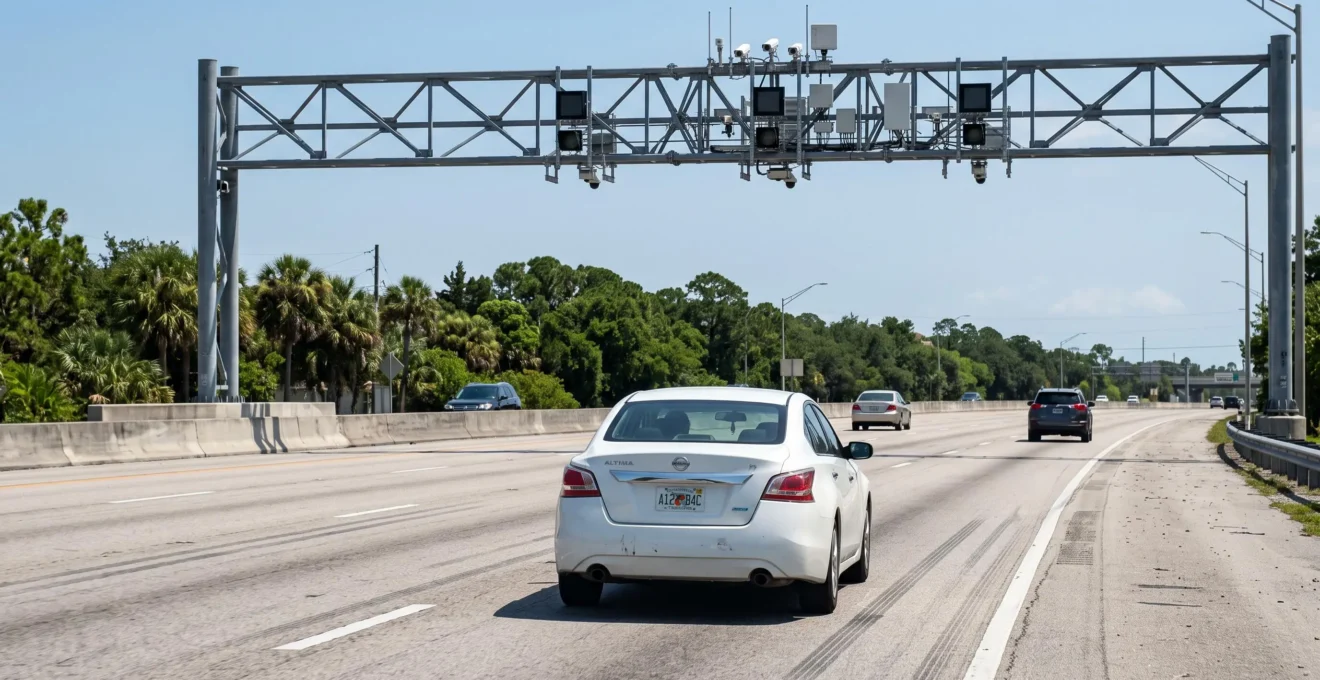
Florida toll roads can surprise rental car drivers because many collection points no longer have a traditional booth where someone accepts cash. Instead, overhead equipment reads a toll transponder or photographs the vehicle’s license plate while traffic continues moving. The toll is recorded automatically, but how that charge reaches you depends on your rental agreement and the road you use.
For visitors driving between Orlando attractions, Miami neighborhoods, Tampa destinations, or Florida airports, the most important rule is straightforward: choose an approved toll payment method before entering a toll road. A rental vehicle does not automatically make every toll lane available, and the absence of a payment booth does not mean the road is free.
Some facilities accept plate-based billing, while certain express lanes require an electronic transponder. Rental companies also have different administrative fees, billing schedules, and enrollment arrangements. Understanding these differences helps you follow the correct lanes, avoid preventable penalties, and recognize legitimate charges after returning the vehicle.
Florida Rental Car Tolls: What Drivers Need to Know
- Many Florida toll roads use electronic collection instead of cash booths. Transponders and license plate cameras record the toll automatically.
- Rental car tolls may be paid through an agency program or an approved personal account. Postpaid plate invoices normally go to the vehicle owner, not directly to the renter.
- Check express-lane restrictions, administrative fees, and your rental agreement before driving. Toll charges can appear weeks after your trip.
- Why Do Some Florida Toll Roads Have No Cash Payment Option?
- How to Check Toll Payment Requirements Before Driving in Florida?
- SunPass or Toll-by-Plate: How Do Florida Toll Payments Differ?
- Which Toll Lane Mistakes Can Lead to Unexpected Charges?
- When Might Florida Rental Toll Charges Appear After Your Trip?
- What Toll Charges Can Affect a Rental Car Used for Daily Commuting?
- Why Is the Final Rental Car Price Higher Than the Advertised Rate?
- How to Review a Car Rental Agreement Without Missing Important Costs?
Why Do Some Florida Toll Roads Have No Cash Payment Option?
Many Florida toll roads have eliminated cash payment because electronic toll collection allows vehicles to pass through tolling points without stopping. Cameras identify license plates, while electronic readers communicate with compatible transponders. For rental car drivers, the important consequence is that payment may be processed automatically through the rental company’s toll program rather than collected at a booth.
Florida’s toll network includes facilities operated by Florida’s Turnpike Enterprise, regional authorities such as the Central Florida Expressway Authority (CFX), and other public or concession-operated road systems. Their collection arrangements are not identical. A payment method accepted on one facility may be subject to different rules, charges, or enforcement procedures elsewhere.
Traditional toll plazas sometimes provide staffed or cash-accepting lanes, but an all-electronic facility does not. Drivers pass beneath overhead equipment that records the transaction using a transponder signal or license plate photograph. When the vehicle belongs to a rental agency, the license plate identifies the registered owner rather than the person currently driving.
Under the arrangement described in the SunPass rental-vehicle payment information, a rental company’s toll-processing vendor may receive the plate-based charge, collect the toll and applicable service fees from the renter, and pay the toll authority. The vendor retains its service fees.
Drivers must also distinguish ordinary all-electronic toll roads from restricted express lanes. General toll roads may allow license plate billing, but managed lanes can impose additional payment requirements.
For example, I-4 Express near Orlando requires a Florida-accepted transponder and does not offer cash or TOLL-BY-PLATE as a normal payment option. If a rental car enters without a transponder, license plate identification can still produce a bill through the rental company. That fallback mechanism does not make plate billing an approved way to enter.
Express lanes may also use variable pricing. The rate changes with traffic conditions, rather than remaining fixed at every time of day. Drivers should read the electronic signs before entering because different destinations can carry different toll amounts.
The next practical step is to identify which tolling systems appear along your intended route and confirm how your rental company handles them before leaving the parking lot.
How to Check Toll Payment Requirements Before Driving in Florida?
Before driving a rental car in Florida, check the toll roads on your route, identify their accepted payment methods, and review the rental company’s toll program. Then decide whether to use the agency’s service or an approved personal transponder or prepaid account. This prevents most confusion at electronic collection points and restricted express-lane entrances.
Start with your navigation app and identify road segments marked as toll roads. Pay special attention to airport access routes, major expressways, toll bridges, and optional express lanes. Navigation apps can reveal likely toll roads, but the relevant toll authority remains the better source for payment eligibility and lane restrictions.
Airport departures deserve particular attention. A route from Orlando International Airport may include toll facilities on SR 528 or SR 417, depending on the destination. Routes from Miami International Airport can involve the Airport Expressway or other tolled connections. Tampa-area journeys may use facilities such as the Veterans Expressway or Selmon Expressway. None should be assumed unavoidable; the exact route matters.
Next, inspect the rental agreement for the toll program name, activation conditions, and administrative fee schedule. Programs such as PlatePass, TollPass, and e-Toll are associated with particular rental arrangements, but their fees and operating rules can differ.
Compare the available arrangements against your expected driving. A short trip involving only a few toll points may not justify a daily service package. However, declining a package does not automatically eliminate fees: plate-based charges may still trigger administration fees under the rental contract.
If you already own a compatible portable transponder, ask whether the agency permits its use. Confirm that you can register the rental plate, that your account has sufficient funds, and that any vehicle-installed device can be shielded or disabled as instructed.
Five Checks Before Leaving the Rental Lot
- Review your route: Save a navigation itinerary showing the toll roads and express lanes you expect to encounter.
- Verify payment acceptance: Record the approved payment method for each relevant tolling system, including restricted express lanes.
- Inspect the rental terms: Save the toll-program fee schedule and the name of any third-party billing provider.
- Confirm the active payment method: Check the rental transponder status or save confirmation that your personal account includes the correct rental plate and dates.
- Preserve billing information: Photograph the signed agreement and save the rental agreement number and toll-service contact details.
Once those details are confirmed, the remaining decision is financial: which payment arrangement will handle your tolls reliably without adding unnecessary service costs?
SunPass or Toll-by-Plate: How Do Florida Toll Payments Differ?
SunPass uses a prepaid account and an electronic transponder or an eligible prepaid plate arrangement, while TOLL-BY-PLATE identifies vehicles through license plate cameras. With a rental car, ordinary postpaid plate invoices go to the registered owner, and the rental company’s program may pass the cost to the driver. Transponder payments and rental-program billing can therefore produce different total costs.
Three common arrangements are relevant to visitors: using the rental agency’s toll service, using a compatible personal transponder, or having plate-based charges processed through the rental company.
| Feature | Rental agency toll service | Personal transponder or prepaid account | Rental-company plate billing |
|---|---|---|---|
| How payment works | Agency device or account processes eligible tolls | Charges are taken from the driver’s own eligible account | Plate cameras identify the rental vehicle; the rental company’s vendor processes charges |
| Additional costs | Program fees depend on the selected package | Applicable account or device costs; generally avoids agency processing fees when correctly configured | Contractual administration fees may apply |
| Setup | Confirm enrollment and device status | Register the correct plate and rental dates where required | Confirm the agency permits this billing arrangement |
| Express-lane eligibility | Depends on the program and facility | Depends on transponder acceptance and lane rules | Not an approved payment option on some restricted express lanes |
| Billing records | Agency or vendor statement | Personal toll account statement | Agency or third-party toll receipt |
The distinction between prepaid and postpaid plate billing is especially important. SunPass permits eligible rental customers to add a rental vehicle’s license plate and rental dates to a SunPass or Florida prepaid TOLL-BY-PLATE account. By contrast, a postpaid plate invoice is addressed to the registered owner, not directly to the temporary driver.
Rates also differ. According to the CFX FAQs on rental cars and toll payments, Pay By Plate rates on CFX facilities are twice the corresponding E-PASS electronic rates. This is a CFX-specific comparison, not a universal rule for every Florida toll road.
2×
CFX states that its Pay By Plate toll rate is double the corresponding E-PASS electronic rate. The comparison applies to CFX facilities and does not include rental-company administration fees.
Central Florida Expressway Authority, official toll-payment FAQs.
Interstate compatibility deserves a separate check. E-ZPass is accepted on Florida toll roads according to current CFX guidance, but drivers should still confirm that their particular transponder model, account, and rental arrangement are eligible for the facilities they intend to use. Not every electronic toll product has identical interoperability.
Portable devices such as compatible E-PASS Uni transponders can be transferred between eligible vehicles. Permanently mounted sticker transponders generally cannot. Using a personal device also requires attention to the rental car’s existing equipment so that two active transponders do not interfere with billing.
A properly configured payment method is only part of the solution. Drivers must also recognize lane restrictions, because a payment arrangement suitable for an ordinary toll road may not satisfy the rules for an express lane.
Which Toll Lane Mistakes Can Lead to Unexpected Charges?
Unexpected Florida rental car toll charges often result from entering a restricted lane without an approved transponder, using an incorrectly registered license plate, leaving multiple transponders active, or misunderstanding express-lane prices. These errors can lead to additional billing or enforcement costs, although a missed transponder reading does not automatically become a violation on every Florida facility.
One important distinction is between a missed electronic payment and an actual toll violation. On many ordinary toll roads, camera-based processing provides a fallback when a transponder is absent or unreadable. The rental company’s billing program may still collect the toll and charge an administrative fee.
However, restricted managed lanes may require specific electronic payment equipment. I-4 Express, for example, requires an accepted transponder even though plate capture can generate a bill after an accidental or unauthorized entry.
The I-4 Express payment and pricing FAQs explain that cash and TOLL-BY-PLATE are not offered payment options. If a rental driver enters without a transponder, the rental company handles the resulting tolls and fees.
Drivers should also understand variable toll displays. I-4 Express charges depend on traffic and destination, but the toll applicable to a displayed destination does not increase beyond the amount shown when the vehicle passes the relevant sign. Traveling farther can produce a different total because the route covers different tolled portions, not because the operator retroactively raises the displayed price.
Other mistakes involve account setup. A transponder associated with the wrong rental plate can cause the transaction to be routed through plate recognition rather than the intended prepaid account. An account without sufficient funds or an improperly installed device can also interfere with processing.
When registering a rental vehicle, check its actual plate carefully rather than relying on reservation paperwork that may refer to a different vehicle. If the agency replaces the car during the rental period, update the relevant toll account as instructed by the provider.
Another problem occurs when a driver activates a personal transponder while leaving the rental company’s transponder exposed. If both devices are compatible and readable, duplicate or incorrectly assigned transactions may occur. Follow the rental provider’s instructions for shielding the unused device.
At facilities where cash remains accepted, use only the designated cash lane and follow the operator’s instructions. If an active transponder is also installed, confirm whether it needs to be shielded before paying at the booth. Do not assume that a cash payment necessarily prevents electronic detection.
If you accidentally enter a restricted express lane, continue driving safely to the next permitted exit. Never stop beneath a gantry, reverse, or cross physical barriers to avoid a toll. Record the route and contact the appropriate billing provider if a charge later appears incorrect.
Even after a trip with no visible problems, the final amount may remain unknown until all electronic transactions are processed and delivered to the rental company’s billing system.
When Might Florida Rental Toll Charges Appear After Your Trip?
Florida rental car toll charges can appear several weeks after the vehicle is returned because electronic transactions must be processed, associated with the rental vehicle, and forwarded through the rental company’s billing system. Depending on the program, the charges may appear as separate credit card transactions or as an invoice issued by a third-party toll administrator.
The delay begins with the toll operator’s transaction processing. A transponder reading or license plate image identifies the vehicle or associated account. When a rental program is responsible, the transaction must also be matched to the driver and rental period before the vendor collects the applicable amounts.
For a documented example, Avis e-Toll states that charges may appear four to eight weeks after return. This is a service-specific billing window, not a guaranteed timeframe for every Florida rental company.
4–8 weeks
The post-return billing period described by Avis e-Toll. Actual timing depends on the rental company, toll authority, transaction processing, and billing arrangement.
Avis e-Toll customer billing documentation.
A post-rental toll statement can contain three different cost categories: the underlying road tolls, contractual administration or service fees, and any separately applicable enforcement or violation charges. Not every transaction includes all three.
These distinctions matter when checking a credit card statement. A charge from a toll-administration company may not display the rental agency’s familiar name, and some toll-related transactions never appear on the original vehicle rental receipt.
To review a delayed charge, obtain the itemized toll record and compare its dates, times, locations, and vehicle details against your itinerary. A personal transponder account statement can provide useful evidence, while travel records and rental pickup and return times help identify transactions outside the authorized rental period.
Where a discrepancy exists, contact the rental company and its toll-service provider in writing. Include the rental agreement number, disputed charge, relevant dates, and supporting records. Ask for the toll transaction details and the contractual basis for any separate administrative fee.
Drivers should distinguish an automatic card charge from an invoice delivered separately by email or post. An unfamiliar invoice should be verified through the provider’s official customer-service channel rather than paid through an unsolicited message. Ignoring a legitimate invoice, however, can lead to further collection activity.
This billing lag becomes particularly relevant for extended rentals, where repeated daily toll transactions can accumulate into a much larger charge than a short vacation would produce.
What Toll Charges Can Affect a Rental Car Used for Daily Commuting?
A rental car used for daily commuting can generate repeated road tolls, rental-company service fees, and additional charges when the payment setup fails. Over several weeks, small recurring tolls can become a significant expense. The most economical arrangement depends on how frequently the driver uses toll roads, the agency’s fee structure, and whether a compatible personal account is permitted.
For example, a driver commuting along a tolled expressway may encounter multiple collection points during each round trip. The total therefore reflects the number of chargeable movements, applicable rates, and any recurring administrative fees.
A short-term visitor who uses a toll road only once may find a daily convenience package expensive. A commuter using toll facilities consistently may reach a different conclusion, particularly if the rental company offers a package that includes underlying tolls rather than simply administering them.
It is essential to distinguish a fixed-price unlimited product from a toll-plus-fee program. Under the former, eligible tolls are included in the package price. Under the latter, the driver still pays individual tolls alongside contractual administration charges.
A documented example appears in the Avis e-Toll billing FAQs. For its specified pay-per-use arrangement without an approved alternative payment method, Avis describes a $6.95 administration fee per calendar day of toll use, capped at $34.75 in administration fees per rental month. Actual tolls remain payable separately.
These figures illustrate why the definition of a fee cap matters. A monthly administration-fee maximum is not necessarily a maximum on the total amount a commuter can owe. Different products, rental locations, and signed terms may also produce different charges.
Consider a hypothetical commuter who uses toll facilities on multiple workdays every week. If the driver’s arrangement charges an administration fee on each toll-use day, those fees may accumulate until an applicable cap is reached. If a separate unlimited program charges a fixed price, comparing its full cost against the expected toll-plus-fee total can reveal which arrangement is more economical.
Repeated payment failures are another risk. A wrongly registered plate or inactive toll account may affect every commute instead of a single journey. The consequences can multiply when the same toll point is crossed repeatedly before the problem is discovered.
For longer rentals, ask whether a compatible portable personal transponder can remain registered to the vehicle for the complete rental period. Confirm that the agency allows this arrangement, ensure the account stays funded, and remove the vehicle from the account after returning it.
Those accumulated expenses also explain why the amount ultimately charged for a rental car can differ substantially from the attractive base rate displayed during booking.
Why Is the Final Rental Car Price Higher Than the Advertised Rate?
The final rental car price can exceed the advertised rate because the base price may not represent every required or optional expense. Taxes, airport-related charges, added protection products, fuel arrangements, and toll-service fees can all affect the total. Toll transactions are particularly easy to overlook because they may be processed separately after the vehicle has been returned.
A rental quote should be reviewed in layers rather than treated as one all-inclusive figure. The advertised vehicle rate is only the starting point. The reservation total may incorporate additional mandatory charges, while optional services and later usage-based expenses require separate attention.
| Cost category | How it affects the total | What to verify |
|---|---|---|
| Taxes and mandatory surcharges | May be added to or included in the quoted total | Itemized taxes, airport charges, and location-specific fees |
| Toll service | May add daily, per-use, or package fees | Enrollment, activation, fee cap, and included tolls |
| Optional protection products | Can increase the daily rental cost | Selected products and whether they are optional |
| Fuel arrangements | May create prepaid fuel or refueling charges | Return-fuel requirement and applicable pricing |
| Post-rental tolls | May be billed after the final vehicle receipt | Toll records, service fees, and billing timeframe |
Toll programs deserve attention because enrollment and activation rules differ. Some operate as optional products purchased at the counter. Others apply pay-per-use charges when a toll is incurred without another approved payment method.
Consequently, it would be misleading to assume either that all rental toll programs charge every day regardless of usage or that declining a daily package guarantees no service fees. The signed contract and the relevant toll-product terms determine the outcome.
When comparing quotes, separate amounts already included in the booking total from optional products and genuinely variable costs. This prevents double-counting taxes that were already disclosed while still accounting for services selected at the rental counter.
Credit card timing can also create confusion. The amount authorized as a rental deposit is not necessarily the final cost, and toll-related card charges may appear after the original rental transaction has been settled.
A useful budget therefore includes the confirmed rental total, optional selections actually accepted, estimated road tolls, and any contractual toll administration charges. Treat the toll estimate as variable rather than a guaranteed fixed amount.
Before accepting the vehicle, the best protection against confusion is a focused review of the agreement that will govern those costs, especially the toll service and delayed-charge provisions.
Key Takeaways Before Signing
- A rental quote and a toll statement may cover different charges; check both rather than assuming the initial receipt is the final total.
- The distinction between an optional prepaid toll package and a pay-per-use processing arrangement determines when administration fees apply.
- A signed agreement, correct license plate registration, and preserved toll records provide the strongest practical basis for reviewing later charges.
How to Review a Car Rental Agreement Without Missing Important Costs?
Review a Florida rental agreement in three passes: first check daily charges and selected options, then inspect taxes and location-specific fees, and finally examine the toll-payment and violation provisions. Pay particular attention to enrollment, administrative charges, and third-party billing. Confirming these details before driving makes later toll statements easier to understand and dispute when necessary.
The first pass should focus on recurring charges and optional products. Look for toll packages, additional-driver charges, navigation equipment, protection products, and other daily services. Verify that the selections shown in the agreement match what you actually accepted.
Do not assume that an option displayed online has the same status in the agreement prepared at pickup. Some services may be added, declined, or modified during the counter transaction. The final signed document and applicable incorporated terms are particularly important when reviewing a later billing dispute.
The second pass concerns the price breakdown. Identify taxes, airport concession charges, location surcharges, and other mandatory items. Determine whether each amount is included in the total already quoted or will be added separately.
The third pass should concentrate on toll wording. Three distinctions are especially useful:
- Opt-in versus opt-out: Whether enrollment requires an affirmative selection or the service operates under a default arrangement subject to stated conditions.
- Per-day versus per-transaction fees: Whether administration charges depend on calendar days, actual toll transactions, or a separately purchased package.
- Responsibility for unpaid tolls: Whether the renter must reimburse the company for tolls, processing fees, and applicable enforcement costs when payment is not completed through an approved method.
Look for the name of the toll-service provider in the agreement, attached fee schedule, or referenced terms. This may be a company different from the rental agency and can explain why future charges appear under an unfamiliar billing descriptor.
Ask the counter representative whether the vehicle contains an active transponder and whether its use depends on accepting a specific package. If you intend to use a personal device, confirm whether the built-in transponder should remain inside a closed shielding compartment.
Document the final selection before leaving. Save the signed agreement, toll-program terms, and evidence of any declined or accepted options. Photographing the relevant pages can help preserve the selections made at pickup, although a photograph does not replace the full agreement or all incorporated contractual terms.
Finally, identify the official customer-service portal or telephone contact for toll records and billing disputes. Keep the rental agreement number available because third-party toll providers may use it to identify the relevant vehicle and rental period.
Before leaving the rental counter, confirm one approved payment method, verify its setup for the assigned vehicle, and save the applicable fee terms. That simple final check gives you a clear way to handle toll points during the trip and reconcile charges afterward.
Can I drive through a Florida electronic toll point without stopping?
Yes. At all-electronic toll points, vehicles travel beneath electronic readers and license plate cameras without stopping. The transaction is recorded automatically. However, you still need an accepted payment arrangement, and certain express lanes require a compatible transponder rather than relying on ordinary plate billing.
Can I use my own SunPass in a Florida rental car?
Yes, subject to the rental company’s requirements and the type of transponder or prepaid account you have. SunPass allows eligible customers to register a rental vehicle’s license plate and rental start and end dates. If you use a portable transponder, install it correctly and follow instructions for shielding the rental company’s device. Remove the rental vehicle from your account after the rental ends.
What should I do if I accidentally enter an express toll lane?
Continue driving safely and leave at the next permitted exit. Do not stop, reverse, or cross a barrier to avoid payment. For I-4 Express, license plate capture provides a billing fallback when a driver enters without an accepted transponder, and rental-car tolls and applicable fees are handled through the rental company. Other express lanes may have different procedures.
Can I pay a rental car’s postpaid Toll-by-Plate invoice directly to SunPass?
Ordinary postpaid TOLL-BY-PLATE invoices are issued to the registered vehicle owner, so rental customers generally receive charges through the agency or its toll vendor instead. An eligible Florida prepaid TOLL-BY-PLATE account is a different arrangement and may be used with a rental vehicle when the required plate and rental dates are registered correctly.
How can I identify a toll charge after returning my rental car?
Check the transaction descriptor, rental agreement number, toll dates, and itemized receipt. Charges may come from a third-party toll service rather than the rental agency itself. If the transaction does not match your rental dates or driving record, contact the provider through its official channel and request supporting toll details before disputing the amount.