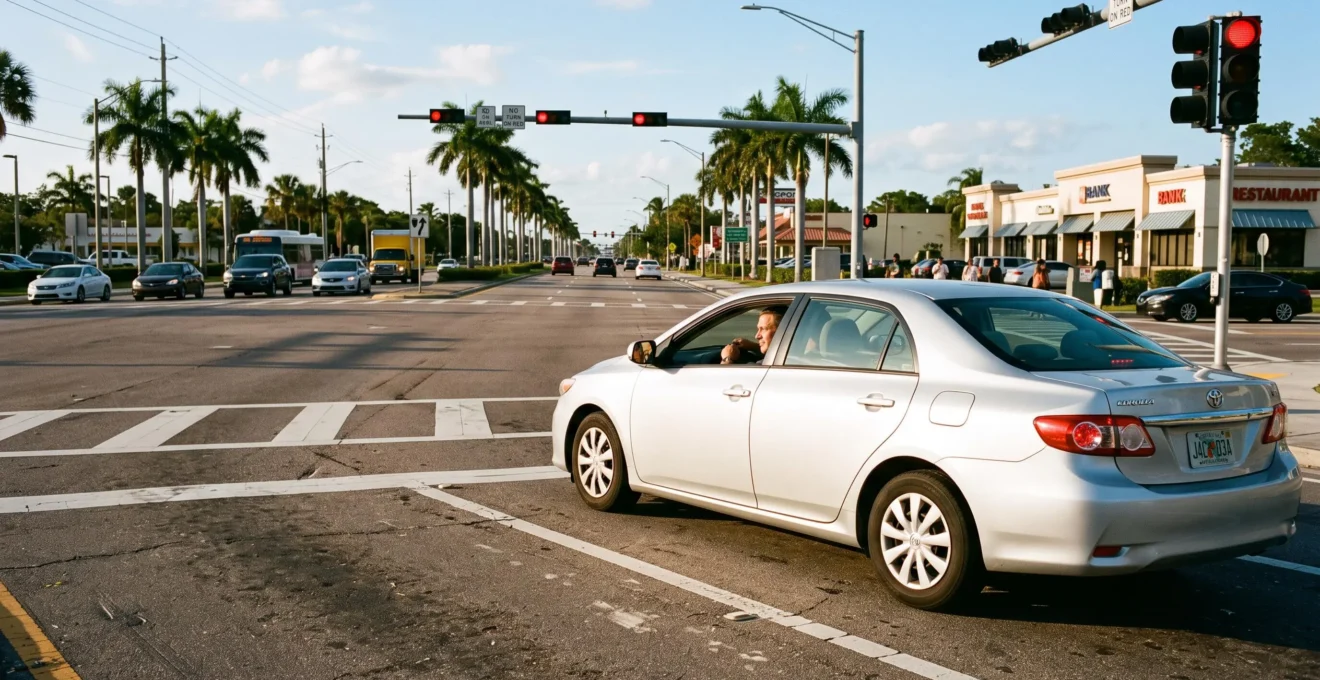
In Florida, you can generally turn right at a steady circular red traffic light after coming to a complete stop, provided no sign prohibits the turn and you yield to pedestrians, cyclists, and vehicles with the right-of-way. The permission applies only when the maneuver can be completed safely. A red light never gives a turning driver priority over other road users.
For visitors driving rental cars, this rule can be confusing. Intersections may have several turning lanes, separate directional signals, busy crosswalks, or restrictions that apply only at certain times. A legal turn depends on the signal, posted instructions, stopping position, and surrounding traffic—not simply whether the road appears clear.
Florida Statutes section 316.075 establishes the principal traffic-signal requirements. Understanding how those requirements work together helps drivers distinguish a permitted right turn from a prohibited movement, especially at unfamiliar intersections in Miami, Orlando, Tampa, and other Florida communities.
Florida right on red: Essential rules
- Stop completely: Halt at the marked stop line, before the near-side crosswalk if there is no line, or at the legally designated position when neither exists.
- Check signals and restrictions: A steady circular red generally permits a right turn after stopping and yielding, unless a posted prohibition applies. Do not assume the same permission applies to a steady red arrow.
- Yield before moving: Pedestrians, cyclists, and vehicles proceeding lawfully through the intersection take priority. If a safe gap is unavailable, remain stopped.
- Why Must You Stop Completely Before Turning Right on Red?
- How to Make a Legal Right Turn on Red at a Busy Florida Intersection?
- No Turn on Red Signs: Which Restrictions Override the General Rule?
- Which Pedestrian and Bicycle Hazards Matter When Turning Right on Red?
- What Should You Do When a Red Arrow Controls Your Florida Turn?
- How to Yield Safely at Florida Crosswalks and Pedestrian Intersections?
- How to Identify Speed Limit Changes on Unfamiliar Florida Roads?
- Which Florida Road Rules Should Out-of-State Drivers Know First?
Why Must You Stop Completely Before Turning Right on Red?
Florida law requires a complete stop before a permitted right turn against a steady red signal because the stop establishes the legal starting point for the maneuver. Your vehicle must become stationary at the designated stopping position before you evaluate traffic and pedestrians. Merely slowing down, rolling forward, or briefly reducing speed does not meet the statutory stopping requirement.
Under Florida Statutes section 316.075 on traffic control signals, the required stopping location follows a specific order:
- Marked stop line: Stop at the clearly marked white line before entering the intersection.
- No stop line: Stop before entering the crosswalk on the near side of the intersection.
- No stop line or crosswalk: Stop at the point nearest the intersecting roadway where approaching traffic is visible, before entering the intersection.
A vehicle that continues creeping forward without becoming stationary has not completed the required stop. Florida law does not specify a universal minimum number of seconds for remaining stopped. The relevant requirement is that the vehicle actually stops at the proper location.
Stopping behind the crosswalk also protects pedestrians. Positioning the front bumper within the crossing can obstruct someone who is walking, using a wheelchair, or approaching with limited visibility. If the crosswalk is occupied, wait behind the line rather than moving into the pedestrian’s path.
After stopping, check your mirrors and blind spots, examine the crosswalk, and assess approaching traffic. If the view is obstructed, proceed cautiously to a better observation position only after completing the initial lawful stop, and remain ready to stop again.
The distinction between a red-light stop and a stop-sign stop is important. Both require a complete halt, but a steady red signal creates an ongoing prohibition on movement with a specific exception for qualifying turns. A stop sign ordinarily allows drivers to proceed after stopping and yielding when it is safe.
Enforcement also requires a distinction. Florida Statutes section 316.0083 contains special restrictions on camera-issued violations for certain careful and prudent right turns, including some situations involving a complete stop after crossing the stop line. These camera-enforcement exceptions do not remove the stopping requirements in section 316.075 or prevent otherwise authorized police enforcement.
Once the vehicle has stopped correctly, the next legal decision is whether the intersection conditions allow the turn. A complete stop is necessary, but it does not by itself authorize entering conflicting traffic.
How to Make a Legal Right Turn on Red at a Busy Florida Intersection?
To make a legal right turn on red at a busy Florida intersection, stop completely at the required location, confirm that the signal and signs permit the movement, and yield to pedestrians and conflicting traffic. Turn only when there is a sufficiently large gap to enter the destination roadway without interfering with road users who have priority.
Traffic volume makes this sequence particularly important. Approaching vehicles may be traveling faster than they initially appear, while people crossing the road can enter the driver’s intended path during the time spent watching traffic from the left.
Use the following sequence when approaching an unfamiliar intersection:
- Approach in the correct lane. Choose a lane designated for right turns, signal appropriately, and reduce speed early enough to stop smoothly.
- Come to a complete stop. Keep the vehicle behind the applicable stop line or crosswalk boundary.
- Confirm the traffic controls. Identify the signal governing your lane and check for prohibitory or time-limited signs.
- Scan for conflicts. Check pedestrians, bicycles, scooters, vehicles approaching from the left, and traffic using any lane your turn could affect.
- Choose a safe gap. Enter only when you can turn smoothly and occupy an appropriate lane without forcing another road user to brake or swerve.
On a road with multiple receiving lanes, turning into the nearest appropriate lane is generally the safest default. Follow lane-direction arrows, pavement markings, and other applicable instructions. Do not assume that a right turn on red permits crossing multiple receiving lanes or entering a lane occupied by another vehicle.
Gap judgment requires attention to both speed and distance. A vehicle far away but traveling quickly may reach the intersection before a slowly accelerating rental car completes its turn. If you cannot confidently assess the gap, wait for a clearer opportunity or for the green signal.
Five checks before completing a right turn on red
- Identify the stopping point: Locate the stop line or crosswalk boundary and bring the vehicle to a verified full halt.
- Verify permission: Read the signal and posted restrictions, confirming that the intended right turn is allowed.
- Clear the crossing: Identify every pedestrian, cyclist, or scooter rider whose path could intersect the turn.
- Select the receiving lane: Determine the appropriate destination lane before moving the vehicle.
- Confirm a safe entry: Recheck the crossing and traffic gap, then turn only if the complete maneuver can be finished without interfering with priority traffic.
Rental vehicles introduce additional uncertainty. An unfamiliar SUV may have wider blind spots than a driver’s usual car, while a different accelerator response or vehicle length may change the time required to enter traffic. These factors justify choosing a more generous gap rather than attempting to imitate local drivers.
A practical rule is to make the decision before entering the roadway. Do not accelerate into the intersection and then hesitate because another vehicle approaches unexpectedly. If the safe gap disappears before you begin turning, remain stopped.
Even an otherwise safe gap cannot make a prohibited turn legal. Before acting on your traffic assessment, confirm that no sign or special signal instruction overrides the general permission.
No Turn on Red Signs: Which Restrictions Override the General Rule?
A posted No Turn on Red restriction overrides Florida’s general permission to turn right after stopping at a steady circular red light. Restrictions may prohibit the maneuver entirely or only under specified conditions. Drivers must follow the instructions applicable to their lane and approach, regardless of whether the crosswalk and receiving roadway appear clear.
Florida allows municipal and county authorities to prohibit right turns against steady red signals when a notice sign is installed where approaching traffic can see it. That makes the posted instruction legally significant rather than optional guidance.
Common restriction formats include:
- NO TURN ON RED: Right turns against the steady red signal are prohibited.
- Time-specific restrictions: An accompanying plate may prohibit the turn during indicated hours or days.
- Lane-specific instructions: Signals or signs may establish different permitted movements for individual turning lanes.
- Special directional signals: A steady red arrow controlling the intended movement requires particular attention and should not be treated as an ordinary circular red signal.
Drivers should read the complete sign assembly, including smaller supplemental plates. A restriction that applies during certain hours should not be interpreted as a permanent ban, but neither should a driver assume that it is inactive without checking the displayed conditions.
Restricted movements deserve particular attention near school entrances, heavily used pedestrian crossings, and complex urban intersections. These are sensible locations to anticipate additional controls, although the presence of a school or crowded sidewalk does not by itself prove that a particular intersection prohibits right turns on red.
Failure to obey a restriction can result in a moving traffic infraction. However, the consequences depend on the enforcement method and applicable provisions. It would be inaccurate to assume that every prohibited turn automatically results in the same fine or driver’s-license points.
$158
Florida Statutes section 316.0083 specifies this amount for the initial notice-of-violation process under the state’s red-light camera enforcement program. It is not a universal total for every traffic-signal violation, and the statute limits camera enforcement of certain permissible right turns.
Florida Legislature, Florida Statutes section 316.0083 on red-light camera enforcement.
For a rental car, a notice may initially involve the registered owner. The rental agreement and applicable notice procedures can affect how the matter is subsequently handled. Administrative charges, when applicable, depend on the rental company’s terms and should be distinguished from statutory penalties.
Where the restriction is unclear, remaining stopped is the safer decision. Once the controlling signs have been checked, the driver’s attention must return to the people and vehicles that could enter the turning path.
Which Pedestrian and Bicycle Hazards Matter When Turning Right on Red?
The principal hazards when turning right on red are pedestrians crossing the destination roadway, cyclists approaching through or beside the intersection, and road users hidden by vehicle blind spots. Drivers must yield to people and traffic with the right-of-way, even after completing a lawful stop. A clear-looking crosswalk can become occupied while the driver waits for a traffic gap.
A typical conflict occurs when pedestrians receive a permitted crossing indication while the turning driver faces a red light. The pedestrians may be moving across the roadway the driver intends to enter, often approaching from the sidewalk on the driver’s right.
Someone crossing lawfully may not expect a stopped vehicle to begin turning into the crosswalk. A driver who concentrates entirely on traffic from the left can overlook that pedestrian’s movement.
Bicycles and scooters create additional conflicts. Cyclists proceeding through an intersection on a permitted signal may approach faster than pedestrians, while a bicycle traveling near the curb can be obscured by another vehicle, a roadside object, or the rental car’s mirrors and pillars.
Use a repeated scanning pattern rather than relying on a single glance:
- Stop behind the line and inspect the crosswalk immediately ahead and to the right.
- Check both sides of the intersection for people entering or approaching the crossing.
- Look left for vehicles and cyclists proceeding along the intersecting roadway.
- Check mirrors and blind spots for nearby bicycle or scooter movements.
- Recheck the crosswalk immediately before releasing the brake.
This second crosswalk check is especially important. A pedestrian who was several steps away during the first observation may have entered the crossing while the driver was evaluating approaching vehicles.
Florida’s tourism destinations, beach communities, and urban corridors can place drivers alongside visitors who are unfamiliar with local crossing arrangements. Seasonal crowds and unfamiliar street layouts make conservative observation useful, without changing the underlying legal duty to yield.
Never use another driver’s impatience as evidence that the path is safe. A horn from behind does not alter the pedestrian’s right-of-way or create an obligation to turn.
The correct response to uncertainty is to remain stopped until conflicting movements are resolved. This becomes particularly important where the turning movement is controlled by a directional signal rather than a conventional circular light.
What Should You Do When a Red Arrow Controls Your Florida Turn?
When a steady red arrow controls your intended right turn in Florida, remain stopped and wait for a signal indication that permits the movement. Do not assume that the usual right-on-red permission applies. Florida’s statutory right-turn exception specifically addresses a steady red signal and does not establish an equivalent exception for a steady red directional arrow.
For visitors accustomed to different state rules, the important distinction is between the signal’s color and its shape. A circular red signal and a directional red arrow convey different controls, even when both appear above the same approach.
Directional arrows are used to manage particular traffic movements. They may separate turning vehicles from conflicting traffic or pedestrian phases, but a driver should not assume the engineering reason for an individual signal without knowing that intersection’s design.
The following comparison provides a practical way to interpret common red indications:
| Signal indication | Required driver response | Right-turn implication |
|---|---|---|
| Steady circular red | Stop completely at the required location. | A right turn is generally permitted after stopping and yielding unless prohibited. |
| Steady red directional arrow | Remain stopped for the controlled movement. | Do not rely on the circular-red right-turn exception; wait for a permitting indication. |
| Flashing red indication | Stop and proceed under the rules applicable after a stop sign. | A turn may proceed after the required stop and yielding, subject to applicable movement restrictions. |
A flashing red indication is different from a steady red indication. Florida Statutes section 316.076 treats flashing red signals as stop controls, requiring drivers to stop and then follow the rules applicable at a stop sign. This applies to a flashing red signal, including a flashing red directional indication when used to control that movement, subject to applicable traffic-control instructions.
Do not confuse a flashing red indication with a flashing yellow arrow. Their meanings and required responses differ. If the indication or its relationship to the turning lane is uncertain, wait rather than guessing.
At an intersection with multiple signal heads, identify the signal governing the lane you occupy. A circular red displayed for one movement does not automatically authorize a turn controlled separately by a steady red arrow.
Once the traffic signal permits movement, the driver’s yielding responsibilities remain in force. Crosswalk conditions must still be assessed, even when a green indication replaces the red signal.
How to Yield Safely at Florida Crosswalks and Pedestrian Intersections?
Florida drivers must yield to pedestrians lawfully using crosswalks and, in specified situations, stop and remain stopped while pedestrians cross. At signalized intersections, drivers must stop for pedestrians crossing with a permitted signal when they occupy the driver’s half of the roadway or approach closely enough from the opposite half to be endangered. Other rules apply at crossings without operating signals.
The relevant requirements appear in Florida Statutes section 316.130 on pedestrian traffic regulations, together with the signal rules in section 316.075.
The nature of the crossing determines how the duty operates:
- Signalized intersections: Stop before the crosswalk and remain stopped when a pedestrian with a permitted signal is in the specified protected position or approaches closely enough to be endangered.
- Crosswalks with stop-for-pedestrian signage: Follow the posted stopping requirement and the statutory pedestrian-protection conditions.
- Crosswalks without operating signals or specific stopping signs: Yield the right-of-way to pedestrians crossing within the statutory protected positions, slowing or stopping when necessary.
At a four-way intersection, pedestrians may approach from different corners. A driver turning right should consider both the crosswalk immediately ahead of the vehicle and the crosswalk that the turning vehicle will enter.
The same practical awareness matters when turning on green. A green circular indication permits movement but does not eliminate the obligation to yield to pedestrians lawfully within an adjacent crosswalk or other traffic lawfully using the intersection.
At a mid-block crossing, look for pavement markings, signs, pedestrian signals, and people preparing to cross. Never assume the absence of a conventional traffic light means that drivers have unrestricted priority.
Failing to yield can result in traffic enforcement and may expose a driver to civil liability if a collision occurs. However, legal responsibility for an individual collision depends on its facts and applicable law; it is not automatically determined solely by the driver’s involvement.
For rental drivers, this exposure is significant because rental insurance, liability coverage, contractual obligations, and any resulting claim are separate questions from whether the traffic maneuver itself was lawful.
Crosswalk safety begins before the vehicle reaches the intersection. Maintaining an appropriate approach speed gives drivers more time to recognize signals, markings, and people entering the roadway.
How to Identify Speed Limit Changes on Unfamiliar Florida Roads?
To identify speed limit changes on unfamiliar Florida roads, watch for posted speed-limit signs whenever the road classification, surrounding development, or traffic environment changes. Florida establishes general statutory limits, but authorized posted limits and other specific provisions can alter them. Drivers should not assume that the limit on one road continues after entering a residential district, commercial corridor, or highway.
Florida Statutes section 316.183 establishes a general maximum of 30 mph in business or residence districts and 55 mph at other locations, subject to applicable exceptions and authorized speed limits. Local authorities may also establish certain lower residential-street limits after the required determination.
These figures provide a legal framework, not a substitute for reading signs. Other statutory provisions govern speed limits on particular highways and road categories.
Use the following comparison as background guidance:
| Road environment | Statutory reference | Practical instruction |
|---|---|---|
| Business or residence district | General maximum of 30 mph | Check for authorized lower or otherwise applicable posted limits. |
| Other road locations | General maximum of 55 mph, subject to exceptions | Check road-specific statutes and posted signs. |
| Certain local residential streets | Authorized limits may be 20 or 25 mph | Follow the applicable local limit and posted controls. |
| School zones and highways with specific controls | Applicable special provisions and posted limits | Observe the particular restriction rather than relying on a general default. |
When entering an unfamiliar roadway, scan for regulatory signs shortly after turns, junctions, and transitions between different driving environments. Watch particularly carefully near schools, where reduced speed limits may be associated with posted times or active control devices.
If you miss a sign, do not simply match the fastest surrounding vehicles. Reduce speed safely, remain attentive to traffic, and identify the next applicable sign. The general statutory limit is useful context, but only when the road classification and absence of a more specific applicable limit are established.
Florida’s reasonable-and-prudent speed requirement also matters. Even a speed below the posted maximum may be inappropriate in heavy rain, poor visibility, or near pedestrians entering a crosswalk.
Approaching an unfamiliar intersection at a controlled speed improves the time available to identify a stop line, recognize a red arrow, and decide whether a right turn is permitted.
Speed awareness is one part of a broader set of Florida driving obligations. Visitors should also understand several rules that can become relevant immediately outside the intersection itself.
Key Takeaways Before Driving in Florida
- Florida traffic rules apply according to where the vehicle is being driven, regardless of the state shown on its license plate.
- Some important obligations arise away from red lights, including rules for stopped service vehicles, school buses, and designated travel lanes.
- Rental agreements can introduce additional administrative or financial consequences when traffic violations occur.
Which Florida Road Rules Should Out-of-State Drivers Know First?
Out-of-state drivers in Florida should prioritize traffic-signal compliance, pedestrian yielding, school-bus stopping requirements, and the state’s Move Over law. Drivers should also understand the limited circumstances allowing left turns on red and review toll-road and restricted-lane instructions before departure. A rental car does not exempt its driver from Florida traffic laws.
Several requirements deserve attention during a visitor’s first drive:
- Right turns on red: Stop at the required location, confirm the movement is permitted, and yield to conflicting traffic and pedestrians.
- Left turns on red: Florida Statutes section 316.075 permits a left turn after stopping from a one-way street onto another one-way street carrying traffic to the left, provided the driver yields and no applicable local restriction prohibits the maneuver.
- Move Over law: Florida’s Move Over requirements apply to specified stopped emergency, service, utility, and other qualifying vehicles. Drivers must follow the applicable lane-change or speed-reduction requirements.
- Stopped school buses: Drivers generally must stop for a school bus displaying the required stopping signals. On roads without a qualifying physical separation or unpaved median, opposing traffic can also be required to stop. Specific divided-road exceptions must be observed carefully.
- Tolls and restricted lanes: Electronic toll collection, managed lanes, and high-occupancy vehicle restrictions may require particular payment arrangements or lane eligibility.
The one-way-to-one-way left-turn exception is easy to misunderstand. It does not authorize a left turn on red from an ordinary two-way street merely because the destination roadway is one-way. Both the origin and destination conditions must satisfy the statutory exception.
Similarly, Florida’s school-bus rules should not be interpreted using a universal rule that all opposing vehicles must always stop. The roadway’s physical configuration matters, and painted markings alone should not be mistaken for a qualifying physical separation.
For a rental vehicle, traffic notices and camera-related correspondence may involve the registered owner before being attributed to the renter under applicable procedures. Rental-company administrative fees and other contractual consequences depend on the agreement. Drivers should review those terms rather than assume a traffic fine represents the complete potential cost.
Before your first trip, confirm the vehicle’s registration information and rental documents, inspect its mirrors and controls, review how tolls will be handled, and check the planned route for school zones, pedestrian-heavy destinations, and unfamiliar intersections. The registration plate does not determine which state’s traffic rules apply.
For visitors driving between an airport, hotel, and major attractions, a route review can also reveal complicated interchanges and restricted lanes. Familiarizing yourself with those features before driving reduces the number of decisions that must be made while approaching an intersection.
Before your next Florida drive, identify the required stopping position, check the controlling signal and signs, and leave enough time to observe pedestrians and approaching traffic. If any part of a right turn on red is uncertain, remain stopped and wait for a clearly permitted, safe movement.
Do you have to turn right on red if the driver behind you honks?
No. Florida law permits qualifying right turns against a steady circular red signal but does not require drivers to make them. You may remain stopped until the signal changes. Pressure from another motorist does not remove your duty to yield or justify entering an unsafe traffic gap.
How many seconds must you stop before turning right on red in Florida?
Florida Statutes section 316.075 does not establish a minimum stopping duration measured in seconds. The vehicle must come to a complete stop at the legally required position. Counting a particular number of seconds is not a substitute for actually stopping and yielding.
Can you turn right on red from either of two right-turn lanes?
Do not assume that both lanes permit the same movement against a red indication. Check the signals, lane markings, and signs controlling each lane. A right turn against a steady circular red is subject to the statutory stopping and yielding requirements, but separate directional signals or posted restrictions may control a particular lane.
Can a Florida red-light camera issue a ticket for a rolling right turn?
Florida’s red-light camera statute contains exceptions that limit camera notices and citations for certain careful and prudent right turns at intersections where the movement is permitted. It also addresses drivers who stop completely after crossing the stop line but before making a permissible turn. Those exceptions do not eliminate the legal stop requirement or necessarily prevent enforcement by an officer.
Can visitors with an out-of-state driver’s license turn right on red in Florida?
Yes. The same Florida traffic-signal rules generally apply to visiting drivers operating lawfully on Florida roads. The driver’s home state, license-plate state, or rental-car status does not change the applicable intersection rules. Visitors must still stop correctly, obey restrictions, and yield before turning.