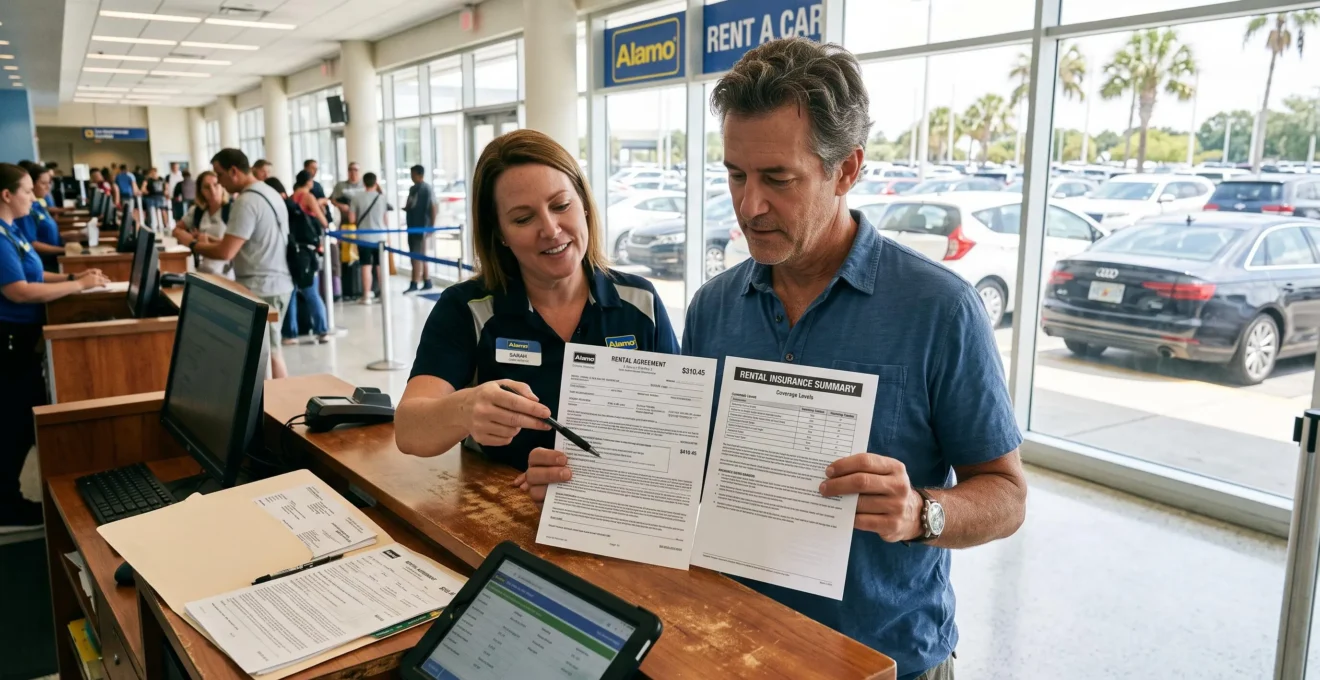
Choosing rental car insurance in Florida requires more than accepting or declining protection at the rental counter. The appropriate coverage depends on the vehicle’s value, your driving experience, existing insurance limits, planned activities, and the financial losses you could absorb after an accident.
A Florida resident with comprehensive personal auto insurance may face different risks from an out-of-state visitor, a young driver, or someone renting a luxury vehicle. Even two renters driving identical cars can have substantially different out-of-pocket exposure because their deductibles, credit card benefits, and contractual exclusions differ.
The practical approach is to identify who pays for injuries, third-party property damage, damage to the rental vehicle, and additional rental-company charges. Then determine which expenses remain your responsibility under the actual policy and rental agreement.
This comparison helps distinguish protection that genuinely fills a gap from coverage that unnecessarily duplicates existing benefits. It also makes it easier to recognize situations where an inexpensive rental creates financial exposure that is not immediately apparent from the advertised daily rate.
Rental car insurance: essential coverage decisions
- Compare your personal liability limits, collision and comprehensive coverage, deductibles, and rental exclusions before purchasing additional protection.
- Check whether the rental vehicle’s value, authorized drivers, intended activities, and rental duration satisfy every applicable coverage condition.
- Separate third-party liability from rental vehicle damage protection, and obtain written confirmation whenever coverage or contract terms are unclear.
- Why Can High-Value Rental Cars Create Greater Insurance Exposure?
- How to Check Your Personal Auto Policy Before Renting in Florida?
- Rental Liability or Damage Waiver: Which Protection Covers What?
- Which Rental Activities Can Fall Outside Your Insurance Protection?
- When Should You Reassess Coverage During an Extended Rental?
- How to Confirm Your Credit Card’s Rental Car Coverage Before Pickup?
- Which Mechanical Problems Make a Rental Car Unsafe to Drive?
- How to Review a Car Rental Agreement Without Missing Important Costs?
Why Can High-Value Rental Cars Create Greater Insurance Exposure?
High-value rental cars can increase insurance exposure because repairing or replacing them may cost more, while contractual charges can extend beyond physical damage. Luxury and specialty vehicles may also exceed credit card eligibility restrictions. The relevant risk is therefore not simply the vehicle’s purchase price, but the amount you could personally owe after applicable insurance and waivers respond.
When a rental vehicle is damaged, the rental company may seek reimbursement for repairs or replacement and additional costs associated with the incident. Depending on the agreement, these can include towing, storage, administrative fees, diminished value, and loss of use while the vehicle is unavailable.
These charges should not be assumed either covered or excluded by every personal auto policy. Their treatment depends on policy wording, applicable law, supporting documentation, and the rental contract.
For example, Enterprise Rent-A-Car‘s Cuyahoga Falls rental policies identify several such charges within the scope of its contractual Damage Waiver provisions. This is an example of one provider’s published terms at an Ohio branch, not a universal description of Florida rental agreements.
A premium vehicle’s rental rate may appear affordable while its potential repair costs, specialized parts, or contractual charges create a much larger financial obligation. The difference becomes especially important when your policy imposes vehicle-value limitations or when a credit card benefit excludes particular luxury or specialty categories.
The following grid offers a practical starting point. It is a qualitative decision tool, not a calculation of expected losses or a statement that every vehicle in a category has identical insurance requirements.
| Vehicle class | What to compare with existing coverage | When supplemental protection deserves consideration |
|---|---|---|
| Economy | Collision coverage, deductible, and contractual fees | When physical damage coverage is absent or the deductible is difficult to absorb |
| Mid-range | Policy extension, vehicle eligibility, and damage-related charges | When existing coverage contains material limits or exclusions |
| Luxury | Vehicle-value restrictions, coverage limits, and credit card exclusions | When the vehicle is ineligible or your potential financial exposure exceeds available protection |
| Specialty | Exact vehicle classification, prohibited uses, and coverage eligibility | When written confirmation is unavailable or existing protection explicitly excludes the vehicle |
Consider a hypothetical renter who has a personal policy covering eligible rental vehicle collision damage but must pay a substantial deductible. Upgrading from an economy vehicle to a premium sedan could introduce additional vehicle eligibility restrictions. The upgrade does not automatically invalidate coverage, but it makes verification necessary before accepting the keys.
For every vehicle class, compare the potential deductible and uncovered contractual costs against the price and conditions of optional protection. Paying for a waiver is not automatically the most economical solution, particularly when existing coverage already addresses the same risks.
Once the vehicle’s eligibility and potential loss amounts are understood, the next step is to establish precisely what your personal auto insurance already covers.
How to Check Your Personal Auto Policy Before Renting in Florida?
Before renting in Florida, review three parts of your personal auto policy: liability limits, collision and comprehensive coverage for non-owned vehicles, and rental-specific exclusions. Confirm that each applies to your intended rental rather than assuming coverage transfers automatically. Request written clarification from your insurer, including the applicable deductible and any restrictions on vehicle type, rental purpose, or duration.
A reliable policy audit begins with the declarations page, but it should not end there. The declarations page identifies important limits and deductibles; the full policy establishes when those provisions apply.
- Verify liability protection. Identify bodily injury and property damage liability limits. Ask whether those limits apply to an eligible rental vehicle in Florida and whether any territorial or contractual restrictions affect protection.
- Confirm physical damage coverage. Determine whether collision and comprehensive coverage extend to the rental vehicle, which losses qualify, and whether the rental’s class or value creates restrictions.
- Identify rental exclusions. Review permitted drivers, personal versus business use, temporary substitute vehicles, rental duration, and any restrictions affecting recreational rentals.
Florida’s insurance rules also warrant careful interpretation. The Florida Department of Financial Services‘ personal automobile insurance overview identifies a 10,000 $ minimum for property damage liability coverage.
$10,000
Florida’s stated minimum property damage liability coverage. This is a legal minimum, not a recommended level of protection, a bodily injury liability minimum, or a guarantee that all accident costs will be covered.
Florida Department of Financial Services, Personal Automobile Insurance Overview.
The important distinction is between satisfying applicable insurance requirements and holding sufficient coverage for a potentially expensive accident. Property damage involving multiple vehicles or other valuable property can create liabilities beyond a low policy limit. The renter may remain responsible for qualifying damages that exceed available coverage.
Out-of-state visitors should not assume that their home state’s minimum insurance requirements establish appropriate protection for a Florida rental. Equally, a Florida policy should not be presumed to extend identically to every non-owned vehicle.
Pay particular attention to the definition of a temporary substitute vehicle. A car rented while your insured vehicle is undergoing covered repairs may be treated differently from a vacation rental. The applicable definitions and coverage extensions must be verified with the insurer.
Ask the insurer to confirm in writing whether your particular vehicle class, rental purpose, location, and dates qualify. Request clarification on liability limits, physical damage protection, loss-of-use charges, and the deductible payable after an eligible claim.
Even when the rental is covered, filing a claim may leave you responsible for the deductible and could affect future premiums, depending on insurer practices, policy conditions, and claims history. No universal premium increase should be assumed.
Five checks to complete before collecting your rental
- Download your current insurance declarations page and record the applicable bodily injury and property damage limits in a coverage summary.
- Locate the collision and comprehensive provisions and record whether rental vehicle physical damage is covered, including deductibles.
- Send your insurer the rental dates, location, vehicle class, and intended use; save its written eligibility confirmation.
- Review your credit card’s current benefits guide and document vehicle exclusions, maximum rental duration, and payment conditions.
- Compare the rental company’s optional protections with your confirmed benefits and save a one-page list of remaining uncovered expenses.
With the personal policy established, the remaining decision is to distinguish protection for damage to other people and property from protection for the rental vehicle itself.
Rental Liability or Damage Waiver: Which Protection Covers What?
Rental liability protection and a damage waiver address different financial risks. Liability insurance responds to covered claims involving injuries or property damage suffered by others, while a Collision Damage Waiver (CDW) or Loss Damage Waiver (LDW) is generally a contractual agreement limiting what the rental company can collect for damage to or loss of its vehicle. Neither automatically replaces the other.
The distinction matters because a renter can face multiple financial obligations after the same incident. A collision might damage the rental vehicle, damage another person’s car, and injure a passenger. Each loss can involve different insurance provisions and payment conditions.
The NAIC‘s automobile insurance consumer information distinguishes liability, collision, comprehensive, personal accident, personal effects, and rental-company protection products. Existing auto, homeowners, or renters insurance may address some of these risks, subject to the policies’ terms.
Use the following table to identify which coverage should be investigated for each type of loss. The listed protection is a potential responding layer, not a promise of payment.
| Scenario | Potential responding protection | Important limitation |
|---|---|---|
| You cause an accident that damages another car | Personal auto liability or applicable rental liability protection | Subject to liability limits, responsibility, and coverage conditions; CDW does not replace third-party liability insurance |
| Your rental is dented in a parking lot | Personal collision coverage, applicable CDW/LDW, or eligible credit card protection | Deductibles, eligibility rules, documentation, and contractual exclusions may apply |
| A passenger suffers an injury | Applicable bodily injury liability, personal injury protection, medical payments, or personal accident coverage | Payment depends on fault, insured status, the type of benefit, and applicable policy provisions |
| Personal property is stolen from the rental | Eligible homeowners, renters, or personal effects insurance | Rental vehicle damage benefits generally do not insure personal belongings |
| The rental vehicle is stolen | Eligible comprehensive coverage, CDW/LDW, or credit card rental protection | Coverage depends on theft provisions, vehicle eligibility, exclusions, and reporting requirements |
| The rental company requests loss-of-use charges | Potentially CDW/LDW, personal auto coverage, or eligible credit card protection | Coverage and the validity or amount of the charge must be determined from the applicable documents |
CDW and LDW are particularly important to understand because they are generally waivers rather than insurance policies. The rental company agrees to reduce or waive specified financial claims under certain contractual conditions.
Those conditions can include restrictions on unauthorized drivers, prohibited activities, and misuse of the vehicle. Reckless driving or driving in violation of specified rental conditions may compromise waiver protection, but the precise consequences depend on the agreement and applicable law.
An unpaid toll does not universally invalidate a damage waiver. Toll charges, administrative penalties, and waiver exclusions should be examined separately unless the actual agreement expressly establishes a connection.
The most useful question is not simply whether to purchase liability protection or a damage waiver. It is which loss would remain your responsibility if a covered or excluded incident occurred.
For example, a renter with adequate third-party liability insurance but no physical damage coverage may have a reason to consider CDW/LDW. Another renter with collision and comprehensive protection may instead need to examine deductibles and rental-company fees before paying for overlapping protection.
Additional liability coverage and a damage waiver can also be relevant together when they address different uncovered risks. Their suitability should be established through a comparison of actual limits and exclusions rather than product names.
Coverage mapping is only effective when the renter also follows the permitted-use conditions. An otherwise covered vehicle can become financially problematic when it is driven outside the agreement’s restrictions.
Which Rental Activities Can Fall Outside Your Insurance Protection?
Rental coverage can be restricted by activities such as unauthorized off-road driving, crossing prohibited geographic boundaries, commercial delivery or rideshare use, and allowing an ineligible driver to operate the car. These activities can affect the rental company’s waiver, a personal insurance policy, or a credit card benefit differently. Coverage consequences must be checked separately rather than assuming a single exclusion applies to all protections.
Rental agreements frequently specify where, how, and by whom a vehicle may be driven. These restrictions matter even when the vehicle itself is eligible for protection.
- Unpaved roads and off-road use: Some agreements restrict driving on particular road surfaces. A maintained gravel road and an off-road trail may be treated differently; verify the exact wording before visiting parks, remote attractions, or recreational areas.
- Geographic restrictions: Travel into another state, Canada, or Mexico may be subject to provider-specific conditions. Certain vehicles may face additional limitations.
- Rideshare or delivery activities: Personal-use rentals may not authorize transportation or delivery services. Separate commercial arrangements or coverage could be required.
- Additional drivers: Allowing a friend, spouse, or colleague to drive without satisfying the agreement’s driver requirements can affect contractual protection.
- Business travel: A rental used for professional activities may be evaluated differently under personal auto insurance and credit card benefits.
Consider a hypothetical Florida vacation involving a rental SUV and a planned drive to a remote outdoor destination. The vehicle class may qualify for credit card damage protection, but that does not establish whether a particular unpaved road is permitted under the rental agreement.
If the route violates contractual restrictions and the vehicle is damaged, the renter may lose waiver protection under the applicable terms. The next question is whether a personal policy or card benefit independently covers the loss. Those protections should never be assumed to respond simply because the rental company’s waiver does not.
The result can be a coverage cascade: a waiver may be unavailable, a separate insurer may apply an exclusion, and the renter may remain responsible for some or all qualifying charges. Whether that cascade occurs depends on the specific wording and facts.
Before signing, match your travel plans against the restrictions rather than relying on the fact that a car can physically complete the journey.
| Planned activity | Question to ask before pickup |
|---|---|
| Visiting a park using gravel access roads | Are these specific roads permitted, and does the waiver remain effective? |
| Crossing state lines | Is the destination allowed for this vehicle class? |
| Traveling internationally | Is cross-border travel permitted, and what documentation or protection is required? |
| Sharing driving duties | Does each driver meet the contract’s authorization requirements? |
| Combining leisure and professional travel | Does the rental contract and each applicable insurance benefit allow the intended use? |
Driver authorization deserves special attention during airport pickups. A traveling companion may be available to drive immediately, but that does not mean the person automatically qualifies as an authorized driver. Some providers permit eligible spouses or domestic partners under particular conditions, while others apply different requirements.
Keep written confirmation of any special permission, including routes, additional drivers, and business use. A verbal assurance that a particular activity is acceptable may be difficult to establish if a dispute develops later.
Travel plans can change after pickup, making it necessary to revisit these restrictions whenever the rental period, destination, drivers, or purpose changes.
When Should You Reassess Coverage During an Extended Rental?
Reassess rental car insurance whenever you extend the return date, change authorized drivers, enter a newly restricted jurisdiction, or begin using the vehicle for a different purpose. These changes may affect coverage eligibility, especially credit card rental-duration limits. An extension should be treated as a possible modification of both the rental agreement and the associated financial protection.
A renter may initially qualify for personal auto protection, a credit card benefit, and a rental-company waiver. That combination should not be assumed to remain unchanged after an extension or material change in use.
The most important review triggers are:
- A longer rental period: Confirm whether the entire rental remains within the credit card benefit’s maximum permitted duration and whether the waiver extends through the new return date.
- A new destination: Check whether the new route crosses any contractual or insurance territorial restrictions.
- A different driver: Confirm that the additional person is authorized under the rental agreement and satisfies any separate benefit conditions.
- A change in purpose: Recheck eligibility if a leisure rental begins serving professional or commercial activities.
- A replacement vehicle: Verify that the substitute vehicle remains in an eligible class and is correctly identified in updated rental documents.
Credit card benefits deserve particular attention because eligible rental duration is often defined in the cardholder benefits guide. The maximum period varies by card and applicable benefit. The absence of a warning at the rental counter does not establish that protection remains valid after an extension.
For example, consider a hypothetical traveler who reserves a Florida rental for a short vacation and later decides to continue driving for an additional period. The new return date could affect card eligibility even if the rental company permits the extension and successfully charges the card.
The correct approach is to confirm coverage under the revised dates, not simply verify that payment was accepted.
When an extension trigger occurs, compare three possibilities: maintaining the existing rental-company waiver under the revised agreement, relying on confirmed personal insurance and eligible credit card benefits, or changing the rental terms to preserve the required protection.
These options are not necessarily interchangeable. A waiver may be extended through the rental provider, while a credit card benefit remains subject to its own duration rules. Personal insurance may impose separate restrictions on how long a non-owned vehicle qualifies.
Extensions can also change the rental price. The provider may revise the daily rate, require a new agreement, adjust authorization amounts, or apply different deposit requirements. These are potential contractual outcomes, not automatic consequences of every extension.
Request the updated agreement and written benefit confirmation before continuing to drive under materially changed terms. Keep the revised return date, rental number, payment record, and coverage confirmation together.
Because credit card protection can be especially sensitive to eligibility and documentation requirements, its conditions should be verified before pickup and rechecked whenever the rental changes.
How to Confirm Your Credit Card’s Rental Car Coverage Before Pickup?
Confirm credit card rental protection by reading the current benefits guide for your exact card, verifying whether coverage is primary or secondary, checking eligible vehicle classes and rental duration, and following all payment and waiver requirements. Contact the benefit administrator for written confirmation before pickup. A card’s general marketing description is insufficient to establish that a particular rental qualifies.
Credit card rental benefits usually concern specified damage to or theft of an eligible rental vehicle. They should not be mistaken for comprehensive third-party liability insurance.
The distinction between primary and secondary coverage affects the claims process and the renter’s possible personal insurance exposure.
Primary coverage generally responds before the renter’s personal auto insurance for eligible losses. Secondary coverage generally operates after applicable personal auto insurance, although specific card programs can use different claims procedures.
For instance, Capital One‘s rental car insurance benefits information distinguishes primary protection for certain eligible cardholders from secondary protection for other eligible products. It also explains that customers with certain secondary benefits may not need to submit a personal insurance claim, although documentation from their insurer can still be required.
That exception is important: secondary does not universally mean that a personal insurance claim must be filed before any card benefit can be considered.
If a claim is filed under personal collision coverage, the deductible and possible effect on future premiums may influence the total cost. Whether the credit card benefit reimburses an eligible deductible or other amount depends on its specific terms.
| Protection layer | Potential role | What to verify |
|---|---|---|
| Personal auto insurance | Covers eligible liability and vehicle damage under applicable policy provisions | Rental eligibility, limits, deductible, and exclusions |
| Primary credit card rental benefit | May respond first to eligible rental vehicle damage or theft | Covered losses, payment rules, vehicle restrictions, and claim procedures |
| Secondary credit card rental benefit | May respond to qualifying losses or expenses according to its coordination rules | Whether a personal claim is required and which remaining expenses qualify |
| Rental-company CDW/LDW | May reduce or waive the renter’s contractual responsibility for eligible vehicle damage | Waived charges, prohibited uses, and interaction with credit card benefits |
A useful coverage statement identifies the primary responding benefit for each risk, any secondary protection, the deductible or contractual amount that remains, and the circumstances in which all protection could be unavailable.
Card benefits commonly require that the rental be paid for with the eligible card and that the rental company’s collision or loss damage waiver be declined. However, the exact payment and activation conditions must come from the applicable benefits guide.
Accepting a waiver can interfere with card eligibility under some programs. Consequently, purchasing additional damage protection without checking the benefit conditions can unintentionally change the coverage arrangement.
Also verify whether expensive, exotic, antique, or specialty vehicles are excluded. Some benefits restrict trucks, certain vans, recreational vehicles, and other categories. The vehicle’s rental-company marketing label is not necessarily the same as the card administrator’s eligibility definition.
Before pickup, retain the relevant benefits guide, written eligibility confirmation, and any required proof-of-coverage letter. Ensure the rental agreement names eligible drivers and that the payment method satisfies the benefit conditions.
After an incident, preserve the rental agreement, damage report, repair documentation, and other records required by the benefit administrator. Reporting deadlines vary, and a claim notification deadline must not be confused with the maximum eligible rental duration.
Financial protection also depends on responsible vehicle use. Checking the rental’s mechanical condition before departure helps prevent avoidable safety risks and disputes over whether a known defect was ignored.
Which Mechanical Problems Make a Rental Car Unsafe to Drive?
A rental car should not be driven when a defect creates a material safety risk, such as ineffective brakes, dangerously damaged tires, serious steering problems, fluid leaks indicating a hazardous condition, nonfunctional essential lights, or defective seatbelts. Critical warning indicators also require prompt assessment. Renters should document the issue, notify the rental company, and request a safe replacement rather than continue driving with a known dangerous condition.
A pre-drive inspection is not a substitute for a professional mechanical assessment. Its purpose is to identify visible or operational warning signs before accepting responsibility for using the vehicle.
Check the following areas before leaving the rental facility:
- Brakes: Watch for warning indicators, unusual pedal behavior, or obvious braking problems during a safe initial check.
- Tires: Inspect visible tread condition, inflation warnings, sidewall damage, and obvious underinflation.
- Dashboard: Identify active warning lights, particularly those related to braking, steering, tires, overheating, or other critical systems.
- Leaks: Report suspicious fluid accumulation or signs of a potentially serious mechanical leak.
- Lights and signals: Confirm that required headlights, brake lights, and turn signals operate correctly.
- Seatbelts: Check that the restraints needed by occupants latch, release, and appear undamaged.
A tire pressure warning does not establish the exact cause of a problem, and every illuminated dashboard indicator does not necessarily mean the vehicle is immediately unsafe. The correct decision depends on the severity of the condition and whether safe operation can be established.
However, a visible tire defect, ineffective braking, or another serious safety problem is sufficient reason to refuse the vehicle until it has been assessed or replaced.
Mechanical defects and cosmetic damage should be documented differently. A small existing scratch may be relevant to the vehicle condition report but does not necessarily affect roadworthiness. An unsafe tire, by contrast, requires a safety response rather than merely noting the condition on a damage diagram.
If a problem develops during the rental, stop in a safe location when appropriate, document the symptoms, and contact the rental company’s designated roadside assistance or support service. Avoid attempting repairs without authorization.
Photographs, written reports, and a record of communications help establish when the renter noticed the defect and what instructions followed. Ask whether the vehicle should remain parked, be recovered, or be replaced.
Continuing to drive after identifying a serious defect could raise negligence and contractual compliance questions if an accident occurs. It does not automatically invalidate every insurance policy or damage waiver; the consequences depend on the circumstances, applicable law, and contractual conditions.
When a replacement is provided, request confirmation of the replacement vehicle’s identification, the amended rental agreement, applicable protection, and the treatment of any charges related to the original vehicle’s unavailability.
A safety-related replacement should not be assumed to eliminate every disputed charge automatically. Obtain a written breakdown and challenge unsupported amounts through the rental company’s established process.
Thorough inspection records become especially useful when reviewing the rental agreement, where damage responsibilities, fees, and dispute procedures determine how later claims are handled.
Key takeaways before signing
- A rental agreement can create financial responsibilities beyond the repair cost, so damage-related charges and their treatment under available protection deserve separate review.
- Vehicle upgrades, additional drivers, and revised rental dates can change the eligibility assumptions used when comparing insurance options.
- Keep the signed agreement, vehicle condition evidence, and written coverage confirmations together so any later dispute can be evaluated against the original terms.
How to Review a Car Rental Agreement Without Missing Important Costs?
Review a rental agreement by examining damage liability, fuel and mileage rules, driver-related fees, cancellation and return conditions, and dispute provisions before signing. Confirm that the vehicle class, listed drivers, payment method, and rental dates match your verified insurance coverage. Document existing damage and request an itemized explanation of any charge or optional protection that is unclear.
The advertised daily rental rate is only one component of the possible total cost. The agreement may establish additional financial responsibilities associated with damage, usage, optional products, and changes to the reservation.
Reading the relevant clauses systematically makes it easier to identify costs that might otherwise become apparent only after pickup or return.
| Contract section | What to verify | Potential financial consequence |
|---|---|---|
| Damage and loss of use | Repair responsibility, loss-of-use provisions, administrative fees, towing, storage, and diminished value | Charges beyond physical repair costs, subject to contract terms and applicable law |
| Fuel and mileage | Fuel return requirements, prepaid fuel arrangements, mileage allowances, and excess mileage rates | Additional fuel or distance-related charges |
| Additional and young drivers | Driver eligibility, authorization requirements, and applicable fees | Additional daily charges or contractual disputes involving unauthorized driving |
| Cancellation and early return | Refund conditions, minimum rental periods, and rate recalculation provisions | Different final charges from the originally expected amount |
| Disputes and arbitration | Notice procedures, dispute resolution terms, and applicable legal provisions | Requirements affecting how contested charges or claims are handled |
Damage waiver pricing should be reviewed separately from the base rental rate. A daily waiver charge can substantially affect the total cost of a longer rental, and the additional amount is meaningful only when compared with the specific risks it removes.
Counter-offered upgrades also merit attention. Switching to a more expensive vehicle category may affect the price, deposit, credit card eligibility, or personal insurance provisions. Before accepting an upgrade, reconfirm that the replacement vehicle satisfies your coverage requirements.
The vehicle condition report is an important part of this process. It creates a contemporaneous record of visible pre-existing damage and can support your position if the rental company later alleges that a mark or defect arose during your rental.
Inspect the exterior, wheels, windows, and interior. Compare each visible defect with the condition report, request that missing damage be added, and retain a copy of the updated record.
Photograph the vehicle from several angles, including close-ups of existing dents or scratches. Preserve the original image files and their available timestamps. If the rental company uses a digital inspection system, keep the submitted report and confirmation.
These records can help resolve a damage dispute, but they do not create a universal legal presumption that the renter is responsible for every undocumented defect. Responsibility and evidence requirements depend on the circumstances, agreement, and applicable law.
Before signing, confirm that the names of authorized drivers are correct, the return location and date match your plans, and the vehicle class corresponds to the protection verified with your personal insurer and credit card administrator.
Review the estimated total, including taxes, optional coverage, deposits, and other disclosed fees. A deposit authorization should be distinguished from a final charge, and its treatment should be confirmed under the provider’s payment conditions.
After return, retain the final receipt and any vehicle return inspection records. Compare the amount charged with the agreement and request an itemized explanation for discrepancies.
The practical next step is to assemble your personal policy summary, credit card benefits guide, and proposed rental agreement into one coverage comparison. Identify the remaining liability limits, deductibles, excluded activities, and contractual charges, then purchase supplemental protection only where it addresses an exposure you do not intend or cannot afford to retain.
Does Florida’s minimum auto insurance requirement provide enough protection for a rental car?
Not necessarily. Florida’s stated $10,000 minimum property damage liability requirement is not a recommended coverage limit or a guarantee of sufficient protection. The appropriate amount depends on potential liability, your existing coverage, and the rental arrangement. Personal injury protection, bodily injury liability, physical damage coverage, and rental-company protections address different financial risks.
Can I rent a car in Florida if I do not own a vehicle or have personal auto insurance?
Potentially, provided you meet the rental company’s eligibility requirements. However, without a personal auto policy, you should carefully establish what liability protection applies and whether the rental vehicle itself is protected against damage or theft. Credit card rental benefits, where available, generally should not be treated as replacements for third-party liability insurance. A non-owner auto policy may be relevant for some renters, but its suitability and rental coverage must be verified with an insurer.
Does accepting a free rental car upgrade change my insurance coverage?
It can. An upgrade may move the vehicle into a category that is excluded or restricted by a personal policy or credit card rental benefit. The fact that the upgrade is free does not establish insurance eligibility. Check the actual vehicle class and obtain confirmation before accepting it.
Who pays the deductible if a rental car is damaged?
If an eligible loss is handled under your personal auto policy, its applicable deductible may be your responsibility. An eligible credit card benefit may reimburse some qualifying expenses, including a deductible where its terms allow, while a valid rental-company damage waiver may reduce or eliminate specified contractual charges. The result depends on which protection applies and its conditions.
Does rental car insurance automatically cover hurricane or flood damage in Florida?
No automatic protection should be assumed. Comprehensive auto coverage commonly addresses certain noncollision events, including qualifying weather-related losses, but its extension to a rental must be confirmed. A rental-company waiver or eligible credit card benefit may have separate conditions. Review the relevant documents, follow official safety instructions, and avoid driving into flooded or otherwise hazardous conditions.