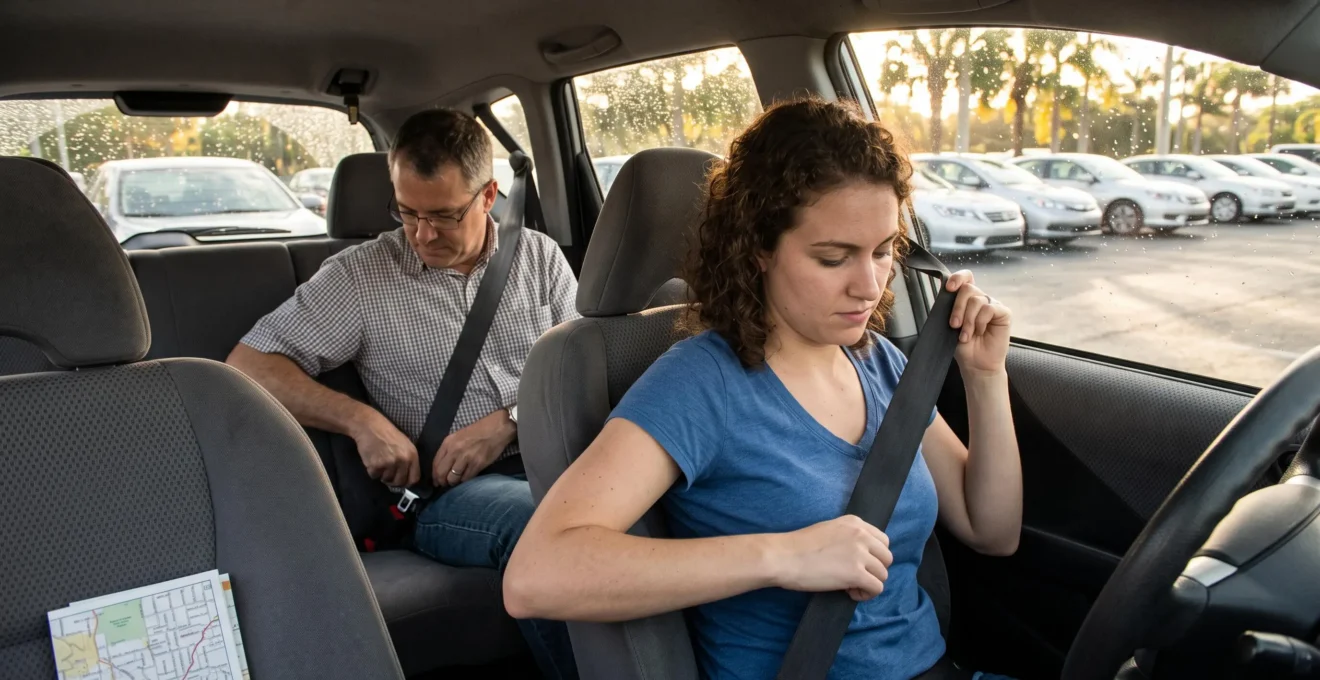
In a typical self-drive rental car in Florida, the driver, every front-seat passenger, and all passengers younger than 18 must wear an appropriately fastened seat belt or use a legally required child restraint. Adults aged 18 or older sitting in the back are generally exempt from Florida’s seat belt wearing requirement, but remaining unbuckled exposes them and other occupants to serious crash injuries.
For families visiting Florida, compliance also depends on the child’s age and restraint. Children aged 5 and younger generally need an approved child restraint, while older children must remain buckled and should continue using a booster until an adult seat belt fits correctly. These obligations apply to ordinary rental cars just as they do to privately owned vehicles.
Understanding the legal rules is only the starting point. Seat belt positioning, pregnancy precautions, child car seat installation, and equipment inspections all affect occupant protection. A rental vehicle’s unfamiliar controls and seating arrangements make these checks especially important before leaving the pickup location.
Florida rental car seat belt rules at a glance
- Who must buckle up: Drivers, adult front-seat passengers, and all occupants under 18, subject to statutory exceptions. Adult rear-seat passengers should buckle up even when the law does not require it.
- Young children: Florida generally requires an approved child restraint through age 5, with different permitted devices for children aged 0–3 and 4–5.
- Before driving: Check every belt’s condition and fit, verify child seat installation, and inspect essential vehicle safety equipment.
- Why Is Riding Unbuckled in the Back Seat Still Dangerous?
- How to Position a Seat Belt Properly for a Safe Highway Journey?
- Adult Seat Belts or Child Restraints: Which Rules Apply in Florida?
- Which Seat Belt Positioning Mistakes Should Pregnant Passengers Avoid?
- When Should You Report a Damaged Seat Belt in a Rental Vehicle?
- Which Child Car Seat Installation Errors Can Reduce Protection?
- How to Verify Lights, Mirrors, and Wipers on an Unfamiliar Rental Car?
- How to Rent the Right Child Car Seat for Your Family Trip to Florida?
Why Is Riding Unbuckled in the Back Seat Still Dangerous?
Riding unbuckled in the back seat is dangerous because an unrestrained passenger can be thrown forward, collide with other occupants, or be ejected during a crash. Although Florida generally does not require rear-seat adults aged 18 or older to wear seat belts, that legal exemption does not change the forces involved in a collision.
Florida’s safety belt requirements are established by Florida’s safety belt statute, section 316.614. It requires drivers to be restrained, makes adult front-seat passengers responsible for wearing their belts, and requires drivers to ensure that passengers younger than 18 are appropriately restrained.
The distinction is important: an adult rear-seat exemption is not a safety recommendation. In a sudden stop or collision, an unrestrained passenger continues moving until something stops that motion. The front seat, another passenger, a vehicle pillar, or the roadway may become the point of impact.
A rear passenger thrown forward can seriously injure a properly buckled front occupant. During a rollover or side-impact collision, the absence of a restraint also increases the possibility of partial or complete ejection.
The National Highway Traffic Safety Administration (NHTSA) recommends seat belt use in every seating position, regardless of whether state law requires it. Airbags and vehicle structures cannot replace the protection provided by a correctly worn belt.
Rental car insurance does not eliminate these physical risks. Florida’s Personal Injury Protection (PIP) system may provide certain injury benefits under applicable coverage terms, but coverage depends on the policy and circumstances. Rental vehicle liability protection likewise does not guarantee payment for every injury or expense.
Florida law also allows a violation of its seat belt statute to be considered as evidence of comparative negligence in a civil action. That does not automatically establish negligence or reduce compensation. Whether an occupant had a legal duty to buckle up, whether a violation occurred, and how it relates to the injuries must be assessed separately. A legally exempt adult rear passenger is not automatically in violation merely because they were unbuckled.
The safest routine is simple: everyone buckles up before departure, including adults traveling in the back. Proper positioning is the next essential step because a fastened belt only works as intended when it fits the occupant correctly.
How to Position a Seat Belt Properly for a Safe Highway Journey?
Position a three-point seat belt with the shoulder strap crossing the center of the chest and collarbone, the lap strap resting low across the hips and pelvic bones, and both sections lying snugly against the body. The belt should remain flat, untwisted, and free from unnecessary slack throughout the journey.
According to NHTSA’s seat belt safety recommendations, the shoulder and lap sections should transfer crash forces to the stronger skeletal structures of the chest and pelvis rather than concentrating them on vulnerable areas such as the neck or abdomen.
Before joining a Florida highway, perform three positioning checks:
- Shoulder strap: Confirm that it crosses the middle of the chest, rests over the collarbone, and stays away from the neck and face.
- Lap strap: Position it low over the hips, touching the upper thighs rather than crossing the soft abdomen.
- Belt tension: Remove excess slack, check for twists, and ensure that the buckle is securely engaged.
In an unfamiliar rental car, first adjust the seat to a comfortable, upright driving position. Excessive seatback recline changes the belt’s contact with the torso and may reduce its ability to restrain the occupant effectively.
If the vehicle has an adjustable upper shoulder anchor, move it until the diagonal strap follows the correct path. Adjustments should be made while parked. Not every rental model provides the same adjustment range, so consult the vehicle instructions when the controls are unfamiliar.
Most modern passenger vehicles use three-point lap-and-shoulder belts. Some older or specialized seating positions may have different restraint arrangements. A lap-only belt does not offer the same upper-body restraint as a three-point belt, and a child booster must not be used with a lap-only belt.
A belt can appear fastened while being used incorrectly. Never route the shoulder strap under the arm or behind the back. These positions remove upper-body restraint and can concentrate crash forces on vulnerable areas. Thick outerwear may also prevent a snug fit; move bulky fabric aside or remove the coat before tightening the belt.
Once the belts are correctly adjusted, confirm that each passenger is using the type of restraint appropriate for their age and size. This distinction is especially important when traveling with children.
Adult Seat Belts or Child Restraints: Which Rules Apply in Florida?
Florida requires drivers and adult front-seat passengers to wear seat belts, while drivers must ensure that occupants under 18 are restrained. Children aged 5 and younger generally need a federally approved child restraint. Children through age 3 require a separate carrier or integrated child seat; ages 4–5 may also use a booster, subject to statutory exceptions.
Two statutes govern these responsibilities: section 316.614 covers general seat belt use, while Florida’s child restraint requirements under section 316.613 establish the rules for younger children.
The following table summarizes the general requirements for occupants of an ordinary self-drive rental vehicle.
| Occupant | Florida legal requirement | Practical safety guidance |
|---|---|---|
| Driver, regardless of age | Appropriately fastened seat belt | Use a correctly adjusted three-point belt |
| Front passenger aged 18 or older | Seat belt required | Keep lap and shoulder sections correctly positioned |
| Rear passenger aged 18 or older | Generally no seat belt wearing requirement under section 316.614 | Wear a seat belt on every trip |
| Child aged 0–3 | Approved separate child carrier or integrated child seat | Use rear-facing protection until the seat’s applicable limits are reached |
| Child aged 4–5 | Approved carrier, integrated seat, or booster, with limited statutory exceptions | Select a device appropriate for the child’s height, weight, and developmental stage |
| Passenger aged 6–17 | Seat belt required, or applicable child restraint | Continue booster use until the adult seat belt fits correctly |
These rules are legal minimums, not an instruction to move every child into an adult seat belt at the earliest permitted age. A belt designed for an adult can cross a smaller child’s abdomen or neck, increasing injury risk during a crash.
Child seat selection should follow a safe progression: rear-facing seat, forward-facing seat with harness and tether, then booster, and finally the vehicle’s lap-and-shoulder belt. The transition between stages depends on the manufacturer’s height and weight limits and the child’s fit, not age alone.
Florida recognizes limited child-restraint exceptions, including specified circumstances for children aged 4–5 involving certain noncommercial transportation, medical emergencies, or documented medical conditions. Families operating an ordinary rental vehicle should not assume these exceptions apply.
Legal responsibility differs by violation. A general seat belt violation is a nonmoving infraction. A violation of Florida’s child restraint statute is a moving violation that can result in three driver-license points, subject to the statutory alternatives and court procedures.
The driver is responsible for meeting the applicable child-restraint duties, even when the child belongs to another adult passenger. An adult front-seat passenger can also be cited for their own failure to buckle up.
Florida’s child restraint statute separately provides that failure to use a child restraint is not comparative negligence and is not admissible as negligence evidence in a civil trial. This differs from the treatment of violations under the general seat belt statute.
For children, compliance depends on both restraint type and correct installation. Adults also have specific positioning considerations, particularly during pregnancy, when the belt must protect both the passenger and the developing baby.
Which Seat Belt Positioning Mistakes Should Pregnant Passengers Avoid?
Pregnant passengers should avoid placing the lap belt across or above the belly, routing the shoulder strap beneath an arm or behind the back, and leaving the belt loose. The lap section belongs below the abdomen, across the pelvic bones, while the shoulder section should pass between the breasts and alongside the belly.
Seat belt use remains essential throughout pregnancy. When the restraint is positioned correctly, crash forces are directed toward the stronger bones of the pelvis and chest rather than concentrated across the abdomen.
Traveling without a seat belt creates substantial risks for the pregnant occupant and fetus. A correctly worn restraint reduces the chance of severe occupant movement and helps the vehicle’s other safety systems work as intended.
Three positioning mistakes deserve particular attention:
- Lap belt over the belly: This places restraint force where it should not be concentrated. Move the belt down so it rests beneath the bump, across the hips and pelvis.
- Shoulder strap across the abdomen or under the arm: Keep the diagonal section across the center of the chest, between the breasts, and to the side of the belly.
- Loose or displaced webbing: Remove slack and ensure that both sections remain flat against the body rather than riding over bulky clothing.
An unfamiliar rental vehicle may introduce another problem: the shoulder anchor may be positioned too high or too low for the passenger’s height and seating posture. This can direct the belt toward the neck or produce an uncomfortable path across the torso.
While the vehicle is parked, adjust the upper shoulder anchor if available, then reposition the seatback to a reasonably upright angle. Check that the belt still passes between the breasts and beside the abdomen. If the belt cannot be positioned correctly, ask the rental agency about a vehicle with a better-fitting restraint rather than improvising an attachment.
Pregnant drivers should also adjust their seating position to maintain safe control of the pedals and steering wheel while maximizing practical distance from the steering wheel airbag. The shoulder belt must remain correctly positioned during these adjustments.
After a collision, a pregnant passenger should seek prompt medical assessment, even if injuries are not immediately apparent. Crash forces can create pregnancy-related complications without obvious external symptoms.
Correct positioning assumes the restraint is mechanically sound. Before leaving a rental agency, inspect the belt’s condition because damaged webbing or a faulty buckle cannot be corrected through ordinary adjustment.
When Should You Report a Damaged Seat Belt in a Rental Vehicle?
Report a damaged rental car seat belt immediately when you discover frayed webbing, a defective buckle, a jammed or poorly retracting strap, or any problem preventing the belt from fastening and fitting correctly. Ideally, identify the defect before leaving the rental agency, document it, and request an appropriate repair or replacement vehicle.
Seat belts are safety-critical equipment. A strap that does not retract properly may leave dangerous slack, while damaged webbing or an unreliable buckle can compromise occupant restraint in a crash.
At pickup, inspect each seating position that passengers will use. Check whether the belt extends smoothly, the buckle engages with an audible click, the webbing lies flat, and the retractor takes up ordinary slack. Vehicle-specific locking behavior can differ, so an unfamiliar mechanism is not necessarily defective.
Look for visible tears, severe abrasion, damaged stitching, twisted webbing, or cracked buckle components. Also pay attention to restraint-system warning lights that remain illuminated unexpectedly. Some warning indicators relate to broader airbag or occupant-restraint systems and require professional diagnosis.
Document any suspected defect before operating the vehicle. A dated photograph or video showing the affected restraint and its location can help establish the vehicle’s condition when it was collected.
Notify the rental desk or the provider’s roadside assistance service. Ask the employee to record the condition on the pickup inspection report or confirm it in writing. If the seat belt cannot be used safely, request another vehicle rather than transporting an occupant in that seating position.
When a defect appears after departure, stop somewhere safe and contact the provider before continuing. Follow its instructions for inspection, assistance, or vehicle replacement. Do not attempt an unauthorized repair or bypass a restraint-system fault.
Prompt reporting can also prevent disputes about whether damage occurred during the rental period. However, photographs and inspection reports do not automatically determine financial responsibility; the rental agreement, evidence, and applicable law remain relevant.
A defective belt and a passenger’s failure to buckle up are not legally identical offenses. Florida’s seat belt statute requires properly adjusted and fastened restraint use, but it does not establish an automatic identical penalty for every equipment failure. The circumstances and applicable vehicle safety duties matter.
For families, the same inspection principle extends to child restraints: even an undamaged and approved car seat may provide inadequate protection when installed incorrectly.
Which Child Car Seat Installation Errors Can Reduce Protection?
Common child car seat installation errors include loose harness straps, excessive movement at the seat’s belt path, incorrect seat orientation or recline, and improperly used attachment systems. These mistakes can reduce protection because the restraint may not hold the child in the intended position or manage crash forces as designed.
The CDC’s child passenger injury-prevention recommendations emphasize selecting the correct restraint for the child’s size, following both vehicle and car seat instructions, and checking the installation before travel.
For a rear-facing seat, maintain the approved recline angle shown by the manufacturer’s indicator. Incorrect recline can affect a young child’s head positioning and protection. Keep children rear-facing until they reach the rear-facing height or weight limit of their particular seat.
After a child outgrows rear-facing limits, use an appropriate forward-facing harness seat, including the top tether as instructed. A booster comes later, when the child is ready for one and meets its manufacturer’s requirements.
A properly installed child seat should move no more than one inch side to side or front to back when tested at the belt path. This check is performed where the vehicle belt or lower-anchor attachment secures the seat, not at the top of the child seat, where some movement can be normal.
The harness must also fit the child securely. Tighten it until excess webbing cannot be pinched at the child’s shoulders, and position the chest clip at armpit level where the manufacturer specifies that arrangement.
Rental vehicles create additional installation challenges because lower LATCH anchors may be difficult to locate, and different vehicles within the same rental category may have different permitted seating positions and attachment configurations.
Do not combine lower LATCH anchors and the vehicle seat belt to secure a car seat unless the relevant manufacturers explicitly permit that installation. For many seats, these are alternative attachment methods rather than systems intended to be used together.
Before driving, confirm that the seat’s installation method is allowed for the chosen seating position. A booster, unlike a harnessed car seat, must position the vehicle’s lap-and-shoulder belt correctly on the child; a lap-only belt is insufficient.
Florida’s legal child restraint age limits do not replace manufacturer instructions or nationally recommended safety practices. A child may legally have reached the minimum age for an adult belt while still needing a booster for adequate fit.
After confirming each child seat, the driver should inspect the vehicle’s other essential safety controls. Visibility and signaling equipment deserve the same attention as occupant restraints before entering traffic.
How to Verify Lights, Mirrors, and Wipers on an Unfamiliar Rental Car?
Before driving an unfamiliar rental car, test its exterior lights, adjust all mirrors from your normal driving position, and operate the windshield wipers and washers. Confirm that the controls work as expected and that the windshield remains clear. These checks help identify safety problems before traffic, darkness, or heavy rain makes them more dangerous.
Rental vehicles may be unfamiliar even to experienced drivers. Headlight switches, fog light controls, mirror adjustments, and intermittent wiper settings vary between manufacturers and models. Learning the controls while parked is safer than searching for them while driving.
Start with exterior lighting. Confirm the headlights, low beams, turn signals, hazard lights, and brake lights. Use a companion to check rear lights when available, or ask rental staff to assist. Do not assume that automatic lighting will respond correctly to every weather or visibility condition.
Next, sit in the position you intend to use while driving. Adjust the rearview and side mirrors to provide a clear view of traffic behind and alongside the vehicle. Mirrors do not eliminate blind spots, so the driver must still check surrounding traffic before changing lanes.
Finally, activate the wipers and washers. Look for streaking, skipping, poor blade contact, or inadequate washer operation. These problems can become especially hazardous during Florida’s sudden heavy rain.
The following five-action inspection creates a practical record of readiness before leaving the rental location.
Five-point rental car departure safety checklist
- Confirm occupant restraints: Fasten and inspect every seat belt to be used. Deliverable: a confirmed secure buckle and correctly positioned belt for each occupant.
- Verify child seats: Check the applicable installation method, harness fit, and movement at the belt path. Deliverable: a securely installed, size-appropriate restraint for every child requiring one.
- Test exterior lighting: Operate headlights, indicators, hazard lights, and brake lights. Deliverable: confirmation that each tested light functions, with assistance for rear checks when necessary.
- Adjust mirrors and test visibility equipment: Set mirrors from the driving position and operate wipers and washers. Deliverable: usable mirror views and a satisfactorily cleared windshield.
- Record unresolved problems: Photograph safety defects and notify the rental provider before departure. Deliverable: an inspection note or written report and confirmation that any safety-critical defect has been addressed.
Do not treat this inspection as a mechanical certification. It is a practical pre-departure check that complements, rather than replaces, the rental provider’s maintenance responsibilities.
If an essential light, wiper, or restraint component is defective, request an appropriate solution before driving. A correctly fastened seat belt cannot compensate for poor visibility or the inability to signal other road users.
Once the vehicle is ready, families should make one final equipment decision: whether the child seat they have reserved, brought, or obtained locally is suitable for the actual rental vehicle and child.
Key takeaways before choosing a child car seat
- Choose a child restraint using the child’s current height, weight, and the manufacturer’s approved usage limits, not the rental category alone.
- Confirm availability and suitability before travel, but treat the actual seat and vehicle as unverified until pickup.
- Allow enough time at the rental location to inspect the seat, complete installation, and resolve incompatibility before departure.
How to Rent the Right Child Car Seat for Your Family Trip to Florida?
Rent the right child car seat by matching the restraint to your child’s age, height, weight, and developmental needs, then confirming that it meets applicable U.S. federal safety requirements. Before driving, inspect the seat’s condition and instructions and install it correctly in the actual rental vehicle. Florida generally requires approved child restraints through age 5.
Families should make this choice before reserving or collecting their rental car. A provider’s labels such as infant seat, toddler seat, or booster are useful starting points, but they do not establish whether a specific restraint fits a particular child.
Check the restraint’s height and weight limits, permitted direction of travel, and installation requirements. Federally compliant child restraint systems are subject to applicable Federal Motor Vehicle Safety Standards, including FMVSS No. 213 or other applicable standards for the device.
For younger children, select a suitable rear-facing seat and maintain that position until the manufacturer’s rear-facing limits are reached. A forward-facing harness seat is appropriate after the child outgrows those limits, while a booster should be used only when the child meets its requirements and can use it correctly.
Families visiting Florida generally have three practical ways to obtain a child restraint. Each involves different tradeoffs.
| Option | Advantages | Points to verify |
|---|---|---|
| Rent from the vehicle provider | Convenient pickup with the rental car; no need to transport a personal seat | Availability, suitability, condition, instructions, total rental charges, and compatibility |
| Bring a personal seat | Known fit, installation method, and equipment history | Airline transport arrangements, possible travel damage, U.S. vehicle compatibility, and applicable approval requirements |
| Purchase or borrow locally | Potentially useful for longer stays or when a rental seat is unsuitable | Verified compliance, complete components, instructions, condition, history, and availability |
A seat supplied by the rental provider should not be assumed suitable or correctly installed. Ask for its model information and inspect it personally. Confirm that the labels identifying the manufacturer, model, and applicable usage limits are present and readable.
Examine the harness, buckle, shell, attachment straps, lower-anchor connectors, and other required components. Check for visible damage, missing parts, or indications that the seat may have been involved in a crash. Where the seat’s history cannot be adequately established, particularly for secondhand equipment, seek an alternative with a reliable history.
Consult the seat’s instructions and the rental vehicle’s owner’s manual. If a complete manual is not physically provided, obtain the correct manufacturer’s instructions for the exact model before installing it. Never assume that an installation method used in another vehicle remains valid in the rental car.
Install the seat while parked at the rental location. Check the permitted seating position, correct belt routing or lower-anchor attachment, recline indicator, harness fit, and movement at the belt path. For forward-facing harness seats, use the top tether as directed by the manufacturer.
Families traveling by air should also consider whether their personal child restraint is approved for use on the aircraft if they intend to use it during the flight. Airline acceptance and aircraft installation rules are separate from Florida road-vehicle restraint law.
Florida’s requirement for children aged 5 and younger establishes a legal minimum, but a child who is older than 5 may still need a booster until the adult seat belt fits properly. Selecting a restraint solely to satisfy the minimum legal age requirement can therefore leave an older child inadequately protected.
Before collecting the vehicle, confirm the child’s measurements, reserve an appropriate restraint or arrange to bring one, and check the provider’s pickup requirements. At collection, inspect the actual equipment and complete installation before departure. If the seat is damaged, unsuitable, or cannot be secured correctly, request a suitable replacement rather than beginning the journey with inadequate protection.
Can a police officer stop a rental car for a seat belt violation in Florida?
Yes. Florida permits primary enforcement of its seat belt requirements, meaning an officer may stop a vehicle for an observed seat belt violation without needing another traffic violation. Whether a citation is appropriate depends on the occupant’s age, seating position, applicable duties, and any statutory exception.
Does Florida require passengers to wear seat belts during short trips?
Yes, where the state’s seat belt law applies, there is no general exemption simply because a trip is short or takes place near a rental agency, hotel, or attraction. Required occupants must be properly restrained while the vehicle is moving.
Can a six-year-old legally use a regular seat belt in Florida?
Florida’s general child restraint requirement applies through age 5, so a six-year-old is not automatically required by that provision to use a booster. However, the child must be restrained under the general seat belt law. A booster remains the safer choice until the vehicle’s adult lap-and-shoulder belt fits correctly, which commonly happens at a substantially older age.
Does a medical condition automatically exempt someone from Florida’s seat belt law?
No. Florida recognizes specific statutory exceptions, including qualifying medical circumstances with the required certification. Simply finding a seat belt uncomfortable or having an undocumented condition does not establish an exemption. Passengers should verify the applicable statutory conditions and necessary documentation before relying on one.
Who is responsible if a rented child car seat is incorrectly installed?
For an ordinary self-drive rental car, the driver has the applicable legal duty to ensure young children are properly restrained. The rental provider’s supply of a child seat does not transfer that duty to the agency. Separate questions about a defective supplied seat, contractual responsibilities, or liability after an accident depend on the circumstances and applicable law.