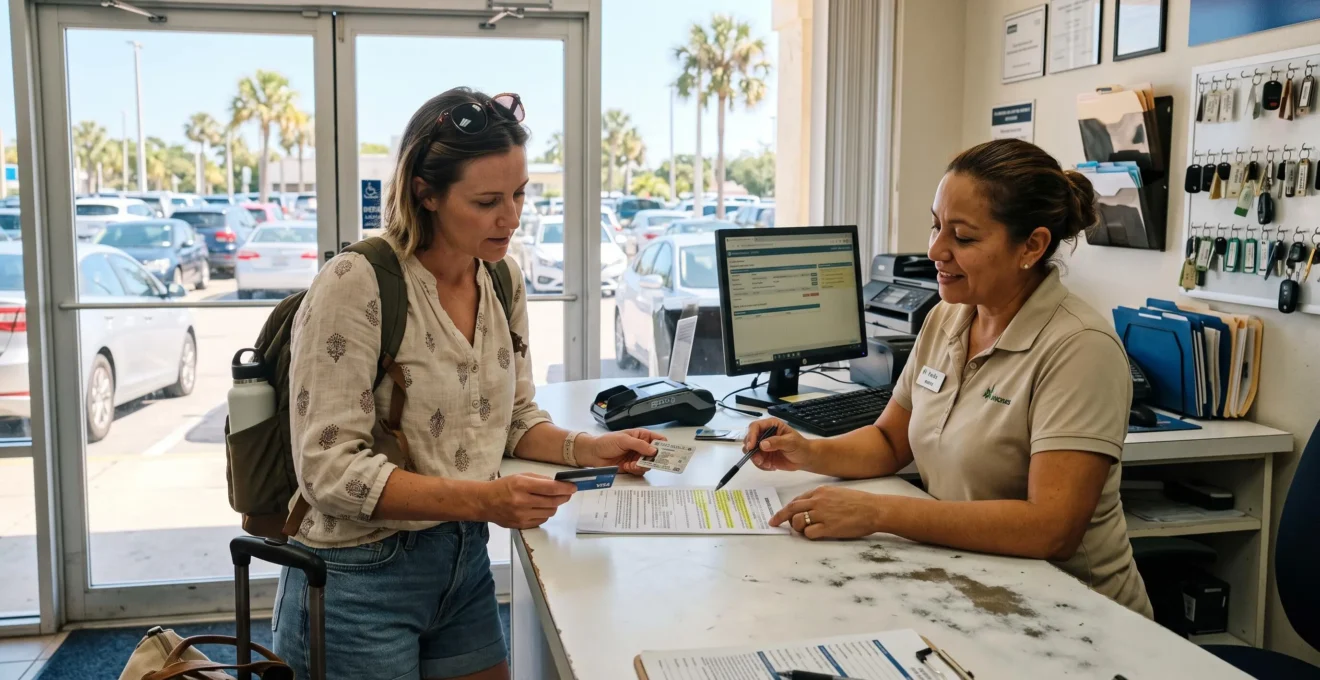
Additional rental car insurance in Florida is worth buying when it fills a meaningful gap in your existing protection, particularly for third-party liability, rental vehicle damage, or contractual charges that your personal auto policy and credit card benefits do not cover. It is generally less valuable when those risks are already adequately addressed.
The difficulty is that rental counter products protect against different financial losses. A credit card may reimburse damage to the rental vehicle without covering injuries you cause to another driver. A personal auto policy may extend liability protection to rentals but leave you responsible for a deductible. A damage waiver may eliminate certain rental company charges without increasing your liability insurance limits.
Florida also has particular insurance rules that make it important to distinguish personal injury protection, third-party liability, and uninsured motorist coverage. Before paying for optional protection, identify the exact risk, determine who would pay first, and compare the rental company’s terms with your existing policies.
Florida rental insurance: the essential decisions
- Buy protection for verified gaps: supplemental liability protection may be valuable when your existing liability limits are inadequate, while a damage waiver may help when vehicle damage is insufficiently covered.
- Do not assume your credit card provides complete insurance: rental collision benefits generally exclude third-party liability and bodily injury.
- Check before pickup: verify your card’s benefit guide, personal auto policy, vehicle eligibility, rental duration, and contractual exclusions before accepting or declining add-ons.
- Why Might Credit Card Rental Coverage Leave Important Gaps?
- How to Confirm Your Credit Card’s Rental Car Coverage Before Pickup?
- Supplemental Liability or Personal Accident Insurance: What Is Different?
- Which Rental Insurance Add-Ons May Duplicate Your Existing Policies?
- When Should You Decline or Accept Optional Insurance at the Counter?
- How to Check Your Personal Auto Policy Before Renting in Florida?
- When Should You Recheck the Terms of a Confirmed Rental Booking?
- How to Match Rental Car Insurance Coverage to Your Travel Risks?
Why Might Credit Card Rental Coverage Leave Important Gaps?
Credit card rental insurance can leave important gaps because it usually focuses on theft or collision damage to the rental vehicle rather than liability to other people. Many cards also provide secondary coverage, meaning eligible claims may first involve your personal auto insurer. Vehicle restrictions, rental duration limits, and excluded charges can further reduce the protection available.
Secondary coverage does not necessarily mean that the credit card benefit is ineffective. It means that the benefit’s payment priority depends on other applicable insurance. If your personal policy covers the loss, you may need to submit a claim through that insurer before receiving an eligible reimbursement through your card benefit.
This arrangement can leave you facing a deductible, claim-related paperwork, or expenses that neither policy reimburses. A personal insurance claim may also affect future premiums, depending on the insurer and circumstances; an increase is not automatic.
The distinction is documented in the Visa Auto Rental Collision Damage Waiver terms and conditions. The specified benefit is generally secondary for qualifying personal rentals, although primary coverage applies in certain circumstances. These terms concern eligible accounts, not every card displaying the Visa network logo.
The same document identifies exclusions involving trucks, open-bed vehicles, cargo vans, certain passenger vans, exotic vehicles, and other vehicle categories. It also excludes rentals exceeding 31 consecutive days. That limit applies to this particular benefit and should not be treated as universal.
A pickup truck rented for a Florida road trip, for example, may fall outside the documented vehicle eligibility conditions. A long family vacation can similarly exceed a card’s maximum rental duration. Restrictions involving prohibited vehicle use, rental agreement violations, and territorial eligibility must also be checked against the applicable benefit guide.
Most importantly, a rental collision benefit does not automatically protect your finances if you injure someone or damage another vehicle.
Use four separate questions to assess the actual coverage:
- Rental vehicle damage: Does the card reimburse eligible collision damage or theft?
- Third-party liability: Who pays if you cause injuries or property damage to someone else?
- Personal injury: Which policy covers medical expenses for you and your passengers?
- Additional rental charges: Are loss-of-use fees, administrative charges, and towing expenses covered, and under what conditions?
Some card benefits reimburse qualifying loss-of-use or administrative charges, but reimbursement may require substantiation and supporting documents. Do not assume every amount demanded by a rental company qualifies.
A credit card can be a useful component of rental protection. It should not be mistaken for a complete replacement for automobile liability, medical, or other applicable insurance.
How to Confirm Your Credit Card’s Rental Car Coverage Before Pickup?
Confirm credit card rental coverage by obtaining the current benefit guide for your exact account and asking the designated benefit administrator to verify your planned rental. Check whether coverage is primary or secondary, which vehicles qualify, how long protection lasts, and what documents are required for a claim. Keep the written confirmation before collecting the keys.
The card network alone is not sufficient proof of coverage. A Visa, Mastercard, American Express, or Discover logo identifies the payment network, but benefits can vary by issuer, card product, and applicable agreement. A travel-rewards card may have limited rental protection or no relevant benefit at all.
Begin with the issuer’s online account portal or the customer service number on the back of the card. Request the current written rental vehicle coverage terms and identify the benefits administrator responsible for eligibility questions and claims.
The issuer’s general customer service department and the benefit administrator may have different responsibilities. An informal assurance that a card includes travel protection is not equivalent to verification that your particular rental qualifies.
Before pickup, record the following information:
- Coverage priority: Whether the benefit applies before or after personal auto insurance.
- Maximum reimbursement: Any monetary limit, vehicle value restriction, or deductible-related condition.
- Vehicle eligibility: Permitted and excluded vehicle classes, including vans, trucks, and specialty vehicles.
- Rental duration: Maximum consecutive rental days and any restrictions involving extensions.
- Claim requirements: Notification deadlines, required evidence, and the benefit administrator’s contact details.
Also verify whether you must pay the entire eligible rental transaction with that card and decline the rental company’s collision damage waiver. These are eligibility conditions under some card benefits, including the documented Visa benefit.
For claims, the administrator may request the rental agreement, proof of payment, accident or police reports where applicable, photographs, repair estimates, and documentation of other available insurance. Exact requirements and filing deadlines depend on the benefit terms.
Keep a copy of the relevant guide and any written eligibility confirmation. If you call, note the date, representative’s name when available, and the specific questions answered. Such records can help resolve discrepancies, although verbal statements do not necessarily override contractual exclusions or guarantee that an appeal will succeed.
Five checks to complete before rental pickup
- Download the current card benefit guide and save a copy showing the applicable account and benefit terms.
- Confirm the booked vehicle class and rental dates against the exclusions, producing a written eligibility note.
- Verify whether the benefit is primary or secondary and record the applicable reimbursement limits.
- Ask the administrator about waiver-declination requirements, claim deadlines, and covered fees; save the answers or a dated call record.
- Compare the card benefit with your personal auto policy and prepare a one-page list of uncovered risks for the rental counter.
Finish this review before the rental agreement is presented for signature. Knowing your card’s exact limitations allows you to evaluate supplemental liability and accident coverage separately.
Supplemental Liability or Personal Accident Insurance: What Is Different?
Supplemental Liability Insurance (SLI) protects against covered claims from other people when you are legally responsible for an accident, while Personal Accident Insurance (PAI) provides specified injury-related benefits for you and eligible passengers. SLI addresses third-party financial exposure; PAI addresses covered accident benefits. Neither should be purchased as a substitute for the other without checking the policy terms.
Rental companies may call supplemental liability coverage SLI or Supplemental Liability Protection (SLP). Its purpose is to provide additional third-party liability protection under the applicable insurance arrangement. The actual limit, exclusions, eligible drivers, and interaction with existing policies depend on the product.
PAI usually concerns specified accident-related benefits, which may include accidental death, medical expenses, or ambulance costs. It does not ordinarily replace broader health insurance or provide comprehensive third-party liability protection.
| Coverage question | SLI / SLP | PAI |
|---|---|---|
| Primary purpose | Covered third-party liability claims | Specified accident benefits for covered occupants |
| Typical covered loss | Injuries or property damage for which an insured driver is legally liable | Eligible medical, ambulance, or accidental death benefits |
| Potential existing overlap | Personal auto liability insurance or other applicable liability coverage | Health insurance, auto medical payments coverage, or applicable PIP |
| Does it cover rental car collision damage? | Generally no | No |
| When to consider it | Inadequate third-party liability protection | A specific accident-benefit gap not adequately covered elsewhere |
Florida’s no-fault system makes these distinctions particularly important. Personal Injury Protection (PIP) generally addresses qualifying injury-related expenses without depending solely on who caused an accident. It does not mean that an at-fault driver can never face a third-party injury claim.
Florida also has specific compulsory coverage rules. In particular, the state’s general compulsory automobile insurance framework does not impose the same universal bodily injury liability requirement that exists in some other states. This is one reason renters should not equate a legal minimum with adequate protection against a serious third-party claim.
Rental vehicle insurance priority is governed in part by Florida Statutes section 627.7263 on rental insurance priority. Under the statutory default, the lessor’s applicable liability and PIP coverage are primary for specified statutory limits, unless the agreement contains the required language establishing a different priority.
Consequently, neither the rental company’s protection nor the renter’s personal policy should automatically be described as always paying first.
For a concrete example, Enterprise describes a standard SLP product providing up to $300,000 in combined third-party liability protection, subject to its terms. Its separately described Enterprise Truck Rental offering has a different limit. These are company-specific product descriptions, not universal Florida limits.
PAI may overlap with health insurance, medical payments benefits, or applicable PIP, but those products can differ in covered persons, limits, exclusions, and the treatment of accident-related expenses. Some accident policies also provide fixed benefits that may be payable alongside other coverage.
Consider SLI when existing third-party liability protection is missing, uncertain, or inadequate relative to potential losses and assets. Consider PAI when an actual injury-benefit gap remains for you or your passengers, particularly where health or accident coverage is limited. Passenger count and driving conditions may affect the assessment, but neither automatically justifies a purchase.
Once these protections are separated by purpose, the next question is whether an existing policy already performs the same function.
Which Rental Insurance Add-Ons May Duplicate Your Existing Policies?
Rental insurance add-ons may duplicate personal auto insurance, credit card collision benefits, health insurance, or homeowners and renters insurance. Collision Damage Waivers, supplemental liability protection, personal accident insurance, and personal effects coverage each address different risks. The right choice depends on comparing their exclusions, limits, deductibles, and contractual obligations rather than assuming that overlapping coverage is identical.
The term rental car insurance can be misleading because some counter products are insurance while others are contractual waivers. A Collision Damage Waiver (CDW) or Loss Damage Waiver (LDW) generally reduces or removes specified amounts the rental company could otherwise charge for damage, loss, or theft.
A waiver does not necessarily duplicate your auto policy completely. Your auto insurer may cover eligible rental vehicle damage but apply a deductible or exclude certain contractual fees. Conversely, the waiver may exclude particular conduct or situations, so it should not be treated as unlimited protection.
The Enterprise rental insurance and protection options distinguish Damage Waiver from insurance and expressly describe it as optional. Enterprise also acknowledges that selected insurance and protection products may duplicate coverage customers already hold.
The following comparison provides a starting point for evaluating counter products.
| Counter product | Possible existing protection | Gap to verify |
|---|---|---|
| CDW / LDW | Personal auto collision and comprehensive coverage; eligible credit card benefits | Deductibles, excluded vehicles, loss of use, administrative charges, and waiver exclusions |
| SLI / SLP | Personal auto liability coverage; other applicable liability policies | Third-party limits, coverage priority, authorized drivers, and exclusions |
| PAI | Health insurance, auto medical payments, PIP, and other accident benefits | Covered travelers, medical benefit limits, exclusions, and additional accident benefits |
| PEC | Homeowners, renters, travel, or other personal property insurance | Deductibles, covered property, theft conditions, and limits away from home |
Personal Effects Coverage (PEC) is distinct from PAI. PEC protects certain belongings under its terms, while PAI concerns specified accident-related benefits. Combining them into a single category can conceal important differences.
A personal auto policy may extend coverage to an eligible rental vehicle under its non-owned automobile provisions. However, coverage can depend on vehicle type, trip purpose, rental location, and other contractual conditions. Policies issued outside Florida must be checked for their actual geographic scope rather than presumed invalid or valid.
If the same deductible applies to the rental as to your own vehicle, declining CDW may be reasonable when you can comfortably absorb that deductible and any uncovered fees. If the deductible or contractual exposure would present a substantial financial problem, the waiver may provide meaningful additional value.
At the counter, create a simple worksheet with four rows: CDW/LDW, SLI/SLP, PAI, and PEC. For each row, mark existing protection as verified, partial, absent, or unknown. Record the relevant limit or deductible and identify which unresolved gap the offered product would close.
Only products addressing a meaningful remaining exposure should be considered for purchase. Also verify the daily price and total rental cost because optional products may not be included in the original reservation estimate.
Redundancy is not always wasteful if two products have materially different deductibles or contractual benefits. The appropriate decision depends on whether those differences justify the additional cost.
When Should You Decline or Accept Optional Insurance at the Counter?
Decline optional rental insurance when your existing protection has been verified, applies to the booked vehicle and rental period, and adequately addresses the relevant losses. Consider accepting an add-on when your coverage excludes the vehicle, expires before the rental ends, imposes an unaffordable deductible, or leaves substantial third-party liability exposure. Base the decision on written terms, not sales pressure.
Three factors deserve particular attention: the reliability of your existing coverage confirmation, the length of the rental, and the eligibility of the actual vehicle. A short rental in an eligible standard car presents different coverage questions from an extended trip in an excluded pickup truck or specialty vehicle.
Consider these explicitly hypothetical situations:
- Short rental with verified coverage: A traveler has confirmed personal auto liability and vehicle damage protection, a qualifying card benefit, and manageable deductibles. Declining overlapping products may be reasonable.
- Excluded vehicle class: A renter’s card benefit excludes the selected pickup truck. CDW or another qualifying damage protection option may fill that particular gap, subject to its terms.
- Extended Florida vacation: A rental exceeds the card’s maximum consecutive rental period. The traveler needs another source of eligible vehicle damage protection for the uncovered period or must reconsider the rental arrangement.
- High deductible or inadequate liability: A renter faces a deductible they cannot comfortably pay or has insufficient third-party liability protection. A suitable damage waiver or supplemental liability product may address those separate problems.
A larger travel group can also change the assessment because more drivers, passengers, or vehicle changes may introduce additional eligibility questions. However, the number of passengers alone does not establish a need for PAI.
Rental agents may strongly recommend optional protection or describe possible charges if you decline. Ask whether the product is legally or contractually required, which specific charges it addresses, and where its exclusions are documented.
For ordinary rentals, products marketed as optional, such as Enterprise’s Damage Waiver, are not mandatory. However, do not assume that every rental company, commercial arrangement, or special vehicle contract has identical requirements.
Declining a damage waiver does not automatically transfer a special legal burden of proof to the renter. It may, however, leave the renter contractually responsible for eligible damage-related charges that would otherwise have been waived. Understanding the agreement and documenting the vehicle’s condition are therefore important.
Before leaving the lot, inspect the bodywork, windshield, wheels, and interior. Photograph existing damage, confirm that it appears on the rental condition record, and retain the photographs and agreement. This evidence is useful whether you purchased a waiver or retained financial responsibility.
Be cautious about inexpensive add-ons offering narrowly defined protection, such as certain tire, windshield, or roadside incidents. A low daily charge can appear reassuring while leaving a much larger third-party liability gap untouched.
Compare the total cost over the complete rental period, not just the daily price. Ask whether the protection has a deductible, what conduct invalidates it, whether additional drivers are covered, and how claims are handled.
If an important term remains uncertain, resolve it with the relevant insurer or benefits administrator before signing. Your personal auto policy is often the most useful next document to review.
How to Check Your Personal Auto Policy Before Renting in Florida?
Check your personal auto policy by reviewing the declarations page, non-owned vehicle provisions, and exclusions, then asking your insurer whether the coverage extends to a Florida rental. Confirm liability limits, collision and comprehensive protection, deductibles, uninsured motorist coverage, and rental company fees. A policy that protects your personal vehicle does not necessarily cover every rental situation identically.
The declarations page identifies your selected coverages, limits, and deductibles. It provides a starting point, but it does not explain every coverage condition or exclusion.
Look for language addressing non-owned automobiles, temporary substitute vehicles, and rental vehicles. These terms are not interchangeable in every policy. A temporary substitute provision, for example, may apply to a different situation from a vehicle rented for vacation.
Read the definitions and exclusions alongside the coverage grants. Pay attention to restrictions involving vehicle type, permitted drivers, business use, rental duration, or geographic location.
Contact your insurer and ask three specific questions:
- Does my current policy extend liability, collision, and comprehensive coverage to a vehicle rented for personal travel?
- Does that protection apply to a rental picked up and driven in Florida if my policy was issued in another state?
- Does it cover rental company loss-of-use charges, administrative fees, or other contractual expenses following damage?
Ask the insurer to identify the applicable policy language and confirm your deductible and liability limits. If possible, obtain a written response that describes your planned vehicle type and trip.
Liability coverage requires special attention. Florida’s no-fault PIP framework concerns specified injury benefits; it does not make third-party liability limits irrelevant. An at-fault accident can still create financial exposure beyond applicable insurance protection.
The renter should also distinguish third-party liability coverage from uninsured or underinsured motorist (UM/UIM) coverage. Liability insurance addresses eligible claims brought against an insured driver. UM/UIM coverage, where available and applicable, may protect insured people against certain losses caused by drivers who lack sufficient insurance.
According to the Insurance Information Institute‘s uninsured motorist statistics, the Insurance Research Council estimated that 20.6% of Florida motorists were uninsured in 2023, compared with 15.4% nationwide. These are historical estimates based on claims-frequency analysis, not a prediction of your personal accident risk.
20.6%
Estimated share of uninsured motorists in Florida in 2023, according to Insurance Research Council estimates. This does not measure the likelihood that a particular rental driver will encounter an uninsured motorist.
Insurance Research Council, as reported by the Insurance Information Institute; 2023 estimates.
Ask whether your UM/UIM coverage extends to a rented vehicle, which people qualify as insured, and whether any territorial or vehicle-related restrictions apply. Do not assume that purchasing SLI provides equivalent uninsured motorist protection: the products address different risks.
When reviewing health and PIP benefits, check which coverage applies to the actual occupants. State-specific policy provisions and the individual’s insurance arrangements can affect the result.
Once your insurer confirms coverage, preserve the response with your reservation documents. The next important step is ensuring the booking details have not changed in ways that affect eligibility.
When Should You Recheck the Terms of a Confirmed Rental Booking?
Recheck your confirmed rental booking approximately 48 hours before pickup and again when signing the rental agreement. Pay particular attention to changes in vehicle class, pickup location, rental duration, pricing, and optional protection terms. A modification can change whether your credit card or personal auto policy covers the rental, even when the reservation remains confirmed.
Booking confirmation establishes the planned transaction, but it does not guarantee that every detail will remain unchanged. Vehicle availability, customer-requested modifications, and rental company procedures may produce differences between the original confirmation and the final agreement.
The following changes deserve review:
- Vehicle substitution: An upgrade or replacement may move the rental into a category excluded by your credit card or personal policy.
- Rental extension: Additional days may exceed a card benefit’s maximum rental duration or affect the agreed protection terms.
- Pickup location change: Moving to another branch or state may introduce different contractual or insurance conditions.
- One-way rental: A different return location may affect contractual requirements and should be checked against applicable territorial and rental terms.
- Rate or protection changes: Revised prices, add-ons, or waiver terms can alter the total cost and the value of optional protection.
A booking beginning in Florida but ending in another state does not automatically invalidate insurance. The relevant question is whether the policy, benefit guide, and rental agreement allow the specific locations and planned use.
Likewise, a different vehicle model within the same general booking category is not necessarily a coverage problem. The concern is whether the actual vehicle meets the insurer’s or benefit administrator’s eligibility definitions.
Approximately 48 hours before pickup, compare your latest confirmation with the documents used when checking coverage. Verify the pickup and return dates, booked vehicle class, authorized drivers, locations, and selected protection products.
At the counter, compare those details with the final agreement. If anything material changes, request confirmation from the applicable insurer or benefit administrator before relying on the original coverage assessment.
Preserve the original booking confirmation, subsequent change notices, written correspondence, and signed rental agreement. These records can help establish which terms were communicated and accepted if a later claim is disputed.
The same practice applies when extending a rental after pickup: reassess eligibility before the original return date rather than assuming that the initial insurance confirmation remains valid indefinitely.
With the booking and existing policies verified, the remaining task is to match the available protection to the financial risks of your particular trip.
Key takeaways before making your final decision
- Evaluate vehicle damage and third-party liability separately; reducing a collision deductible does not increase liability limits.
- Assess the consequences of an uninsured loss against your financial resources, not simply the daily price of the protection product.
- Make your decision using the actual rental agreement, eligible vehicle class, coverage priority, and written policy terms.
How to Match Rental Car Insurance Coverage to Your Travel Risks?
Match rental car insurance to your travel risks by identifying four potential losses: damage to the rental vehicle, liability to other people, injuries to covered occupants, and additional rental company charges. Then compare each loss with your verified coverage, the characteristics of the trip, and the amount you could afford to pay personally. Purchase supplemental protection only where the remaining exposure justifies its cost.
The most useful decision framework begins with financial consequences rather than a list of products. A standard rental car may qualify for existing collision protection, yet the driver could still face substantial third-party liability exposure. Conversely, someone with adequate liability protection might have no collision coverage for the rental vehicle.
Use the following matrix to identify the relevant priorities.
| Risk dimension | Travel factors to review | Potential protection decision |
|---|---|---|
| Damage or theft of the rental vehicle | Vehicle class, rental duration, credit card eligibility, auto policy deductible | Consider CDW/LDW when eligible damage coverage is absent or the remaining exposure is financially significant. |
| Third-party liability | Existing liability limits, financial assets, authorized drivers, applicable rental agreement | Consider SLI/SLP when available protection is insufficient for a serious covered third-party claim. |
| Injuries to the renter or passengers | Passenger insurance, PIP or medical payments applicability, health coverage, accident benefits | Consider PAI only when its specific benefits address an identified gap and justify the price. |
| Loss of use and administrative fees | Auto policy exclusions, card benefit terms, waiver language, documentation requirements | Consider a qualifying waiver when contractual charges remain uncovered or are otherwise unacceptable. |
Florida’s insurance environment adds important context. The state’s no-fault framework affects certain injury-related benefits, while rental liability priority can depend on the precise language of the agreement. Historical uninsured motorist estimates also support checking UM/UIM protection rather than assuming all drivers carry sufficient insurance.
Busy destinations such as Miami and Orlando may involve unfamiliar roads, airport traffic, and frequent navigation decisions. These are practical trip-planning considerations, not evidence that every rental in either city requires additional insurance or that accident costs are necessarily higher there.
Personal finances should influence the decision. A traveler with substantial savings, home equity, or business assets may place greater importance on verifying liability limits and considering additional third-party protection. However, assets and liability exposure do not determine the precise insurance limit needed in every case; applicable law and individual financial circumstances also matter.
For someone with limited savings, an otherwise manageable auto insurance deductible may still represent an unaffordable unexpected expense. In that situation, a suitable damage waiver may have practical value even if the existing insurance technically covers the vehicle.
A hypothetical comparison illustrates the distinction. Traveler A has verified collision coverage but inadequate third-party liability limits. Traveler B has adequate liability protection but no eligible coverage for damage to a selected rental vehicle. Traveler A should investigate supplemental liability protection, while Traveler B should investigate rental vehicle damage protection. Buying the same product would not solve both problems.
Before accepting an add-on, ask four final questions: What exact loss does it cover? What existing policy already responds? Who pays first? What deductible, limit, exclusion, or contractual charge remains?
Before your next Florida rental, prepare a short coverage summary showing the protection already verified, remaining financial exposures, and any add-on that would close a meaningful gap. Bring it to the counter, compare it with the final agreement, and make the purchase decision based on documented coverage rather than assumptions.
Is additional rental car insurance mandatory in Florida?
Florida does not generally require an ordinary rental customer to purchase every optional insurance or protection product offered at the counter. Applicable financial responsibility requirements and the rental agreement still matter. Some rental arrangements have additional conditions, so verify what is legally required and what is an optional purchase.
Can I use credit card rental insurance without owning a car?
Potentially. Some credit card benefits provide primary rental vehicle damage protection when the eligible cardholder has no personal automobile insurance. However, cardholder eligibility, vehicle restrictions, payment conditions, and the applicable benefit guide control the result. Such benefits generally do not replace third-party liability insurance.
Does a rental car damage waiver cover every type of damage?
No. A damage waiver reduces or eliminates specified contractual responsibility for rental vehicle damage, loss, or theft, but it remains subject to its terms and exclusions. Certain conduct, prohibited uses, or categories of charges may invalidate or limit the waiver. Review the actual agreement before assuming all damage-related costs are waived.
Does supplemental liability insurance protect me from uninsured drivers?
Not automatically. Supplemental liability protection generally concerns covered third-party claims for which an insured renter or authorized driver is legally responsible. Uninsured or underinsured motorist coverage addresses a different risk involving injuries or losses caused by drivers lacking sufficient insurance. Ask the insurer whether UM/UIM benefits are separately included.
What should I do if the rental company changes my vehicle at pickup?
Check whether the replacement vehicle remains eligible under your credit card benefit and personal auto insurance. Pay particular attention when moving to a truck, passenger van, specialty vehicle, or another potentially restricted category. If eligibility is uncertain, contact the relevant benefits administrator or insurer before accepting the substitution, and retain documentation of the change.