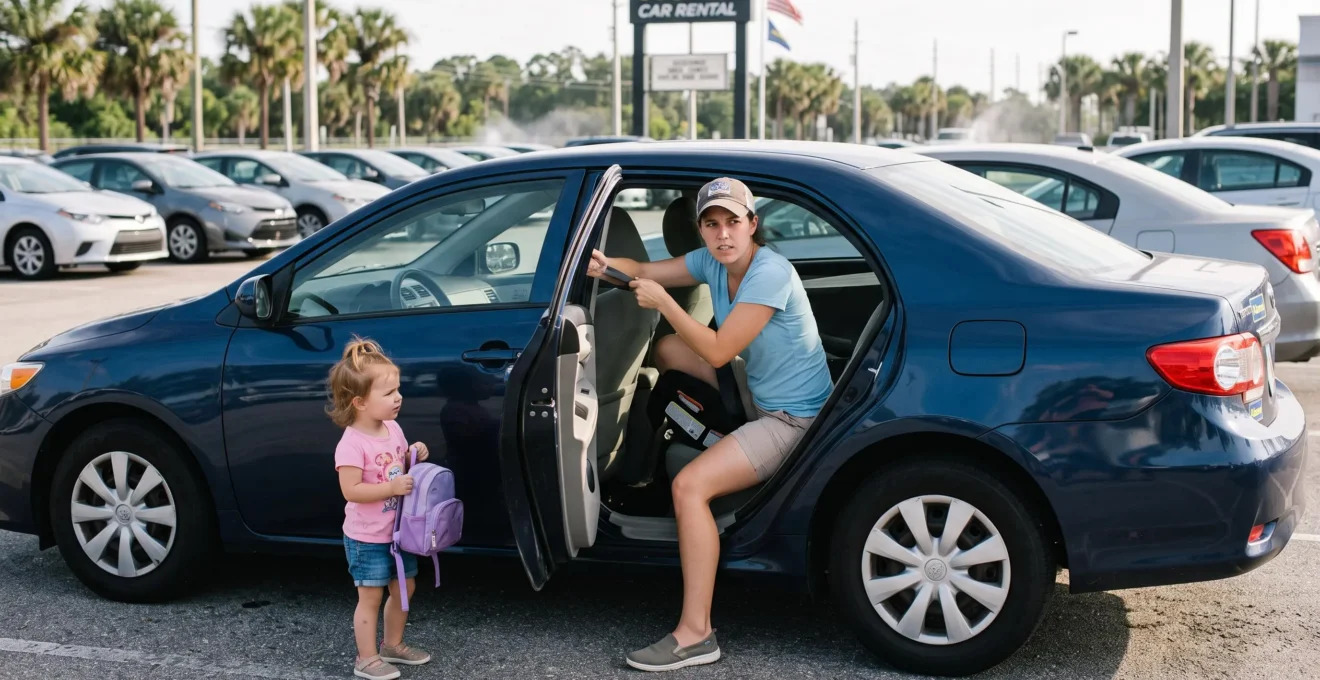
Choosing a child car seat for a Florida rental car starts with three questions: Does the restraint fit your child, does it fit the vehicle, and can you install it correctly? A convenient rental option is not necessarily an appropriate one, particularly when a child is approaching the height or weight limit of their current seat.
Florida requires approved child restraints for children aged five and younger, with different legal provisions for children through age three and those aged four or five. But legal compliance is only the starting point. A child’s measurements, developmental stage, and the manufacturer’s instructions determine which restraint provides suitable protection.
For families arriving at Orlando, Miami, Tampa, or another Florida destination, the decision also involves rental inventory, unfamiliar vehicles, equipment condition, and luggage space. Planning these details before departure reduces the risk of discovering an unsuitable seat at the rental counter.
The safest practical approach is to identify the correct restraint category before booking, verify the equipment offered, and complete the installation checks before driving away.
Florida child car seat rental: the essentials
- Choose rear-facing, forward-facing, or booster protection according to your child’s age, height, weight, and the specific restraint’s limits.
- Reserve the correct seat category early, but inspect its condition, crash-history documentation, and compatibility before accepting it.
- Install the restraint according to both manuals, verify that it moves no more than one inch at the belt path, and check your child’s harness or seat belt fit.
- Why Does a Child’s Size Matter More Than Travel Convenience for Car Seats?
- How to Check a Rental Child Seat Before Installing It?
- Bring Your Own Car Seat or Rent One in Florida: Which Is Better?
- Which Child Car Seat Installation Errors Can Reduce Protection?
- When Should You Reserve a Child Seat for a Florida Rental Car?
- Adult Seat Belts or Child Restraints: Which Rules Apply in Florida?
- How to Organize Seats and Luggage in a Seven-Passenger Minivan?
- What Should You Check When Collecting a Rental Car in Florida?
Why Does a Child’s Size Matter More Than Travel Convenience for Car Seats?
A child’s size matters more than travel convenience because a restraint can protect properly only when its design, harness, and permitted height and weight ranges match the passenger. Age provides useful guidance, but it cannot establish fit by itself. Parents should identify the appropriate restraint before considering rental price, portability, or available luggage space.
The National Highway Traffic Safety Administration (NHTSA) recommends keeping children rear-facing for as long as their seat permits, then using a forward-facing harness until its applicable limits are reached. A booster becomes appropriate when the child has outgrown the forward-facing harness and can sit correctly using the vehicle’s lap-and-shoulder belt.
These stages are explained in NHTSA’s car seat and booster seat safety recommendations.
The following decision grid helps families identify the category to request. The age ranges are general safety guidance, not automatic transition dates or universal manufacturer limits.
| Child’s stage | Recommended restraint | What to verify |
|---|---|---|
| Infant under 12 months | Rear-facing infant or convertible seat | Minimum and maximum height and weight, harness fit, and required recline angle. |
| Toddler who still fits rear-facing | Rear-facing convertible or all-in-one seat | Remain rear-facing until reaching the manufacturer’s applicable limit. |
| Child who has outgrown rear-facing limits | Forward-facing seat with harness and tether | Harness height, permitted weight, and top-tether installation. |
| Child who has outgrown the forward-facing harness | Belt-positioning booster | Booster minimum size requirements and correct lap-and-shoulder belt positioning. |
| Older child who may fit an adult seat belt | Vehicle seat belt, only when fit is correct | Lap belt low across the upper thighs, shoulder belt across the chest and shoulder, and stable seating posture. |
A seat that is merely convenient can position the lap belt across a child’s abdomen or the shoulder belt against the neck. Incorrect positioning can increase the risk of injury in a crash. Moving a child prematurely into a booster or adult belt to save trunk space does not resolve the underlying fit problem.
Children near a transition deserve particular attention. For example, a four-year-old approaching the maximum harness height may still require a harnessed seat that accommodates their measurements. The child’s birthday alone does not justify switching to a booster.
Before booking, record your child’s current height and weight in pounds and inches, alongside the restraint category currently used. Ask the rental branch which specific models are available and whether their published limits accommodate those measurements.
Once the correct restraint category is established, the next challenge is determining whether the individual rental seat is in acceptable condition.
How to Check a Rental Child Seat Before Installing It?
Inspect a rental child car seat before installing it by checking its identification labels, manufacturer instructions, recall status, crash history, structural condition, and working components. A seat should not be accepted merely because it looks clean. If its history cannot be verified or a safety-critical part is missing, request another restraint before leaving the rental location.
Unlike a family-owned seat, rental equipment may have been used by numerous passengers. A visual inspection cannot establish whether a seat has experienced a significant crash or whether it has been maintained according to manufacturer requirements.
NHTSA’s used car seat safety checklist provides a useful framework for evaluating previously used restraints. Although it is not a rental-specific certification procedure, its criteria are directly relevant when assessing equipment at a rental counter.
Start with the manufacturer’s label. Identify the model number and manufacture date, then check the applicable expiration guidance and outstanding recalls. Car seats do not share one universal expiration period, so the specific manufacturer instructions matter.
Next, examine the shell for cracks, deformation, or unusual stress marks. Check the harness for fraying, twisting, unauthorized alterations, and damaged stitching. Confirm that the buckle and chest clip engage and release correctly and that all required installation components are present.
Ask the rental representative to confirm that the seat has not been involved in a crash requiring replacement and that its recall status has been checked. If the company cannot provide satisfactory information, visual appearance alone is not sufficient reassurance.
Cleanliness also matters. Rental seats can accumulate crumbs, spilled drinks, and residue around the buckle. Ask how the provider cleans its seats between customers and whether only manufacturer-approved cleaning methods are used. Wipe accessible surfaces according to the instructions; avoid soaking buckle mechanisms, applying unapproved chemicals, or removing components for cleaning without authorization.
Five checks to complete before accepting a rental child seat
- Photograph the manufacturer’s identification label and confirm the model, manufacture date, and applicable expiration information. Keep a readable label photo.
- Check the model against recall information and request confirmation of acceptable crash history. Record the result or the representative’s response.
- Inspect the shell, harness, buckle, chest clip, and required parts. Create a short condition record noting any damage or missing component.
- Obtain the correct instruction manual, in print or from the manufacturer, and confirm the seat can accommodate your child. Save the manual reference.
- Photograph the seat’s overall condition and any existing marks before installation. Retain the photos with the rental agreement.
If any critical check fails, ask for an appropriate replacement rather than improvising a repair or substituting missing components. An incomplete inspection does not prove a seat is safe.
The inspection requirement also affects the larger decision: whether renting a restraint is preferable to traveling with a seat whose history you already know.
Bring Your Own Car Seat or Rent One in Florida: Which Is Better?
Bringing your own car seat is often preferable when it fits your child correctly, has a known safety history, and can be transported without damage. Renting avoids carrying bulky equipment but introduces uncertainty about the available model, its condition, and installation. The better option depends on trip duration, airline arrangements, child size, and confirmed rental availability.
A familiar seat offers more than convenience. Parents already know its harness adjustments, installation method, and permitted configurations. This can reduce the learning required when collecting an unfamiliar rental car after a long flight.
However, bringing a seat also requires planning. Checked equipment can be delayed or damaged during baggage handling, and a seat from another country may not satisfy applicable U.S. approval requirements. Families traveling internationally should verify that their restraint is suitable for the intended vehicle and jurisdiction.
The comparison below separates the practical trade-offs from assumptions about rental pricing.
| Decision factor | Bring your own | Rent in Florida |
|---|---|---|
| Fit for your child | Known and already established, provided the child has not outgrown it. | Must be verified against the actual available model. |
| Crash and maintenance history | Known if the seat has remained under your control. | Requires satisfactory information from the provider. |
| Installation familiarity | Usually familiar, although vehicle compatibility still needs checking. | May require learning an unfamiliar installation system. |
| Travel logistics | Requires transport through the airport and appropriate handling. | Equipment is collected at the rental location if available. |
| Cost | Potential airline or transport-related costs. | Daily charges, possible taxes, and other applicable rental terms. |
| Availability | Available when transported successfully with the family. | Depends on provider inventory and reservation conditions. |
For a longer vacation, compare the total rental charge with the cost of obtaining a suitable seat. A hypothetical 14-day rental billed separately each day could become less economical than purchasing a basic new restraint, depending on actual prices and fees. Obtain quotations rather than assuming one option is cheaper.
Flying introduces another consideration. A child using an appropriate, FAA-approved restraint in their own aircraft seat can have additional protection during turbulence. The seat must be approved for aircraft use, compatible with the aircraft seating position, and permitted under the airline’s requirements. Booster seats that rely on an automotive shoulder belt generally are not suitable for use with an aircraft lap belt alone.
Transporting the child seat in the cabin also keeps it with the family upon arrival. This can be valuable when the first journey is from the airport to a hotel or vacation rental.
A third option is purchasing a new, lightweight, U.S.-approved seat upon arrival or arranging delivery in advance. This gives parents a known product and a potential seat for future trips. However, the child still needs a suitable restraint for any vehicle journey before the new seat is collected.
Whatever the option, confirm that the seat is compatible with the actual rental vehicle rather than assuming every approved restraint fits every car.
Once the restraint has been selected, correct installation becomes more important than how it was obtained.
Which Child Car Seat Installation Errors Can Reduce Protection?
Child car seat installation errors can reduce protection when the restraint is too loose, the vehicle belt follows the wrong path, or anchors and tethers are used incorrectly. Harness mistakes create additional risks even when the seat itself is secure. Parents should follow both the vehicle and restraint manuals and test the installation before every journey.
A common installation error is failing to tighten the restraint sufficiently. When tested at the designated belt path, a properly installed car seat should not move more than one inch side-to-side or front-to-back. Movement elsewhere on the shell is not the correct basis for this test.
Another mistake is routing the seat belt through the wrong opening. Convertible seats can have different belt paths for rear-facing and forward-facing installation. Choosing the incorrect path may prevent the restraint from performing as designed.
Rental vehicles commonly provide LATCH systems, but their anchor locations and permitted uses differ. LATCH stands for Lower Anchors and Tethers for Children. ISOFIX is a related system designation used in other markets; compatibility should never be assumed simply because the names are familiar.
For a harnessed seat, use either the vehicle seat belt or lower anchors according to the manuals. Do not combine both installation methods unless the restraint and vehicle manufacturers explicitly permit it. A forward-facing seat should also use the top tether as directed by the manufacturers.
Lower anchors have weight restrictions. NHTSA explains that, when a seat lacks a lower-anchor weight-limit label, the maximum permitted child weight may be calculated by subtracting the seat’s weight from 65 pounds. This does not override stricter manufacturer or vehicle limits. When the lower-anchor limit is reached, install using the vehicle seat belt as instructed, retaining the appropriate top-tether use.
Harness fit requires a separate check. Rear-facing harness straps generally emerge at or below the child’s shoulders, while forward-facing straps generally emerge at or above them, subject to the manufacturer’s instructions. The harness should lie flat and be snug enough that excess webbing cannot be pinched at the shoulder.
The chest clip on a harnessed seat should normally sit at armpit level, not across the abdomen. Bulky clothing beneath the harness can compress during a crash and leave excessive slack. Use appropriately fitted clothing and follow the manufacturer’s guidance for keeping the child warm without compromising harness tightness.
The seat’s recline indicator is another important consideration, especially for infants. An incorrect rear-facing angle can affect the child’s head position and the restraint’s protective performance.
Families who want practical help can contact a certified child passenger safety technician. Florida has fitting stations where technicians provide individualized guidance on restraint selection and installation.
The University of Florida’s Florida CPS fitting station information explains how to find stations and check their appointment arrangements. Confirm availability in advance; immediate or free assistance is not guaranteed at every location.
Correct installation requires enough time and an appropriate vehicle, making advance reservation particularly important for families relying on rental equipment.
When Should You Reserve a Child Seat for a Florida Rental Car?
Reserve a child car seat when booking your Florida rental vehicle, then verify the requested category directly with the pickup branch before arrival. Child restraints are inventory-dependent accessories, and a reservation does not necessarily guarantee a particular model. Advance confirmation is especially important during busy travel periods and when more than one child seat is required.
Car rental branches do not necessarily stock the same number or types of restraints. Airport locations may have different inventories from neighborhood branches, but neither location type should be assumed to guarantee availability.
Seasonal demand adds uncertainty. School holidays and major vacation periods can increase requests for infant seats, convertible restraints, and boosters. The practical objective is to identify potential shortages while alternative arrangements are still possible.
Use the following booking sequence:
- At vehicle reservation: select the correct child restraint category and quantity, using your children’s measurements rather than age alone.
- Before the trip: contact the actual pickup branch and ask which restraint categories and models it expects to provide.
- Shortly before arrival: reconfirm the reservation, seat count, pickup arrangements, and applicable charges.
- At collection: verify the physical equipment and complete the inspection and installation before leaving.
Ask whether your reservation guarantees the requested category, whether substitutions are permitted, and how the branch handles unavailable equipment. These are matters of company policy and contract terms, not protections automatically established by Florida’s child restraint law.
If the correct restraint is missing, request an appropriate replacement at the counter. A different vehicle may help if your own seat is compatible with it, but an upgrade does not solve the absence of a suitable child restraint.
Do not assume that a taxi or rideshare is an acceptable fallback without checking how the child will be safely restrained. A vehicle offering child-seat service must still provide equipment appropriate to the child’s measurements.
When comparing airport and city locations, request the full quote for both the vehicle and child-seat accessory. Price and inventory differences are provider-specific; there is no reliable rule that one branch category is always cheaper or better stocked.
Keep the reservation confirmation and any written seat-category assurances accessible offline, along with the branch’s contact details.
Even when the rental company supplies the equipment, the driver must understand Florida’s child restraint requirements before transporting a child.
Adult Seat Belts or Child Restraints: Which Rules Apply in Florida?
Florida generally requires children aged five or younger to use a properly used, crash-tested, federally approved child restraint. Children through age three require a separate carrier or integrated child seat, while children aged four and five may use those devices or an approved booster. Older children must still comply with applicable seat belt requirements, and proper belt fit remains essential.
These provisions are established by Florida Statute 316.613 on child restraint requirements.
The statutory age categories are not equivalent to NHTSA’s recommended stages for transitioning between rear-facing, forward-facing, and booster restraints. Florida law sets minimum requirements; the manufacturer’s height and weight specifications determine whether a particular seat is suitable for an individual child.
| Age group | Florida legal requirement | Safety consideration |
|---|---|---|
| Birth through age 3 | Separate child carrier or manufacturer-integrated child seat. | Use rear-facing protection until the manufacturer’s applicable limits are reached. |
| Ages 4–5 | Separate carrier, integrated child seat, or booster, subject to statutory exceptions. | Continue using a harnessed restraint when the child remains within its permitted limits and a transition is not appropriate. |
| Ages 6–12 | Applicable vehicle seat belt requirements. | Continue booster use until the adult seat belt fits properly. |
| Ages 13–17 | Applicable passenger seat belt requirements. | Every passenger should use the vehicle’s seat belt correctly. |
Florida’s statute includes limited exceptions for certain transportation circumstances involving children aged four or five, including qualifying gratuitous transportation, medical emergencies, and documented medical conditions. These exceptions should not be interpreted as general permission to skip a restraint in an ordinary family rental car.
Responsibility also matters. Florida’s child restraint statute places duties on the vehicle operator, while its provisions address certain chauffeur-driven transportation separately. In an ordinary self-drive rental, the driver cannot assume that the rental company’s provision of a seat establishes legal compliance.
A violation of the child restraint statute can result in three driver-license points under its enforcement provisions, subject to the statute’s applicable conditions. The availability of a rented seat is not a defense for using it improperly.
Families visiting from jurisdictions with more protective requirements should consider maintaining their established safety practices. Florida’s minimum rules do not require parents to move a child forward-facing or discontinue booster use as soon as legally permitted.
For older children, evaluate actual belt fit: the lap portion should lie low over the hips and upper thighs, the shoulder portion should cross the chest and shoulder, and the child should remain correctly seated throughout the journey.
Meeting these requirements becomes more complicated when a family needs several child restraints in a seven-passenger vehicle.
How to Organize Seats and Luggage in a Seven-Passenger Minivan?
Organize a seven-passenger minivan around the child restraints first, then assign adult passengers and luggage to the remaining space. Not every seating position necessarily has lower anchors or a suitable top-tether location. Parents should verify the actual vehicle layout before installing seats, especially when third-row access and a stroller are part of the travel plan.
The number of advertised passenger seats does not determine the number of usable child restraint positions. Some minivans provide lower anchors only in selected second-row or third-row seats, while other positions may allow installation using the vehicle seat belt.
Start by identifying which children require rear-facing, forward-facing harnessed, or booster protection. Then inspect the vehicle manual and seating positions to find approved installation arrangements.
Place a child who needs frequent attention where an adult can reach them safely while the vehicle is parked. A position on the sidewalk side may simplify loading and unloading, provided it supports the required installation.
A forward-facing harnessed seat needs particular attention to top-tether availability and use. Rear-facing seats require sufficient space and an approved installation position. Booster seats need properly positioned lap-and-shoulder belts and enough room for a child to buckle independently without disturbing adjacent restraints.
Consider third-row access before securing a large seat in the second row. If moving or folding a second-row seat is necessary to reach the rear, a permanently installed restraint may interfere with that access. Never move a vehicle seat in a way that contradicts the vehicle or child restraint instructions.
Families visiting Florida theme parks also need space for strollers, backpacks, and luggage. A third row occupied by passengers reduces available cargo volume, even in a vehicle advertised for seven people.
Use the dedicated cargo compartment whenever possible. Secure heavier items against movement and avoid stacking loose bags beside children. During sudden braking or a collision, unsecured objects can move through the passenger compartment and cause injuries.
Do not use a folded seating position for luggage if that position is needed for a child restraint or passenger. Likewise, avoid placing items where they interfere with seat belt buckles, tether routing, or access to the vehicle doors.
Before confirming a minivan rental, ask about the likely seating configuration and whether the branch can identify the actual vehicle model. If a substitution occurs, reassess the entire seating plan.
The final test is not the seating diagram made at home but the real vehicle and restraint equipment available at collection.
Key takeaways before collecting your rental car
- Keep your child’s measurements and required restraint configuration accessible; a substitute vehicle or seat must still satisfy both.
- Allow enough time at pickup to inspect the restraint and test its installation before loading passengers and luggage.
- Be prepared to reject an unsuitable seat or vehicle rather than accepting an installation that cannot be completed correctly.
What Should You Check When Collecting a Rental Car in Florida?
When collecting a Florida rental car, verify that the actual vehicle supports your child’s restraint, inspect the child seat and its installation equipment, and test all relevant safety functions before leaving the lot. A reservation confirmation does not establish compatibility. The final decision should be based on the vehicle and child restraint physically provided.
Begin with the seating positions. Locate the lower anchors and top-tether anchors specified in the vehicle manual. Check that the rear seat belts latch correctly, retract normally, and can be used for the installation method required by your car seat.
Do not assume that every visible metal fitting is an approved child restraint anchor. Similarly, a seat belt that works for an adult passenger is not automatically compatible with every restraint’s installation procedure.
Check the rear doors, interior locking mechanisms, child safety locks, and the amount of space available for the required seating position. Confirm that the installed restraint will not obstruct necessary access or interfere with adjacent passengers.
If the rental company supplies a different model from the one reserved, reassess the installation from the beginning. A class upgrade may change second-row geometry, belt routing, anchor locations, and available cargo space.
Photograph the vehicle’s exterior and interior before departure. Include existing scratches, damaged upholstery, seat belt defects, and the condition of any supplied child seat. Keep the rental agreement and condition documentation together so pre-existing issues can be distinguished from damage arising during the rental.
Before loading the luggage, complete a stationary installation check:
- Position the restraint in a manufacturer-approved rear seating location.
- Install it using the permitted seat belt or lower-anchor method and applicable tether requirements.
- Check that movement at the belt path does not exceed one inch in either tested direction.
- Verify the recline indicator, harness configuration, and belt or anchor tension.
- Secure the child and confirm appropriate harness tightness, chest clip position, or booster belt fit.
A short, low-speed test drive within an appropriate area of the rental facility can help confirm that the seating arrangement does not obstruct the driver and that ordinary vehicle operation feels normal. It is not a substitute for the stationary installation checks, nor should a child ride in an improperly secured restraint during the test.
If the seat cannot be installed correctly, stop and resolve the problem before entering public roads. Ask for an appropriate alternative seat, another compatible vehicle, or assistance from a qualified child passenger safety technician. Do not improvise anchor connections or modify installation hardware.
Take particular care when using a seat unfamiliar to you. Compare the vehicle manual and restraint instructions rather than relying on appearances or previous experience with another model.
Before leaving the rental lot, confirm three things in order: your child fits the restraint, the restraint fits and is securely installed in the vehicle, and your child is correctly buckled. If any condition remains unresolved, request suitable equipment or another vehicle before beginning the family journey.
Can a child use a European car seat in a Florida rental car?
Do not assume that a European-approved car seat is acceptable for ordinary use in a U.S. rental vehicle. European and U.S. restraint approval systems differ. Check the seat’s certification, the applicable U.S. requirements, and the vehicle’s installation instructions before traveling. If compatibility or regulatory compliance cannot be established, arrange a suitable U.S.-approved restraint.
Does a booster seat need LATCH anchors in a Florida rental car?
Not necessarily. Many belt-positioning boosters use the vehicle’s lap-and-shoulder belt to restrain the child, while some also offer lower-anchor attachments to secure the booster itself. Follow the booster manufacturer’s instructions. An appropriate lap-and-shoulder belt and correct belt positioning are essential, regardless of whether the booster uses lower anchors.
Can a child car seat be installed in the front passenger seat?
The rear seat is the recommended location for children, and NHTSA recommends keeping them in the back seat at least through age twelve. Never install a rear-facing child restraint in front of an active passenger frontal airbag. Check both manuals and the applicable legal requirements before considering any alternative seating arrangement.
What should parents do if a rental seat has no visible expiration date?
Look for the manufacturer, model number, and manufacture date, then consult the applicable manufacturer’s service-life guidance. A missing printed expiration date does not automatically establish that a seat remains usable. If the seat cannot be identified or its age and suitability cannot be confirmed, request a different restraint.
Should parents replace a rental child seat after a minor vehicle collision?
Stop using the seat until the relevant manufacturer guidance and crash circumstances have been evaluated. Some manufacturers require replacement after any collision, while others allow continued use after certain minor crashes under specified conditions. Inform the rental company, document the incident, and obtain an appropriate replacement when required. Never assume that the absence of visible damage means the restraint can safely be reused.