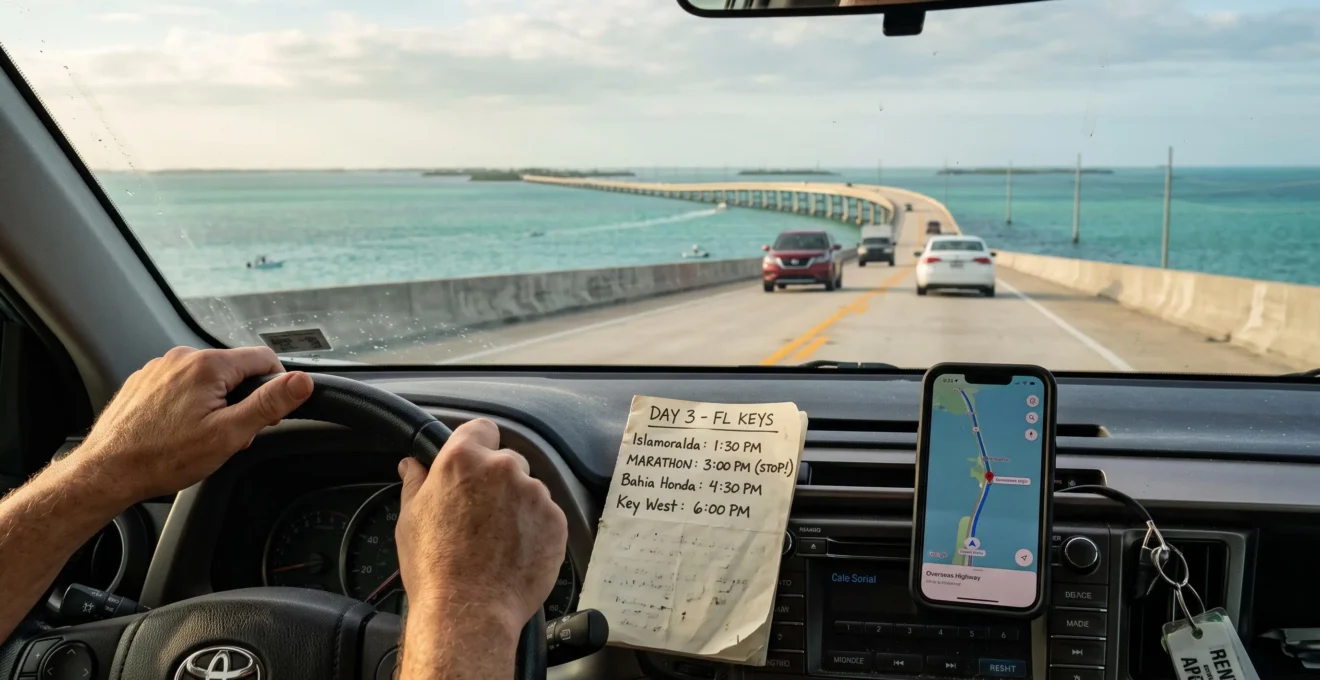
A memorable Florida weekend road trip doesn’t require crossing the state. It requires choosing a destination close enough to leave room for swimming, exploring, dining, and enjoying the people traveling with you. For a two-day escape, the difference between a manageable coastal drive and an ambitious cross-state itinerary can determine whether Sunday feels relaxing or exhausting.
The most effective approach is to start with your available leisure hours, establish a realistic driving budget, and select a route that fits your departure city. Miami opens the door to the Upper Florida Keys, Tampa makes Gulf Coast beaches convenient, Jacksonville provides access to historic Atlantic destinations, and Orlando offers several coastal options with different traffic considerations.
Rental pickup times, parking arrangements, weekend congestion, and return deadlines also deserve attention before departure. A carefully chosen route can be more enjoyable than a longer itinerary packed with attractions, especially when the goal is spending quality time together rather than collecting highway miles.
Florida weekend road trip essentials
- Choose by driving time: Select a destination based on your starting city and the leisure hours remaining after the round-trip drive.
- Protect your destination time: Plan one primary activity each day, avoid unnecessary detours, and check traffic conditions before leaving.
- Rent strategically: Match your pickup and return times to your actual travel schedule, including fuel stops, parking, and possible delays.
- Why Does Your Starting City Matter for a Two-Day Florida Escape?
- How to Plan a Weekend Drive From Miami to the Upper Florida Keys?
- St. Augustine or Clearwater: Which Is Better for a Relaxed Weekend?
- Which Weekend Road Trip Mistakes Waste the Most Vacation Time?
- When Should You Leave Orlando for a Weekend Beach Trip?
- How to Plan a Multi-City Florida Road Trip With One Rental Car?
- How to Schedule a 24-Hour Rental Without Paying for Extra Time?
- When Does a Short-Term Car Rental Make Sense for a Florida Visit?
Why Does Your Starting City Matter for a Two-Day Florida Escape?
Your starting city determines which Florida weekend destinations leave enough time for actual relaxation. A beach or historic town that feels nearby from one city may require most of another traveler’s weekend to reach. Setting a realistic round-trip driving budget before choosing attractions helps protect leisure time and prevents an enjoyable getaway from becoming an exhausting highway itinerary.
Think of the weekend as a limited supply of usable hours. Subtract sleep, meals, check-in, and travel from the time available between departure and return. What remains is your drive-time budget: the amount of travel you can reasonably accept without sacrificing the experiences that motivated the trip.
For a hypothetical Saturday-morning-to-Sunday-evening getaway, a couple might decide that two to three hours of driving in each direction is their preferred limit. This is a planning preference, not a universal threshold. Travelers who enjoy scenic driving may choose differently, while anyone prioritizing beach time may prefer a shorter route.
Florida’s major departure cities naturally favor different types of escapes.
| Starting city | Convenient trip types | Practical planning advantage |
|---|---|---|
| Miami | Upper Florida Keys, snorkeling, reef activities, waterfront dining | Direct access toward Key Largo and Islamorada without crossing Central Florida |
| Orlando | Cocoa Beach, Cape Canaveral area, nearby attractions, selected Gulf Coast escapes | Several coastal choices with different driving distances |
| Tampa | Clearwater, Gulf beaches, coastal communities | Shorter access to nearby Gulf Coast destinations |
| Jacksonville | St. Augustine, Atlantic beaches, historic towns | Nearby opportunities to combine coastal scenery with walkable historic districts |
Consider the Florida Keys. From Miami, a trip to Key Largo can accommodate a snorkeling excursion, waterfront dinner, and a leisurely morning before returning. From Orlando, reaching the same destination requires substantially more driving, leaving less time for those activities. The destination has not changed, but the weekend experience has.
The starting point also affects rental logistics. Picking up a car near your hotel or actual departure point may avoid an unnecessary journey to an airport counter. Conversely, an airport pickup can be convenient when arriving by plane and immediately heading out of town.
Compare the total pickup journey, branch opening hours, fees, and the direction of your route rather than assuming one location is always faster.
Once the departure city is settled, a straightforward corridor such as Miami to the Upper Keys becomes easier to organize around experiences instead of mileage.
How to Plan a Weekend Drive From Miami to the Upper Florida Keys?
A two-day Miami-to-Upper-Keys road trip works best as a southbound journey through Key Largo, Tavernier, and Islamorada, followed by a return along the same highway. Choose one primary activity, limit secondary stops, and set a return deadline before departure. Because U.S. 1 carries traffic through the Keys, leave flexibility for congestion rather than relying on a fixed arrival time.
The route generally follows the Florida Turnpike south toward Florida City before continuing on U.S. 1, the Overseas Highway. The Florida Keys travel and driving information identifies Key Largo around mile markers 108–90 and Islamorada around mile markers 90–63.
These mile markers make it easier to organize a one-road corridor itinerary. Instead of repeatedly leaving the highway for disconnected attractions, move through the Upper Keys in geographic order.
A practical two-day itinerary could follow this structure:
| Stage | Recommended activity | Planning allowance |
|---|---|---|
| Saturday morning: Miami to Key Largo | Drive south, stop for breakfast if needed, and reach your booked water activity | Allow extra time for traffic and equipment preparation |
| Saturday midday: Key Largo | Snorkeling excursion, marine experience, or waterfront relaxation | Approximately 2–4 hours as a flexible activity allowance |
| Saturday afternoon: Tavernier to Islamorada | Continue south, check in, and enjoy a waterfront stop | Keep the schedule light |
| Saturday evening: Islamorada | Sunset and dinner near your accommodation | Minimize additional driving |
| Sunday morning: Upper Keys | Breakfast, kayaking, or a relaxed coastal activity | Reserve an unhurried morning |
| Sunday afternoon: Return to Miami | Travel north with planned rest and fuel stops | Use current traffic and daylight conditions to set departure |
The activity allowances are illustrative rather than verified travel durations. Boat departures, weather, parking availability, and traffic may require adjustments. Reserving a timed excursion before adding sightseeing stops helps avoid conflicts.
Keep essential gear accessible: swimwear, towels, reef-appropriate sun protection, reusable water bottles, water shoes, and any equipment required by your booked operator. Check whether snorkeling equipment is included before bringing your own.
For driving logistics, review the rental company’s toll-payment arrangements. The Florida Turnpike Extension and Card Sound Road use electronic toll collection, but rental providers may impose different service charges. Check the vehicle’s fuel level around Florida City and the larger Upper Keys communities rather than assuming every smaller stop has a convenient station.
There is no single verified last fuel station that every traveler must use. The practical approach is to identify a suitable station before departure and retain enough fuel for unexpected slow traffic.
Islamorada can serve as a useful planned turning point for a short Upper Keys weekend. This is an itinerary choice, not a geographic point of no return. Continuing toward Marathon or Key West adds distance and can reduce time for relaxation.
On Sunday, work backward from your desired Miami arrival and check current northbound traffic. For example, a traveler hoping to arrive before dusk should calculate the estimated drive, add a delay allowance, and leave Islamorada accordingly. No fixed departure hour guarantees a daylight arrival.
A successful Keys escape balances water activities with realistic return logistics. Travelers seeking a different atmosphere can apply the same principle when choosing between Florida’s historic towns and Gulf Coast beaches.
St. Augustine or Clearwater: Which Is Better for a Relaxed Weekend?
St. Augustine is generally the better choice for couples seeking history, walkable streets, and restaurants within a compact downtown. Clearwater suits travelers whose ideal weekend revolves around beach time, Gulf Coast scenery, and sunset views. The more relaxing choice depends on your starting city, tolerance for crowds, accommodation location, and whether you prefer walking between attractions or driving along the coast.
These destinations offer different vacation rhythms. St. Augustine encourages visitors to settle into one area, while Clearwater and its surrounding beach communities may involve more movement between accommodations, restaurants, and coastal stops.
| Decision factor | St. Augustine | Clearwater |
|---|---|---|
| Overall atmosphere | Historic streets, architecture, museums, dining | Sandy beaches, Gulf views, waterfront dining |
| Best weekend activity | Walking through the historic district | Swimming, beach relaxation, sunset viewing |
| Driving after arrival | Potentially minimal when staying downtown | May involve short coastal trips, depending on accommodation |
| Rental considerations | Convenient overnight parking near lodging | Beach parking, repeated short drives, possible parking fees |
| Useful departure region | Jacksonville and Northeast Florida | Tampa Bay and nearby Gulf Coast communities |
| Possible drawback | Busy historic streets and heat during extended walking | Crowded beach access and heavier demand near sunset |
For a couple interested in architecture, cafés, and leisurely evening walks, staying close to St. Augustine’s historic center may eliminate the need to use the car throughout much of the visit. A convenient parking arrangement can matter more than having a vehicle available for every short journey.
Clearwater offers a different benefit: the opportunity to spend long stretches beside the water. If beach access is the priority, booking accommodation within walking distance of the sand may reduce the need to move the car during busy periods.
Seasonality can change the experience at either destination. Holiday weekends, school breaks, festivals, and popular evening hours may increase demand for parking and restaurants. Summer heat and humidity also make extended walking less comfortable for some travelers, particularly during midday.
For families or small groups carrying beach equipment, convenient vehicle access may be helpful. Couples traveling light may find a walkable location more relaxing, even if its accommodation price is higher.
Ask four questions before deciding: Is the main attraction history or swimming? How much walking in the heat feels comfortable? Can accommodation reduce parking hassles? Which destination requires less round-trip driving from the actual departure address?
Neither destination guarantees a crowd-free escape. Once the atmosphere is chosen, avoiding common scheduling mistakes often matters more than adding another attraction to the itinerary.
Which Weekend Road Trip Mistakes Waste the Most Vacation Time?
The biggest Florida weekend road trip mistakes are adding too many stops, departing without checking traffic, overlooking fuel and meal logistics, and choosing inconvenient rental pickup locations. Each mistake consumes time that could have been spent at the destination. The damage becomes especially noticeable on short getaways, where a delayed start or unnecessary detour can disrupt an entire afternoon.
These mistakes can be ranked by their likely effect on an individual itinerary, although no verified statewide study establishes a universal ranking.
- Overloading the itinerary: A supposedly quick attraction may require extra driving, parking, waiting, and walking. Several small detours can eliminate the day’s main leisure period.
- Ignoring traffic conditions: Congestion around major cities, highway incidents, and holiday travel can disrupt carefully planned arrival times.
- Skipping food and fuel planning: Searching for services at the last minute adds unnecessary stops, particularly on routes with fewer convenient options.
- Using an inconvenient rental branch: Traveling across a city to collect or return a car can add transportation time before the road trip even begins.
- Misunderstanding return requirements: Limited weekend hours, fuel policies, and after-hours procedures can create avoidable delays or charges.
A late-morning departure demonstrates how these problems compound. Consider a hypothetical trip scheduled to leave at 8 a.m. that instead begins at 10 a.m. The lost two hours may push arrival closer to lunchtime, interrupt a planned activity, and leave less flexibility if parking or check-in takes longer than expected.
Departure timing should not be based on assumptions that a specific hour is always congested. The Florida 511 traffic information service, operated by the Florida Department of Transportation, provides current information about congestion, incidents, construction, and travel times on monitored major routes.
Use that information before departure and again when making return decisions. It supports informed adjustments but does not predict every future weekend delay.
Another useful planning filter is the half-day rule: if an optional detour and its return journey would consume more than half of the leisure hours available that day, remove it or make it the main destination.
For example, imagine having six leisure hours on Saturday. An optional attraction requiring two hours of driving each way would use four of those hours before parking or visiting. By this rule, it should be dropped. A nearby stop requiring 20 minutes each way leaves substantially more leisure time.
Rental preparation also deserves a few minutes. Photograph the vehicle’s existing condition at pickup, check the fuel policy, confirm return instructions, and verify the branch’s weekend opening hours. These steps create a useful record and reduce the risk of resolving avoidable issues during the trip.
Five checks before your Florida weekend departure
- Calculate your available leisure hours after driving, sleep, and check-in. Record a maximum round-trip driving allowance.
- Choose one primary destination and remove unnecessary detours. Save a route with no more than a few planned stops.
- Review current traffic, fuel opportunities, and meal stops. Save a preferred departure window and one suitable service stop.
- Confirm rental pickup hours, return conditions, toll arrangements, and parking. Keep a screenshot or copy of the relevant booking details.
- Inspect and photograph the rental vehicle before departure. Save the photos and a final return-time reminder with a traffic and refueling buffer.
The goal is not to eliminate spontaneity. It is to preserve enough flexibility that unexpected traffic, an inviting restaurant, or an extra hour at the beach can fit without derailing the weekend.
When Should You Leave Orlando for a Weekend Beach Trip?
For an Orlando weekend beach trip, an early Saturday departure is a practical starting strategy because it preserves more daylight and beach time. A Friday-evening departure may work better for an overnight stay, provided the extra hotel cost makes sense. The best departure hour ultimately depends on your destination, current traffic, accommodation plans, and preferred Sunday return time.
Orlando offers access to both Florida coastlines, but the driving commitment differs considerably. According to VISIT FLORIDA‘s Orlando destination information, Cocoa Beach is approximately 60 miles east of Orlando, while Clearwater Beach is approximately 106 miles west.
These approximate distances help establish which destination may be more convenient. They do not represent fixed journey times or guarantee that either route will be free of congestion.
| Beach destination | Approximate distance or location | Weekend planning consideration |
|---|---|---|
| Cocoa Beach | Approximately 60 miles east | Shorter-distance option for Atlantic beach time and surfing |
| Cape Canaveral area | Atlantic Coast, near Cocoa Beach | Useful for combining coastal activities with nearby attractions |
| Clearwater Beach | Approximately 106 miles west | Gulf beach experience with a longer driving commitment |
For a single-day escape, Cocoa Beach may be the more comfortable choice because of its shorter approximate distance. Clearwater can make sense when travelers specifically want Gulf Coast scenery and are willing to devote more of the day to transportation.
There are three useful departure strategies.
- Early Saturday departure: Leave enough time for a full beach morning, lunch, and an afternoon activity. Check live traffic rather than relying on a guaranteed congestion-free hour.
- Friday-evening departure: Arrive near the coast before Saturday’s activities begin. Compare the additional accommodation cost with the convenience of waking up at the destination.
- Saturday overnight departure: Travel on Saturday and return Sunday, preserving a relaxed evening while allowing more flexibility for the second day’s activities.
The return deserves its own plan. For Gulf Coast journeys involving Interstate 4, review current conditions before leaving the beach. Sunday traffic may affect the drive, particularly around busy travel periods, but a precise recurring delay cannot be assumed.
Leaving mid-afternoon may provide more daylight for the return. Staying later can extend beach time, but it may also mean driving after dark. Neither approach is automatically faster.
A useful decision test compares round-trip driving with expected leisure time. If a hypothetical itinerary requires five hours behind the wheel but offers only three hours at the beach, consider a closer destination or an overnight stay.
Once the preferred coastal route is clear, travelers interested in seeing several Florida cities can use the same time-first approach to build a longer itinerary without accumulating unnecessary backtracking.
How to Plan a Multi-City Florida Road Trip With One Rental Car?
A multi-city Florida road trip works best when the itinerary follows a logical geographic direction and avoids repeated hotel changes. Choose two anchor cities, keep driving legs within your preferred daily limit, and place attractions along the connecting route. One rental car can simplify luggage transportation, but the best booking depends on whether returning to the original city is necessary or a one-way drop-off is available.
The first decision is whether the trip should form a loop or move in one direction.
A round-trip rental requires returning the vehicle to the agreed return location, typically in the original city. This can suit travelers flying into and out of the same airport, but the return journey must be included in the driving budget.
A one-way rental allows pickup and return at different locations when the rental provider permits it. Such reservations may include a drop-off charge, with pricing dependent on company, route, vehicle, and booking conditions. Compare the complete quoted price rather than assuming either option is cheaper.
Build the route in three stages:
- Choose your arrival city and final departure city. Confirm whether the itinerary must return to its origin.
- Select two anchor cities separated by a daily drive you would comfortably accept. For a leisure-focused trip, a personal target of two to three hours per major driving leg may be reasonable, but it is not a mandatory limit.
- Add intermediate stops only when they break up the journey or provide an experience worth the extra time. Avoid destinations that require significant backtracking.
Consider an explicitly hypothetical trip beginning in Jacksonville, visiting St. Augustine, and continuing toward Orlando. The route can move generally southward instead of requiring repeated trips between the same cities. Exact driving durations should be checked for the chosen addresses and travel dates.
Vehicle choice matters more when the car carries luggage between several hotels. Check the number of passengers, suitcase capacity, and comfort during longer driving legs. A small car may suit two travelers with light luggage, while a group carrying several large bags may need additional cargo room.
Check the rental agreement for authorized drivers, permitted travel areas, mileage provisions, and any applicable coverage restrictions. Do not assume insurance or credit card benefits automatically apply to every driver or itinerary.
Multi-city travel also has hidden time costs. Each hotel change involves packing, checkout, parking, and checking in elsewhere. Parking charges can accumulate across destinations, particularly when hotels charge separately for overnight vehicle storage.
For short trips, a single accommodation hub with carefully chosen excursions may offer more relaxation than changing hotels every night. For longer routes, moving accommodation can make sense when it eliminates substantial backtracking.
After deciding the route shape, the next planning question is how to align the rental period with the actual hours the vehicle will be needed.
How to Schedule a 24-Hour Rental Without Paying for Extra Time?
To fit a trip within a 24-hour rental, schedule pickup and return around the actual time you need the vehicle, not simply the beginning and end of your vacation. Work backward from the return deadline, include travel and refueling time, and verify the provider’s billing rules. A small delay can trigger extra charges, and grace periods differ between rental companies.
The rental clock generally follows the pickup and return times specified in the agreement. Collecting a vehicle earlier than necessary can consume paid rental time before the road trip begins, while an overly tight return schedule may create avoidable pressure.
Consider a hypothetical rental collected Saturday at 9 a.m. and due Sunday at 9 a.m. That booking spans 24 hours, but it does not automatically provide a full Saturday-and-Sunday leisure weekend. A Sunday afternoon return would fall outside that example’s original deadline.
For a longer weekend involving two evenings, the rental may need to exceed 24 hours. The objective should be to pay for the period actually required, not to force a 36- or 48-hour itinerary into an unsuitable one-day booking.
Use the following scheduling method:
- Identify the latest time the vehicle can be returned while the branch is accepting returns under your booking conditions.
- Estimate the drive back from the destination using the intended route and current or recently available journey information.
- Add a practical buffer for refueling, traffic, unloading, and inspecting the car. A 45–60-minute allowance is a planning example, not an official company requirement or guarantee.
- Calculate the latest safe departure from your final destination.
- Choose a pickup time and rental duration that accommodate the complete itinerary, including the planned return buffer.
For example, suppose a rental must be returned at 5 p.m. and the estimated journey back takes two hours. Adding a hypothetical one-hour buffer produces a planned destination departure of 2 p.m. The calculation is simple, but the buffer should increase when route conditions or return logistics are uncertain.
Rental companies do not all handle late returns identically. For example, Enterprise‘s U.S. late-return policy generally provides a 29-minute grace period for daily rentals. Under the circumstances described in that policy, later returns can produce hourly charges or an additional rental-day charge.
The Enterprise policy describes additional hourly charges after the grace period and an additional rental day when the applicable delay reaches 2.5 hours or more. These are company-specific provisions, not universal U.S. rental rules. Actual charges depend on the contract and the circumstances of the return.
After-hours drop-offs require particular care. A vehicle left when an Enterprise branch is closed is not checked in until the next business day, and the renter remains responsible until satisfactory check-in. Confirm whether after-hours return is available, when billing stops under the applicable agreement, and where the keys must be deposited.
If a trip may exceed its booked duration, compare the provider’s quoted extension cost with the applicable late-return charges and the price of another rental day. A grace period should not be treated as extra vacation time guaranteed at no cost.
Mileage and timing are separate considerations. An unlimited-mileage booking can reduce uncertainty about distance-based charges, but it does not automatically extend the rental period. A mileage-limited agreement requires checking both the distance allowance and return deadline.
When the actual trip requires a car for only part of the visit, the broader decision becomes whether a short-term rental is worthwhile compared with other ways of getting around Florida.
Key takeaways before booking your rental
- Count the hours when a vehicle is genuinely needed, including pickup, the return journey, and refueling, rather than paying automatically for the entire vacation.
- Compare total transportation expenses, not just the daily rental rate: parking, toll programs, taxes, coverage options, and extra-driver charges can change the result.
- Check branch operating hours and return conditions before committing to an itinerary, especially when the journey ends on Sunday or a holiday.
When Does a Short-Term Car Rental Make Sense for a Florida Visit?
A short-term car rental makes sense when a Florida visit includes a defined car-dependent excursion, such as a weekend beach escape, an overnight coastal trip, or several attractions that are inconvenient to reach without driving. It becomes less attractive when the destination is walkable, parking is expensive, or a longer rental or transportation alternative offers better overall value.
The useful decision threshold is not simply how many days you are visiting Florida. It is how many days actually require a car.
For example, a couple staying several nights in a walkable Miami neighborhood might use rideshares or local transportation for urban activities, then rent a car for a planned Upper Keys excursion. In another situation, travelers moving between several Florida cities may find that keeping one vehicle throughout the journey is more convenient.
Compare the realistic alternatives before booking.
| Transportation option | When it makes sense | Potential drawback |
|---|---|---|
| 24-hour rental | One concentrated day of car-dependent travel | A strict return deadline may limit the itinerary |
| Two-day or weekend rental | Overnight escape with driving on both days | Parking, fuel, taxes, and rental charges add to the total |
| Weekly rental | Frequent driving throughout a longer visit | May be unnecessary if the car sits unused for several days |
| Rideshare services | Occasional urban trips without overnight parking needs | Repeated journeys or longer distances can become expensive |
| Hotel shuttle or available local transport | Selected attractions, airports, or well-served urban areas | Routes, schedules, availability, and service areas may be limited |
For a meaningful comparison, calculate the complete transportation cost:
- Rental base rate and applicable taxes.
- Airport concession fees or other location-related charges, when applicable.
- Insurance or optional protection products, considering whether personal auto insurance or credit card benefits apply to the specific rental.
- Fuel, tolls, and any rental-company toll-processing fees.
- Hotel and destination parking charges.
- Young-driver, additional-driver, mileage, or one-way fees where applicable.
Personal insurance and credit card rental protection vary by policy, issuer, vehicle, driver, and location. Review the relevant terms rather than assuming coverage is included or duplicated.
Group size can shift the calculation. For a small group sharing one appropriately sized car, the total vehicle cost may compare favorably with several separate rideshare journeys. For a couple staying in one compact district, renting and parking a car might offer little additional convenience.
Pickup timing also matters. Collecting a car late Friday afternoon and returning it Sunday evening may suit a full-weekend itinerary, but that interval exceeds 24 hours. It should be priced according to the rental company’s actual billing rules rather than treated as a one-day rental.
Similarly, a mid-morning pickup is not inherently more expensive. It becomes inefficient when it forces a return deadline that conflicts with the desired schedule or creates a longer paid period than necessary.
Short-term renting works especially well when the trip has a defined beginning, destination, and return plan. It offers flexibility for beach equipment, group travel, and attractions beyond convenient public transportation, provided the additional costs remain worthwhile.
Start with the experiences worth leaving town for, select a destination that fits the available leisure hours, and request a rental quote covering the complete trip. Compare that total with the realistic alternatives, then reserve enough flexibility for traffic, meals, and the return journey. The best Florida weekend road trip is the one that leaves you with more time enjoying Florida than planning how to get back.
How many destinations should a two-day Florida road trip include?
For a relaxed two-day trip, one main destination with one or two nearby secondary stops is usually a practical starting point. The ideal number depends on driving distance, activity reservations, and how much time each stop requires. Prioritize experiences rather than trying to visit as many towns as possible.
Are Florida weekend road trips practical without using toll roads?
Some Florida weekend routes have toll-free alternatives, but avoiding toll roads can increase driving distance or travel time. Compare available routes before departure and check the rental company’s toll-payment terms. For short weekends, the additional travel time may outweigh the money saved.
What should travelers do if bad weather affects a Florida beach weekend?
Check the weather forecast and any relevant official advisories before departure, particularly when planning boating, snorkeling, or outdoor coastal activities. Keep an indoor alternative available, review cancellation conditions, and avoid driving through hazardous weather. A flexible itinerary can accommodate changes without sacrificing the entire weekend.
Is it better to book a hotel near the beach or stay farther away with free parking?
Compare the accommodation price difference with the cost of destination parking, fuel, and repeated drives. A walkable beachfront hotel may be worth more when beach time is the main priority, while accommodation farther inland can work well when visiting several attractions. Include the convenience of unloading luggage and beach equipment in the decision.
Can a rental car be returned to a different Florida city?
Many rental providers offer selected one-way bookings between locations, but availability, eligible vehicles, and additional charges depend on the company and route. Enter the actual pickup and return branches when requesting a quote. Confirm the return location and any associated fees before finalizing the reservation.