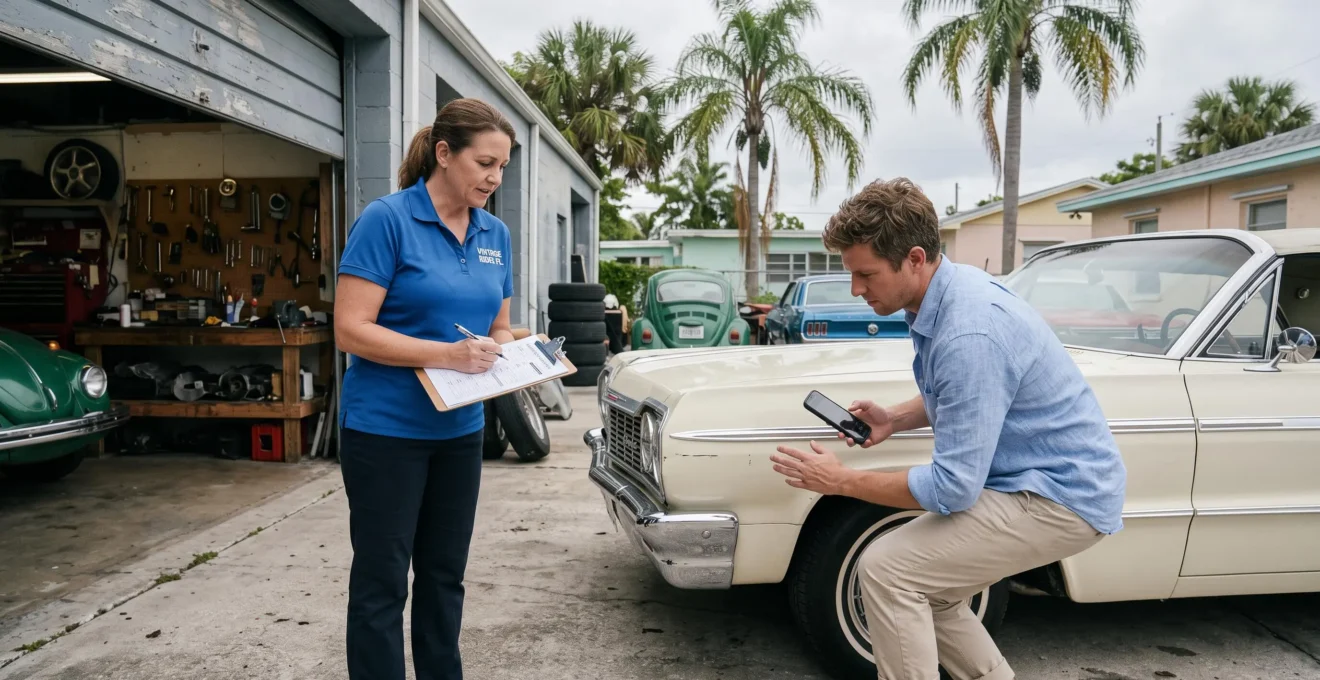
A classic car can transform a Florida wedding, anniversary, photoshoot, or private celebration into a memorable occasion. However, renting a vintage vehicle involves considerations that rarely arise with a modern rental car. Mechanical condition, driver eligibility, insurance arrangements, weather protection, and delivery logistics can all determine whether the experience unfolds as intended.
Before booking, establish exactly how the vehicle will be used: driven by a guest, operated by a professional chauffeur, or delivered for stationary photographs. Then inspect its condition, confirm the authorized drivers and applicable coverage, and obtain written terms for delays, breakdowns, rain, and vehicle substitution.
The distinction matters because a beautifully restored automobile may retain original mechanical characteristics, limited weatherproofing, or fragile interior materials. Its historical appeal does not necessarily translate into modern convenience or safety. For couples, collectors, and event planners, the most appropriate rental is therefore not simply the most striking car, but one whose condition and operating requirements fit the occasion.
Essential checks before booking a Florida classic car
- Verify mechanical readiness: inspect the specific vehicle, confirm its safety equipment, and assess whether the designated driver can operate it confidently.
- Confirm contractual protection: establish insurance responsibilities, permitted use, mileage restrictions, deposits, and breakdown arrangements in writing.
- Plan for the event itself: account for Florida weather, realistic travel times, approved decorations, and an alternative if the vehicle becomes unavailable.
- Why Do Classic Cars Drive Differently From Modern Rental Vehicles?
- How to Inspect a Vintage Rental Car Before a Wedding Drive?
- Driving Rental or Static Display: Which Fits a Classic Car Event?
- What Can Florida Humidity and Rain Mean for a Vintage Car Rental?
- When Should a Classic Car Arrive Before a Wedding Ceremony?
- Which Decorative Accessories Can Damage a Classic Rental Car?
- Which Luxury Car Rental Restrictions Can Limit Your Driving Plans?
- Which Car Styling Details Create an Elegant Arrival at Special Events?
Why Do Classic Cars Drive Differently From Modern Rental Vehicles?
Classic cars can feel substantially different from modern rentals because steering, braking, transmission design, visibility, and occupant protection have evolved over decades. Depending on its model and modifications, a vintage vehicle may require greater steering effort, earlier braking, and more deliberate gear changes. Renters should confirm the particular car’s equipment and assess driver competence before committing to an event journey.
Some older automobiles lack power steering, making tight turns and low-speed parking physically demanding. Vehicles equipped with drum brakes may respond differently from those with modern disc-brake systems, although actual braking performance depends on maintenance, tires, road conditions, and the vehicle’s design.
Early manual transmissions may have unsynchronized gears, requiring techniques unfamiliar to drivers accustomed to modern synchromesh gearboxes. Even an automatic classic may have different throttle response, steering feedback, and transmission behavior.
Age alone does not determine a vehicle’s capabilities. Restored classics sometimes incorporate upgraded brakes, steering assistance, or revised drivetrains. Ask the rental company to identify which systems remain original and which have been modified.
Safety equipment deserves separate attention. The NHTSA overview of vehicle safety improvements explains how occupant protection and technologies such as airbags and electronic stability control developed over time. The equipment fitted to an individual classic must still be verified rather than inferred from its appearance or model year.
Before approving a self-drive rental, assess whether the designated driver is comfortable with the vehicle’s actual braking, steering, visibility, seat belts, and available safety systems. Where the company permits it, a supervised familiarization drive before the event can reveal difficulties that photographs cannot.
Choose a route suited to the car’s capabilities. Calmer local roads may be preferable to congested expressways, particularly where the vehicle has limited rearward visibility or requires more conservative braking. Evaluate traffic conditions and safe stopping opportunities rather than assuming that every classic has the same limitations.
Finally, confirm the driver’s age, licensing eligibility, authorization, and insurance conditions. A conventional rental history does not establish eligibility for a specialty vehicle.
If the driving experience creates avoidable uncertainty, a chauffeur-operated arrangement may preserve the occasion’s character while reducing the demands placed on guests. The next priority is establishing whether the chosen car is mechanically and cosmetically ready.
How to Inspect a Vintage Rental Car Before a Wedding Drive?
Inspect a vintage wedding rental by checking tires, brakes, lights, wipers, fluid leaks, maintenance records, and visible bodywork before accepting the vehicle. Photograph existing imperfections and complete a signed condition report with the provider. Because older cars may contain original or aging components, mechanical documentation and a written breakdown contingency are especially important before an event with a fixed schedule.
Start with the tires. Examine tread condition, sidewall cracking, visible damage, and inflation information. Ask about tire age and inspect the spare, if the vehicle carries one. Adequate tread alone does not establish that older rubber is suitable for driving.
Next, request confirmation that the brakes have been inspected and are functioning appropriately. Check exterior lights, turn signals, windshield wipers, and any fitted defogging equipment. Look beneath the vehicle for unexplained fluid accumulation, distinguishing documented characteristics from leaks requiring attention.
These checks should not replace a qualified mechanic’s assessment. If the car exhibits concerning braking behavior, damaged tires, or an unexplained mechanical problem, do not proceed with a self-drive rental until the issue has been professionally resolved.
Ask to review available maintenance documentation, including recent mechanical work and restoration records. A rebuilt engine may improve certain aspects of reliability, but it does not establish the condition of the cooling system, suspension, electrical components, or brakes. Request the date and scope of the most recent professional inspection.
Cosmetic condition also matters. Photograph the paint, chrome, wheels, glass, upholstery, dashboard, and convertible roof where applicable. Use timestamped images and a signed condition report to establish which scratches, dents, or wear marks existed before pickup.
Two contractual questions deserve particular attention: whether roadside assistance and vehicle recovery are included, and whether the exact automobile advertised is guaranteed. Some agreements may permit substitution, so confirm whether a replacement could differ in model, color, body style, or condition.
Five checks to complete before accepting a vintage rental
- Verify tires and basic safety equipment: obtain a completed vehicle inspection record covering tires, brakes, lights, and wipers.
- Review maintenance evidence: request a dated summary of recent servicing, restoration work, and known mechanical limitations.
- Document existing damage: create a timestamped photo set and obtain a condition report signed by both parties.
- Confirm breakdown arrangements: obtain written roadside assistance contacts, recovery procedures, and the proposed event-day contingency.
- Secure vehicle identity: obtain booking confirmation identifying the actual car and explaining any permitted substitution.
A satisfactory inspection establishes a stronger basis for the booking, but it cannot guarantee that an older vehicle will operate without interruption. That residual uncertainty should influence whether the car is driven or simply displayed at the event.
Driving Rental or Static Display: Which Fits a Classic Car Event?
A driving rental suits people who want to experience a classic vehicle on the road, while a static display is generally better when the car is primarily needed for an entrance backdrop or photographs. Driving introduces route, mileage, driver authorization, and insurance considerations. Static arrangements may reduce those exposures, but delivery, placement, staffing, and event access still require careful coordination.
The distinction affects more than convenience. A self-drive package commonly transfers specific operational responsibilities to an authorized renter. A chauffeur arrangement places driving duties with a designated operator, subject to the company’s contractual and insurance arrangements. A stationary display may involve no guest driving at all.
The following comparison provides a practical starting point, although individual rental providers can structure their packages differently.
| Decision factor | Driving rental | Static display |
|---|---|---|
| Main purpose | Transportation and driving experience | Photography, entrance setting, or exhibition |
| Driver requirements | Authorized driver and applicable coverage | Guest driving generally unnecessary |
| Mileage | Potential mileage cap and additional charges | Usually centered on delivery and collection logistics |
| Primary exposure | Road use, mechanical interruptions, and driving-related damage | Placement, guest contact, handling, and stationary damage |
| Typical pricing basis | Daily or agreed rental period | Event duration, delivery, collection, and possible staffing |
| Planning priority | Route, parking, driver eligibility, and contingency transport | Venue access, display location, protection, and collection timing |
Static display is not automatically cheaper. Specialized transport, waiting time, difficult venue access, or extended staffing can offset savings from reduced driving. Likewise, a chauffeur-driven wedding package may be priced differently from a daily self-drive arrangement.
For an accurate comparison, request itemized quotes covering the vehicle, rental duration, delivery, collection, mileage, chauffeur services, waiting time, coverage, and applicable taxes or fees. Compare the total cost against the time the car will actually be needed.
For example, in a hypothetical wedding where the automobile is needed only for portraits and an entrance photograph, a delivered display could be more practical than hiring it for an entire day. If the couple wants a scenic drive afterward, the benefits of an approved driving package may justify additional planning.
Be precise about permitted usage. Do not assume that a stationary-display contract authorizes even a short drive around the venue. Ask how an unauthorized change of use would affect coverage, responsibility for damage, and other contractual protections.
The most suitable arrangement is the one that delivers the desired experience without introducing unnecessary logistical exposure. In Florida, weather resilience is a significant part of that decision, particularly for open-top vehicles.
What Can Florida Humidity and Rain Mean for a Vintage Car Rental?
Florida’s humid conditions and seasonal thunderstorms can complicate vintage car rentals through water intrusion, window fogging, convertible roof limitations, and moisture-sensitive electrical components. These risks depend on the vehicle’s restoration and maintenance rather than its age alone. Before booking, inspect weather seals and roof operation, confirm covered parking, and establish written arrangements for rain-related changes.
According to the National Weather Service information on Florida’s thunderstorm season, the rainy season generally extends from May 15 to October 15 in southwest Florida and from May 25 to October 10 in the remainder of west-central Florida covered by its Tampa Bay office. Conditions are typically warm and humid, with frequent showers and thunderstorms. These regional periods are climatological guidance, not fixed dates for all of Florida or forecasts for a particular event.
Older convertible roofs may require manual operation or careful alignment before their latches engage. Weather seals can harden or deteriorate, and older ventilation systems may offer less effective window clearing than modern climate controls.
Similarly, electrical connections and wiring in poorly maintained vehicles can be vulnerable to moisture. Restoration quality and current condition are more informative than the model’s age when evaluating these concerns.
For a convertible, request a roof demonstration and ask about previous water ingress. Determine whether the top can be operated safely by guests or must be handled by rental staff. Never assume a vintage soft top can be closed quickly enough to protect passengers during an approaching storm.
Arrange covered pickup, passenger loading, and photography locations where feasible. A nearby indoor or sheltered alternative is particularly useful when the celebration cannot be rescheduled.
Humidity also influences presentation. Chrome, leather, wood veneers, and older upholstery may require careful storage and cleaning. Confirm whether the rental agreement requires overnight covered parking or restricts exposure to rain, and identify who is responsible for any associated arrangements.
Most importantly, obtain the company’s rain policy in writing. Establish whether postponement, cancellation, an enclosed substitute vehicle, or a change from driving to display is possible, and what financial consequences apply. These remedies depend on the contract rather than on a universal Florida rental rule.
Weather planning should preserve both passenger safety and the vehicle’s condition. Once a workable weather alternative exists, the event schedule can be built around realistic travel and photography requirements.
When Should a Classic Car Arrive Before a Wedding Ceremony?
A classic wedding car should arrive early enough for a condition check, passenger preparation, planned photography, and a realistic travel buffer before the ceremony. There is no reliable universal arrival interval: the appropriate lead time depends on venue access, driving distance, mechanical requirements, and the photography schedule. Work backward from the ceremony rather than relying on a standard rental delivery window.
Begin with the time the couple must be ready at the ceremony location. Subtract the time allocated to arrival portraits, passenger unloading, and final preparations. Then account for the planned journey using a pace suitable for the specific vehicle and route.
Add a separate allowance for traffic, difficult parking, vehicle inspection, and potential mechanical interruptions. A classic transported to the venue may also require unloading, positioning, or a short operational check before it can be used.
For example, consider a hypothetical ceremony beginning at 4:00 p.m. Suppose the photography team wants 25 minutes for vehicle portraits, passenger loading and unloading require 10 minutes, the planned journey takes 20 minutes, and the event team reserves another 30 minutes for traffic and operational uncertainty. Under those assumptions, the car would need to be ready for the planned sequence by approximately 2:35 p.m. Any delivery inspection or unloading time would need to occur beforehand.
This is a planning illustration, not an industry-standard arrival time. The actual schedule should be agreed with the rental company, venue, photographer, and wedding coordinator.
Older vehicles may lack effective air conditioning, making extended waiting uncomfortable during hot Florida weather. A driver may also need additional time to prepare the engine or complete a post-transport check. These requirements should be confirmed for the particular automobile rather than assumed.
Coordinate the arrival photograph carefully. Identify where the vehicle may stop, whether the photographer needs a particular approach angle, and whether the chauffeur should park immediately afterward. Make sure the chosen stopping point does not obstruct emergency access or other venue operations.
Finally, distinguish the vehicle’s scheduled delivery time from the beginning of billable service. For hourly packages, clarify whether waiting, early positioning, or photography counts toward the rental period. Ask what happens if the provider arrives late, including any adjustment, replacement, or refund expressly available under the agreement.
A reliable timeline protects more than punctuality: it prevents an otherwise elegant vehicle from becoming a source of last-minute pressure. Once the schedule is settled, decorations should be assessed with equal care.
Which Decorative Accessories Can Damage a Classic Rental Car?
Adhesive tape, magnetic signs, tightly secured ribbons, glitter, and spray-on decorations can damage a classic rental car’s paint, trim, or interior. Original finishes and aging materials may be particularly sensitive to contact and cleaning. Before decorating, obtain the rental company’s written approval for the exact materials, attachment points, and removal procedure.
Adhesives can leave residues or disturb delicate paint and clear coats, especially where a vehicle has undergone restoration or cosmetic repair. Products marketed as removable are not automatically suitable for older finishes.
Magnetic decorations present a different issue. They may not attach to aluminum, fiberglass, or other nonferrous panels. On compatible metal panels, trapped particles or movement can still scratch the surface.
Ribbons tied around mirrors, antennas, door handles, or chrome ornaments may create abrasion or unwanted stress. Decorative arrangements must never obstruct the driver’s view, vehicle lights, license plate, steering components, or safe access to the cabin.
Decoration permission and insurance protection are separate questions. If renter-installed accessories cause damage, responsibility may fall on the renter under the contract. Do not assume that a collision damage waiver or personal insurance policy covers paint removal, damaged trim, or cleaning fees. Obtain the provider’s specific liability terms before approving the design.
Safer possibilities include floral arrangements secured with approved soft ties, company-authorized clips, or removable accessories designed for the particular vehicle. Interior vase holders or freestanding decorations may also be suitable where they do not interfere with occupants or vehicle operation.
For valuable finishes, the simplest solution is often to have the rental company install and remove the decorations. This creates a clearer responsibility arrangement and reduces the chance of an inexperienced decorator handling fragile components.
Do not overlook cleanup. Glitter, confetti, loose petals, adhesives, and spray products can become lodged in vintage fabric, carpeting, or delicate upholstery. Cleaning may require specialized treatment, and charges depend on the rental terms and the actual condition at return.
Share the proposed decoration materials and placement photographs with both the florist and rental company. Ask for written approval of the complete design rather than relying on verbal consent to decorate the car generally.
Preserving the vehicle’s finish is part of creating a refined presentation. However, cosmetic care alone does not resolve the financial and operational restrictions that can determine whether a planned drive is permitted.
Which Luxury Car Rental Restrictions Can Limit Your Driving Plans?
Classic and luxury vehicle rental agreements may restrict driver age, authorized operators, mileage, travel boundaries, passengers, pets, and vehicle use. Insurance conditions, security deposits, and payment-card holds can also affect the real cost of a booking. Because requirements vary by provider and vehicle, renters should verify every restriction in the written agreement before finalizing their route or event budget.
The FTC consumer advice on renting a car recommends examining total costs, mileage conditions, additional-driver charges, insurance arrangements, roadside assistance, and cancellation policies. Its guidance concerns U.S. rentals generally; it does not establish uniform conditions for classic cars in Florida.
Start with eligibility. Some providers may set their own minimum ages, impose young-driver surcharges, or require particular documentation. The FTC references age 25 as a standard minimum in general rental guidance while acknowledging that some major companies accept younger drivers with additional charges. That is not a universal legal minimum for Florida classic rentals.
Only drivers expressly authorized by the agreement should operate the car. Allowing an unapproved guest to drive may affect contractual protections, including damage waivers.
Next, map the intended journey. Check mileage caps, excess-mile charges, permitted counties or states, and any restrictions on highways, unpaved roads, or overnight storage. A route suitable for an ordinary rental may fall outside the permitted use of a specialty vehicle.
Insurance requires direct verification. Personal auto policies and credit card rental benefits should not be presumed to cover vintage, antique, collectible, or exotic automobiles. Ask the insurer or card issuer whether the specific vehicle and intended use are eligible.
Florida Statutes section 627.7263 addresses the priority of certain rental-vehicle liability and personal injury protection coverages, including prescribed contractual wording when the authorized driver’s insurance is designated as primary. It does not determine every damage exclusion or establish that a renter’s personal policy covers a classic car.
Ask which liability coverage applies, whether a collision or loss damage waiver is offered, and what exclusions, deductibles, and responsibility limits remain. A damage waiver is not necessarily equivalent to liability insurance for injury or third-party property damage.
Budget for the payment-card hold as well as the advertised rental charge. Holds may exceed the rental price and can temporarily reduce available funds. Confirm the hold amount, accepted payment method, deposit conditions, and expected release process with the provider and payment-card issuer.
Finally, check passenger capacity and cabin-use restrictions. Confirm the number of usable, legally permitted seating positions and appropriate restraints for the intended occupants. Smoking, pets, food, and beverages may also be restricted because damage or odors can be difficult to remove from older interiors.
The most visually appealing choice is not necessarily the most practical one. Once eligibility, coverage, and permitted use are settled, styling can become the deciding factor without compromising preservation or event logistics.
Key considerations before choosing the final look
- Prioritize verified condition: recent photographs of the actual vehicle are more useful than promotional images of an equivalent model.
- Design around real access requirements: gowns, passenger mobility, parking clearance, and photographer positioning can influence the ideal body style.
- Approve the complete presentation: exterior accessories, chauffeur attire, and vehicle placement should align with the rental company’s preservation requirements.
Which Car Styling Details Create an Elegant Arrival at Special Events?
An elegant classic car arrival depends on a coherent combination of vehicle era, body style, color, condition, and event setting. A polished automobile that complements the venue and allows comfortable passenger access often creates a stronger impression than a rarer but poorly presented model. Choose styling details that support photography, practical movement, and preservation rather than decoration alone.
Begin with the relationship between the car and the occasion. A restrained prewar sedan may complement a formal historic venue, while a refined mid-century convertible could suit a coastal celebration. These are aesthetic possibilities, not fixed rules: the surrounding architecture, dress code, and couple’s preferences should guide the choice.
Color also affects the visual result. Cream, black, deep blue, silver, and other period-appropriate finishes can interact differently with floral palettes, wedding attire, and natural light. Evaluate the actual vehicle in recent photographs rather than relying solely on a catalog description.
The body style has practical implications. Convertibles provide an open composition for photography but increase weather exposure. Closed sedans offer more protection, although door openings, seat height, and cabin space vary considerably.
For formal attire, test passenger entry and exit where possible. Wide skirts, long trains, and structured dresses can make narrow door openings awkward. Running boards may help with positioning on some vehicles but can also introduce a step that requires assistance. Confirm that doors can open safely at the planned stopping location.
Photographic composition deserves advance attention. The vehicle’s grille, hood line, roof profile, and exterior color influence how it frames the couple. Discuss whether the preferred photographs show the arrival in motion, passengers stepping out, or the car positioned beside the venue.
Do not assume that every hood or trunk can support decorations, equipment, or people. Placement must be approved by the rental provider, and no one should sit or lean on delicate body panels without explicit permission.
Presentation quality often matters more than rarity. A carefully maintained classic with consistent paintwork, clean chrome, and a suitable silhouette may photograph more convincingly than a scarce model with visible cosmetic deterioration. Request recent, unedited images of the actual car, including its interior and both sides.
Coordinate the final styling with the provider before the event. Confirm approved ribbons and flowers, chauffeur dress expectations, passenger access, parking position, and the time available for photography. Where a chauffeur is included, establish whether their attire is specified in the package or can be agreed separately.
Request a final written confirmation identifying the vehicle, approved styling, usage arrangement, delivery schedule, and contingency plan. With those details agreed, the classic car can contribute to the occasion without placing its condition, the guests, or the event timetable at unnecessary risk.
Can a classic rental car be used only for wedding photographs?
Yes, if the provider offers a stationary-display or photography package. Confirm whether delivery, positioning, supervision, collection, and the agreed display period are included. A display-only booking should not be treated as authorization to drive the vehicle.
Should a classic wedding car have a backup transportation option?
A backup is advisable when the vehicle plays an essential transportation role. Even a properly maintained classic can encounter an unexpected issue. Arrange alternative transport for time-sensitive journeys and ask whether the rental provider guarantees a replacement, offers a refund, or has another contractual remedy.
Does the rental price normally include insurance and roadside assistance?
Not necessarily. The base rate may include certain protections while excluding optional coverage, roadside assistance, deductibles, or other charges. Request an itemized quotation and verify which protections apply to the exact vehicle, authorized driver, and intended event use.
What happens if the reserved classic car is unavailable on the event day?
The outcome depends on the contract. The provider may offer a replacement vehicle, rescheduling, a refund, or another agreed remedy. Before booking, establish whether the exact model and color are guaranteed and whether you can reject a substitute that does not meet the event’s requirements.
Can a vintage rental be transported to a venue without being driven by the renter?
Yes, where the rental provider offers vehicle delivery or a chauffeur-operated service. Confirm the transport method, unloading arrangements, venue access requirements, responsibility during positioning, and collection schedule. This option can suit events where the vehicle’s appearance matters more than the driving experience.