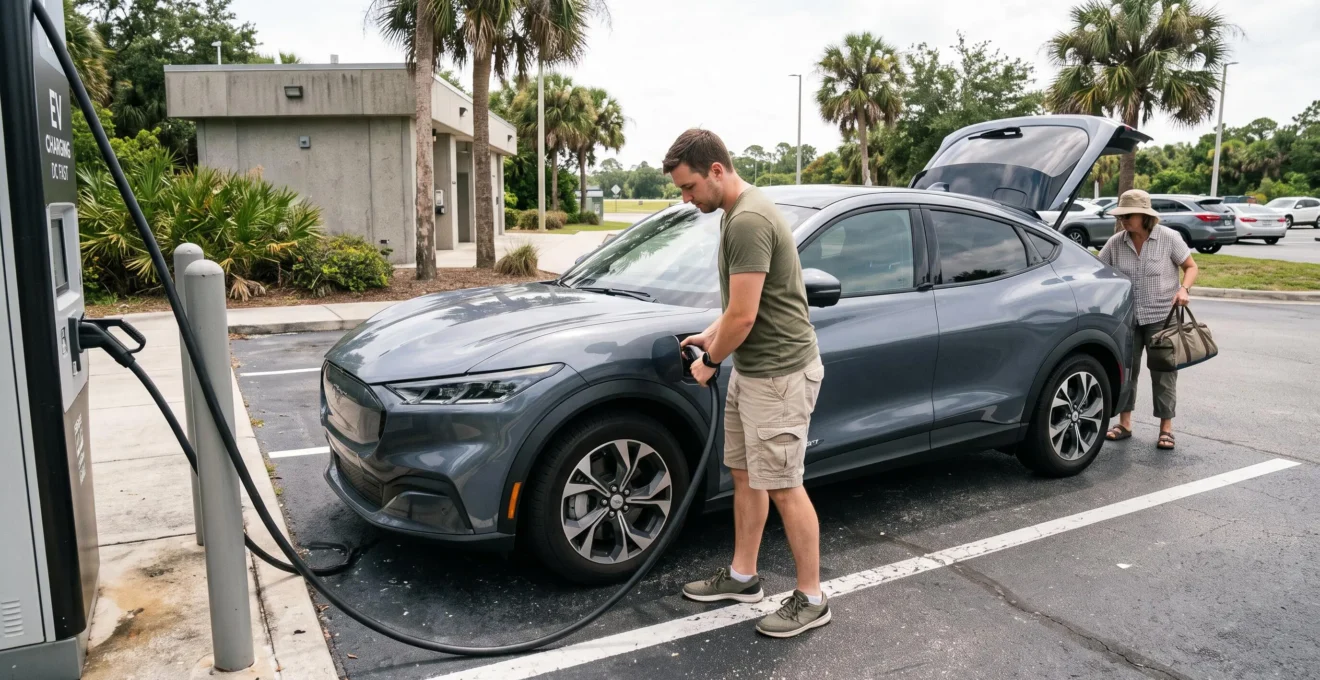
An electric rental car can be a practical choice for a Florida road trip, provided its real-world driving range, charging compatibility, and access to reliable charging stations fit the itinerary. It is particularly convenient when overnight accommodation provides dependable charging or when longer driving days include suitable charging stops.
Florida’s major highways connect popular destinations such as Orlando, Tampa, Miami, and the Florida Keys. However, the presence of charging infrastructure across the state does not mean every route offers equally convenient charging. Vehicle specifications, interstate driving speeds, summer temperatures, and the location of overnight stops all influence the experience.
For environmentally conscious travelers unfamiliar with electric vehicles, the key question is not simply whether Florida has enough chargers. It is whether the specific rental vehicle can complete each planned journey without creating unacceptable delays, detours, or uncertainty. A realistic charging plan, supported by alternative locations and clear rental terms, makes that decision easier.
Electric Rental Cars in Florida: The Essentials
- Match the vehicle to the route: Check realistic highway range against the longest driving day, allowing a battery reserve and room for detours.
- Verify charging before departure: Confirm connector compatibility, operational stations, payment methods, and backup chargers rather than relying on map pins alone.
- Compare the complete rental experience: Include electricity costs, charging time, hotel availability, rental fees, and the battery level required at return.
- How to Rent a Car in Florida Without Disrupting Your Travel Plans?
- How to Plan a Multi-City Florida Road Trip With One Rental Car?
- Why Does Electric Car Range Change With Highway Speed and Air Conditioning?
- How to Locate Compatible EV Chargers Along Florida Highways?
- Which Charging Compatibility Problems Affect First-Time EV Renters?
- Hotel Charging or Public Fast Charging: Which Works Better Overnight?
- Prepaid Fuel or Full-to-Full: Which Rental Option Costs Less?
- When Should You Charge an EV Before Returning It to the Rental Agency?
How to Rent a Car in Florida Without Disrupting Your Travel Plans?
Renting an electric car in Florida without disrupting your vacation requires three conditions: manageable daily driving distances, dependable charging during planned stops, and enough schedule flexibility to accommodate charging delays. An EV can suit an Orlando-based vacation with predictable excursions, but a tightly scheduled trip involving lengthy drives and remote destinations demands more careful preparation.
Begin with the itinerary rather than the rental company’s vehicle categories. A vacation involving theme parks, nearby attractions, and several nights at the same hotel creates opportunities to recharge while the car is parked. A trip that combines interstate journeys, isolated attractions, and early-morning departures offers fewer opportunities for convenient charging.
Before booking, confirm the specifications of the actual vehicle model or acceptable equivalent. The information that matters includes estimated highway range, usable battery capacity, DC fast-charging capability, supported connectors, and available charging equipment.
A reservation described only as an electric SUV may not guarantee a particular model or charging performance. Ask the rental company whether a gasoline-powered alternative is permitted if the assigned EV cannot reasonably support the itinerary, and whether changing vehicles would affect the quoted price. Do not assume substitution is an automatic contractual entitlement.
A simple pre-booking feasibility test is to identify the longest driving day, estimate the distance the assigned EV can cover while preserving a battery reserve, and locate at least one realistic charging opportunity. If the journey depends on a single uncertain charger, reconsider the vehicle or itinerary before making a nonrefundable commitment.
At airport pickup, confirm the battery percentage, charging instructions, included adapters, and location of the first compatible charger. Hertz, for example, states in its published U.S. rental terms that it endeavors to supply EVs with an 80% charge, but this is not guaranteed. An unfamiliar dashboard or charging application can usually be explained at pickup; an unsuitable charging connector or inadequate vehicle capability may require a different car.
The objective is not to eliminate every possible charging delay. It is to ensure that charging remains a manageable part of the journey rather than a recurring obstacle.
How to Plan a Multi-City Florida Road Trip With One Rental Car?
A multi-city Florida road trip is feasible in one electric rental car when longer travel days connect destinations with verified charging opportunities and shorter sightseeing days allow the battery to recover. Orlando, Tampa, Miami, and the Florida Keys can form a workable itinerary, but driving routes, overnight locations, sightseeing detours, and backup charging options determine its practicality.
Consider a hypothetical itinerary beginning in Orlando, continuing west to Tampa, heading southeast toward Miami, and then traveling south through the Florida Keys. This route involves different highway corridors and driving conditions rather than a simple sequence of straight-line distances.
For planning purposes, the approximate road distances below illustrate the scale of the journey. They are rounded estimates, not verified live-route measurements; exact distances must be recalculated for the selected hotels, attractions, roads, and traffic conditions.
| Travel leg | Approximate road distance | Charging consideration |
|---|---|---|
| Orlando to Tampa | 85–95 miles | Potentially manageable without a dedicated charging stop, depending on starting charge and vehicle efficiency. |
| Tampa to Miami | 275–285 miles | Assess at least one compatible fast-charging opportunity along the selected route. |
| Miami to Key West | 160–170 miles | Check charging availability before leaving the Miami area and near the overnight destination. |
| Key West to Miami | 160–170 miles | Calculate the return leg independently, including the battery level available at departure. |
The route from Orlando to Tampa commonly uses I-4, while journeys between Tampa and Miami can involve I-75 and Alligator Alley. Connections along Florida’s Atlantic coast use I-95, and Florida’s Turnpike provides another important travel corridor. The Florida Keys require additional planning because the Overseas Highway concentrates travel along a more geographically constrained route.
The Florida Department of Transportation‘s Alternative Fuel Corridors page documents designated corridors intended to support charging infrastructure development. In 2022, FDOT added more than 4,000 miles to the state’s Alternative Fuel Corridors, a reported 58% increase. These historical designations do not establish that individual chargers are installed, accessible, or functioning today.
Separate driving days from sightseeing days. Longer journeys are easier when they end at accommodations with suitable charging. Shorter local excursions may allow overnight replenishment without adding a dedicated highway stop. The same principle applies to optional beach visits, nature excursions, and inland detours.
Before finalizing the route, identify which legs have at least two reachable compatible charging locations and which depend on one station. Where alternatives are limited, changing the overnight city, adjusting the destination order, or shortening an optional detour may improve resilience.
A successful multi-city itinerary is not necessarily the shortest route. It is the route that combines useful stops, realistic daily distances, and enough charging alternatives to accommodate an unexpected delay.
Why Does Electric Car Range Change With Highway Speed and Air Conditioning?
Electric car range changes because energy consumption depends on driving speed, weather, cabin cooling, vehicle load, and battery management. Sustained highway speeds increase aerodynamic energy demand, while air conditioning and battery cooling draw additional electricity. Consequently, an advertised range estimate should not be treated as the guaranteed distance available between charging stops on a Florida interstate.
A vehicle’s published range generally reflects a standardized test procedure rather than every possible driving condition. At higher speeds, aerodynamic drag increases approximately with the square of speed, and the power needed to overcome it rises even more rapidly. Highway driving also provides fewer braking events from which regenerative braking can recover energy.
Florida’s summer conditions introduce additional demands. Cabin air conditioning consumes electricity, and a hot battery may require active thermal management. Passengers and luggage increase vehicle mass, affecting energy use particularly during acceleration and on changing terrain.
However, air conditioning is not necessarily the largest cause of reduced highway range. The energy cost of sustained high-speed driving can be more significant, depending on the vehicle and conditions. Turning off cabin cooling therefore does not guarantee a large improvement, especially when it compromises passenger comfort.
For a more useful estimate, calculate the energy available above the desired arrival reserve and divide it by observed consumption.
Estimated remaining driving distance = usable battery capacity × (current charge fraction − reserved charge fraction) ÷ energy consumption per mile.
Hypothetical Example: Estimating Highway Range
Suppose an EV has a usable battery capacity of 70 kWh, begins a highway leg at 80% charge, and the driver wants to retain a 15% battery reserve. Assume observed energy consumption is 0.30 kWh per mile.
The energy available above the reserve is 70 × (0.80 − 0.15) = 45.5 kWh. Dividing by 0.30 kWh per mile gives an estimated 152 miles before reaching that reserve, assuming consumption remains constant. This is a mathematical illustration, not a performance claim for any particular rental vehicle.
After the first highway leg, compare the dashboard’s consumption reading with the original estimate. If consumption is higher than expected, shorten the next planned leg or select an earlier charging stop. Battery percentage on arrival is more useful than relying solely on a displayed range prediction.
Moderately reducing speed within legal limits and surrounding traffic conditions can improve efficiency by lowering aerodynamic demand. The trade-off is additional travel time, which should be compared with the likely energy benefit. There is no universal speed that maximizes practicality for every EV and journey.
For Florida road trips, a reliable battery reserve and a revised estimate based on real driving data are more valuable than trying to extract every possible mile from a single charge.
How to Locate Compatible EV Chargers Along Florida Highways?
Finding suitable EV chargers along Florida highways requires checking more than geographic proximity. A useful station must support the rental vehicle’s connector and charging capabilities, be accessible during the planned stop, and offer a realistic chance of completing a charging session. The strongest route plan identifies both convenient primary chargers and reachable backup locations.
Start with the U.S. Department of Energy‘s electric vehicle charging stations resource, which links to its Alternative Fueling Station Locator. The locator supports searches by location or route and provides filters for charging characteristics, including distinctions between public, private, and planned stations.
Cross-check prospective stops using PlugShare and the relevant charging-network applications. Filter by the vehicle’s supported connector, DC fast-charging capability, public access, and operational information. Recent driver reports can help identify faults, access barriers, or charging experiences that a general map listing may not reveal.
Evaluate the actual travel impact of each station. A charger close to an interstate exit with food and restrooms may be more convenient than a station that appears nearby but requires a lengthy detour through local streets. Consider the exit, access road, expected charging duration, available stalls, and time needed to rejoin the highway.
A station marked available is not a guarantee of an immediate successful session. Charging ports may be occupied, restricted, or malfunctioning, and availability indicators can change between departure and arrival.
Build a two-layer charging plan: primary stops selected for convenience and backup stops selected because they remain reachable if the first option fails. A backup should be compatible with the actual rental vehicle, not merely another marker on the map.
Five Checks Before Relying on a Highway Charger
- Identify the vehicle’s supported connectors. Record the AC connector, DC fast-charging connector, and any approved adapter supplied with the rental.
- Filter the intended route. Produce a shortlist of compatible, publicly accessible charging locations along the planned highway corridor.
- Inspect primary stations. Save each station’s location, operating information, number of usable charging ports, and any recent fault reports.
- Choose backup stations. Save at least one alternative where feasible, with enough projected arrival charge to reach it safely.
- Check payment readiness. Confirm the necessary charging account or payment method and retain the network’s charging instructions before departure.
If the primary location is occupied or offline, compare the vehicle’s predicted arrival battery percentage at the backup location against the planned reserve. Waiting may be preferable when a diversion would leave too little charge. Continuing is reasonable only when the alternative is genuinely reachable.
Reliable charging is ultimately a route-planning problem: compatibility, station access, and an achievable backup matter more than the total number of chargers displayed across Florida.
Which Charging Compatibility Problems Affect First-Time EV Renters?
First-time electric vehicle renters can encounter incompatible connectors, unsupported adapters, restricted charging-network access, and payment or session-start failures. Even when a charging plug physically fits, the vehicle and charging station must support the same charging method and any applicable network permissions. Verifying these details at pickup prevents avoidable problems during the first highway charging stop.
North American charging systems use several connector standards. Understanding the distinction between AC charging and DC fast charging is especially important because an adapter designed for one does not automatically support the other.
| Connector | Typical charging use | What renters should verify |
|---|---|---|
| J1772 | Level 1 and Level 2 AC charging | Whether the vehicle accepts the connector directly or needs a compatible AC adapter. |
| CCS1 | DC fast charging, with an associated J1772 AC connection | Whether the vehicle has a CCS1 port and supports the station’s charging equipment. |
| NACS / SAE J3400 | AC and DC charging | Whether the vehicle and particular charging network support the intended session. |
| CHAdeMO | DC fast charging | Whether the vehicle has the corresponding inlet and a compatible station is available. |
Tesla Superchargers require particular attention. Tesla distinguishes Tesla-only sites, sites equipped with Magic Dock for compatible non-Tesla EVs, and NACS Superchargers with eligibility that depends on the vehicle manufacturer and model. Its official Supercharging Other EVs support page explains these categories and directs drivers to identify compatible locations using their vehicle details.
Some CCS1 vehicles need a manufacturer-approved NACS DC adapter. A matching plug alone is insufficient, and an adapter intended for AC charging must not be improvised for DC fast charging. Tesla also restricts the types of adapters accepted for eligible Supercharging sessions.
Other complications are administrative rather than mechanical. A network may require account registration, payment authorization, or a particular session-start procedure. Payment-card holds, app errors, and network-specific billing arrangements can interfere with an otherwise compatible charging stop.
Before leaving the rental facility, ask an employee to demonstrate the charging-port location, identify the supported DC connector, explain any included adapters, and show how a charging session is started and stopped. Confirm that the required accounts and payment methods are usable. A demonstration of the vehicle’s controls does not replace verification of network access.
When equipment is missing or incompatible, resolve the issue with the rental company. Purchasing an unapproved adapter or attempting to force a connector creates unnecessary technical and safety risks.
Once the vehicle’s charging requirements are understood, accommodation charging becomes easier to assess because renters can distinguish a genuinely usable hotel charger from one that merely appears convenient.
Hotel Charging or Public Fast Charging: Which Works Better Overnight?
Hotel Level 2 charging is often the more convenient overnight option when a compatible charger is accessible and the vehicle can remain connected for several hours. Public DC fast charging is generally better when arrival is late, departure is early, or overnight access is uncertain. The best choice depends on charging power, availability, cost, and the following day’s required range.
Level 2 charging supplies AC electricity that the vehicle’s onboard charger converts for battery storage. DC fast charging delivers electricity through a different charging process and can replenish the battery much more quickly, subject to the vehicle’s limits and battery conditions.
The U.S. Department of Energy identifies Level 2 equipment with power ratings ranging from 2.9 to 19.2 kW and explains that actual charging time depends on the vehicle and equipment. These equipment ratings do not guarantee the power a particular rental EV will accept.
For a traveler spending the night at a hotel, charging time that overlaps with sleep creates little additional itinerary disruption. Conversely, a fast-charging stop may be preferable when sufficient overnight charging cannot be guaranteed.
A hotel advertising EV charging does not necessarily guarantee an available charging space. Before booking, confirm whether the equipment is reserved for guests, whether spaces can be booked, whether valet assistance is required, and whether the car may remain connected overnight. Ask whether electricity is included in parking fees or billed separately.
Overnight energy recovery can be estimated by multiplying the actual accepted charging power by the expected connection time and adjusting for charging losses. The calculation must also respect the battery’s remaining capacity and any vehicle charging limits.
Hypothetical Example: Overnight Battery Recovery
Assume a rental EV accepts 6.6 kW from a hotel charger for eight hours. Applying an illustrative 90% overall charging efficiency gives 6.6 × 8 × 0.90 = 47.5 kWh delivered to the battery, provided enough battery capacity is available.
At an assumed consumption rate of 0.30 kWh per mile, this energy corresponds to approximately 158 miles of driving. These values illustrate the calculation only; actual charging power, efficiency, time, and driving consumption vary.
If the hotel charger is occupied, interrupted, or slower than expected, compare the battery level with the next morning’s required departure charge. If the vehicle can comfortably reach a suitable fast charger on the following day’s route, a late-night detour may be unnecessary. If the next leg has limited charging opportunities, solving the shortfall before departure becomes more important.
Overnight charging is most useful when availability is confirmed and the recovered energy meaningfully supports the next day’s itinerary; otherwise, a well-positioned fast charger may offer greater certainty.
Prepaid Fuel or Full-to-Full: Which Rental Option Costs Less?
Full-to-full generally avoids paying for unused gasoline when the renter can refill the tank conveniently before return, while prepaid fuel can be advantageous under particular prices and usage patterns. Neither arrangement is directly equivalent to EV charging. Comparing gasoline and electric rentals requires separate calculations for fuel, electricity, rental charges, charging time, and return-related fees.
Under a full-to-full gasoline arrangement, the renter normally returns the vehicle at the required fuel level and pays separately for fuel consumed. A prepaid fuel option typically charges for an agreed fuel purchase upfront, with the financial result depending on the contract and how much gasoline remains unused.
Electric rentals usually have different terms covering the battery level at return and possible recharge fees. An EV renter should not assume that gasoline fuel policies apply to battery charging.
For a useful comparison, estimate the complete trip cost using actual quotes and the expected trip mileage.
| Cost component | Electric rental | Gasoline rental |
|---|---|---|
| Rental charges | Quoted EV rental price and applicable fees | Quoted gasoline-vehicle rental price and applicable fees |
| Energy purchases | Public charging sessions and applicable charging fees | Fuel purchases based on expected consumption and gasoline prices |
| Accommodation energy | Hotel charging charges, where applicable | Not applicable |
| Return requirements | Applicable battery-level requirement or recharge fee | Required refill or applicable fuel-service charge |
| Potential unused energy | Charge purchased beyond the required return level | Unused prepaid gasoline, depending on contractual terms |
| Time implications | Dedicated charging stops, detours, and possible waiting | Refueling stops and any associated detours |
The basic break-even test is to compare the total projected EV rental and charging expense against the total projected gasoline rental and fuel expense. For gasoline rentals, calculate full-to-full and prepaid arrangements separately when both are offered.
Total EV cost = rental charges + electricity purchases + charging-related fees + applicable return fees.
Total gasoline cost = rental charges + fuel cost under the chosen policy + applicable return charges.
Electricity is not automatically cheaper for every road trip. A journey relying heavily on paid DC fast charging may produce different results from one with complimentary hotel charging. Likewise, a prepaid gasoline option can become less economical when a substantial portion of the purchased fuel remains unused.
Travel time is another consideration. Charging during a planned meal or overnight stay may create little inconvenience, while an unplanned detour can disrupt a time-sensitive itinerary. Rather than assigning every charging minute an arbitrary dollar value, assess whether the additional time affects reservations, scheduled activities, or departure deadlines.
The lowest advertised rental rate is not necessarily the lowest total trip cost. For electric rentals, the final return-charge policy deserves particular attention because it can change both the last day’s schedule and the final bill.
Key Takeaways Before Returning Your EV
- Confirm the actual battery-return requirement in the rental agreement instead of relying on a percentage quoted by another provider.
- Calculate how much charge the vehicle will consume between the last practical charging stop and the rental-return facility.
- Compare any applicable recharge fee with the real cost and scheduling impact of making a final public charging stop.
When Should You Charge an EV Before Returning It to the Rental Agency?
Charge an electric rental car before return only when the expected arrival battery level would fall below the applicable contractual requirement or when public charging is preferable to the rental company’s recharge fee. The correct timing depends on the agreement, the distance to the return facility, likely energy consumption, and the time remaining before departure.
EV return conditions vary by rental company and reservation. Hertz’s published U.S. terms state that renters are never required to return a vehicle with more than 75% battery charge. This is an upper limit on the required return level, not a universal instruction to return every Hertz EV at exactly 75%.
Renters should verify the applicable threshold, any permitted charge difference, and the fee structure in their own agreement. Other agencies may apply different conditions, and the applicable rental contract takes precedence over assumptions drawn from another company’s policy.
To calculate a suitable final charging target, estimate the energy needed for the journey between the last charger and the rental-return facility. Convert that energy into a percentage of usable battery capacity, then add the actual contractual return threshold and a reasonable allowance for delays or detours.
Hypothetical Example: Charging Before an Airport Return
Assume a rental contract requires at least 70% charge at return, the EV has 70 kWh of usable battery capacity, and the remaining drive to the airport is 25 miles. At an assumed consumption of 0.30 kWh per mile, the drive requires 7.5 kWh, equivalent to approximately 10.7 percentage points of the battery.
Adding an illustrative 5-percentage-point allowance produces a target of approximately 86% before leaving the final charger. This is a fictional calculation using a hypothetical contract, not a statement of any rental company’s current requirement.
Charging to 100% is not automatically necessary or economical. The vehicle may charge more slowly at higher battery percentages, and the agreement may require substantially less than a full battery at return.
Compare the total cost of a final charging stop with the agency’s recharge fee. Include electricity pricing, any session charges, expected waiting time, and the additional driving required to reach and leave the charger. If the rental company offers a clearly priced recharge service, accepting that fee may be more practical than risking a late return, although the financial result depends on the actual contract.
Unexpected traffic, an unavailable charging station, or a tight flight connection can change the decision. Recalculate the arrival charge using the vehicle’s current estimate, check the applicable recharge conditions, and prioritize reaching the correct rental-return location safely and on time.
At return, document the final battery percentage and vehicle condition according to the rental process. Keep the return confirmation and relevant charging receipts, particularly when charging charges may be processed after the vehicle is returned.
Before committing to an electric rental car in Florida, compare the longest driving day, verify compatible primary and backup chargers, and confirm the rental’s charging and return terms. An EV is a practical road-trip choice when charging fits naturally into the travel schedule—not when the entire itinerary must continually change to accommodate the battery.
Can tourists rent an electric car in Florida without previous EV driving experience?
Yes. Previous EV ownership is not inherently necessary, although rental eligibility depends on the company’s usual requirements. First-time EV renters should confirm the vehicle’s driving controls, charging connector, payment procedure, and navigation features before leaving the pickup facility. A short orientation is particularly useful when collecting an unfamiliar EV after a flight.
Can an electric rental car be charged without installing a mobile app?
Sometimes. Payment methods vary between charging networks and individual stations. Some support direct card payment or other guest payment options, while others require an application or account. Check the actual charging locations before travel and confirm whether the rental company’s billing arrangement changes how sessions are started or paid for.
Is it practical to rent an EV in Florida without a hotel charger?
It can be practical if dependable public charging is available near planned destinations or along the travel route. However, relying exclusively on public charging usually requires more deliberate scheduling. Consider whether charging can overlap with meals or sightseeing and whether compatible alternative stations remain reachable if the preferred location is unavailable.
Should an EV rental be charged to 100% before every long driving day?
Not necessarily. The appropriate starting charge depends on the next day’s distance, expected consumption, available chargers, and the vehicle’s charging guidance. Charging can slow significantly as the battery approaches full capacity. A plan that preserves a reasonable arrival reserve and includes reliable charging opportunities may be more convenient than routinely waiting for a full charge.
Is an electric rental car always the more environmentally friendly option?
An all-electric rental vehicle produces no tailpipe emissions while driving, but its overall environmental impact depends on electricity generation, vehicle production, energy consumption, and the gasoline vehicle used for comparison. Travelers interested in reducing emissions should also consider trip distance, efficient driving, and whether unnecessary detours or additional vehicle use can be avoided.