Choosing a comfortable sedan for Florida travel involves more than selecting a familiar model or paying for a higher vehicle category. Highway noise, seat support, cabin temperature, passenger space and parking visibility can all influence the quality of a journey, particularly when driving between Miami, Orlando, Tampa and other destinations. For business travelers, these details also affect the ability to arrive composed and ready for a meeting.
A well-equipped midsize sedan can provide an appealing balance of refinement, manageable dimensions and everyday practicality without requiring an oversized vehicle. However, the right choice depends on the number of occupants, luggage requirements, driving distance and expected parking conditions. Rental categories also deserve careful attention: an advertised model does not necessarily guarantee a particular vehicle or equipment level. The most effective approach is to identify the comfort features that will genuinely improve the journey, then verify their availability before leaving the airport.
What Makes a Sedan Comfortable for Florida Travel?
- Prioritize a quiet cabin, adjustable seating, effective climate control and appropriate lumbar support for extended interstate journeys.
- Match passenger capacity and actual luggage dimensions to the rental category rather than relying exclusively on advertised trunk volume.
- Check parking visibility, driver-assistance equipment and the complete rental cost before accepting an upgrade.
- Why Does Cabin Noise Matter in a Sedan on Long Florida Highway Drives?
- How to Check Sedan Seat Comfort Before a Three-Hour Drive?
- Midsize or Full-Size Sedan: Which Fits Four Adults With Luggage?
- Which Sedan Design Features Can Complicate Parking in Miami?
- Which Sedan Comfort Features Are Worth Checking Before Pickup?
- Cloth or Leather Seats: Which Feel More Comfortable in Florida Heat?
- Why Does Lumbar Support Matter During a Four-Hour Drive?
- How to Match a Florida Rental Car to Your Budget and Actual Needs?
Why Does Cabin Noise Matter in a Sedan on Long Florida Highway Drives?
Cabin noise matters because sustained road, tire and wind sounds can make extended Florida highway journeys less comfortable, particularly when driving for several hours without a substantial break. A sedan that feels quiet during a short airport transfer may become noticeably less refined at cruising speed. For travelers combining interstate driving with business commitments, cabin insulation deserves consideration alongside seating and climate control.
Florida routes such as I-95, I-75 and Florida’s Turnpike involve extended periods of relatively consistent driving. Depending on the road surface, tires and vehicle, noise can come from asphalt contact, wheel wells, wind around mirrors and door seals, and engine operation. A four-cylinder engine paired with a continuously variable transmission (CVT), for example, may produce a sustained engine sound under certain acceleration conditions. This is different from tire roar or aerodynamic noise, and the distinction matters when evaluating a vehicle.
Long exposure to monotonous driving conditions is also relevant to alertness. The CDC’s National Institute for Occupational Safety and Health identifies long driving hours, monotonous tasks and extended inactivity as factors that can contribute to driver fatigue. Fatigue can slow reactions and impair decision-making. This does not establish that a noisy sedan directly causes measurable fatigue, but it reinforces the importance of managing the overall driving environment.
Before leaving the rental lot, perform a short road test if permitted. With the windows closed, listen for:
- Wind entering around the upper door seals and side mirrors.
- Persistent tire noise that becomes prominent as speed increases.
- Engine drone during steady cruising or moderate acceleration.
- Unusual rattles from the dashboard, doors or luggage compartment.
Ask whether the available vehicle has acoustic glass, additional sound insulation or a different equipment level from other examples of the same model. Tire condition and pressure can also influence road noise, although pressure should remain within the manufacturer’s recommended specifications. These factors cannot all be changed after booking: vehicle class, engine configuration and factory insulation are largely fixed.
Quietness has practical value for business travelers. It can make hands-free conversations easier to follow, reduce the need to increase audio volume and create a more composed environment before arriving at a client appointment. The CDC’s CDC guidance on driver fatigue provides further context on the risks associated with extended driving and the importance of rest.
A quieter cabin cannot replace adequate breaks, sufficient sleep or attentive driving. It is one component of a more comfortable journey, and its importance increases when interstate travel occupies a substantial part of the itinerary.
How to Check Sedan Seat Comfort Before a Three-Hour Drive?
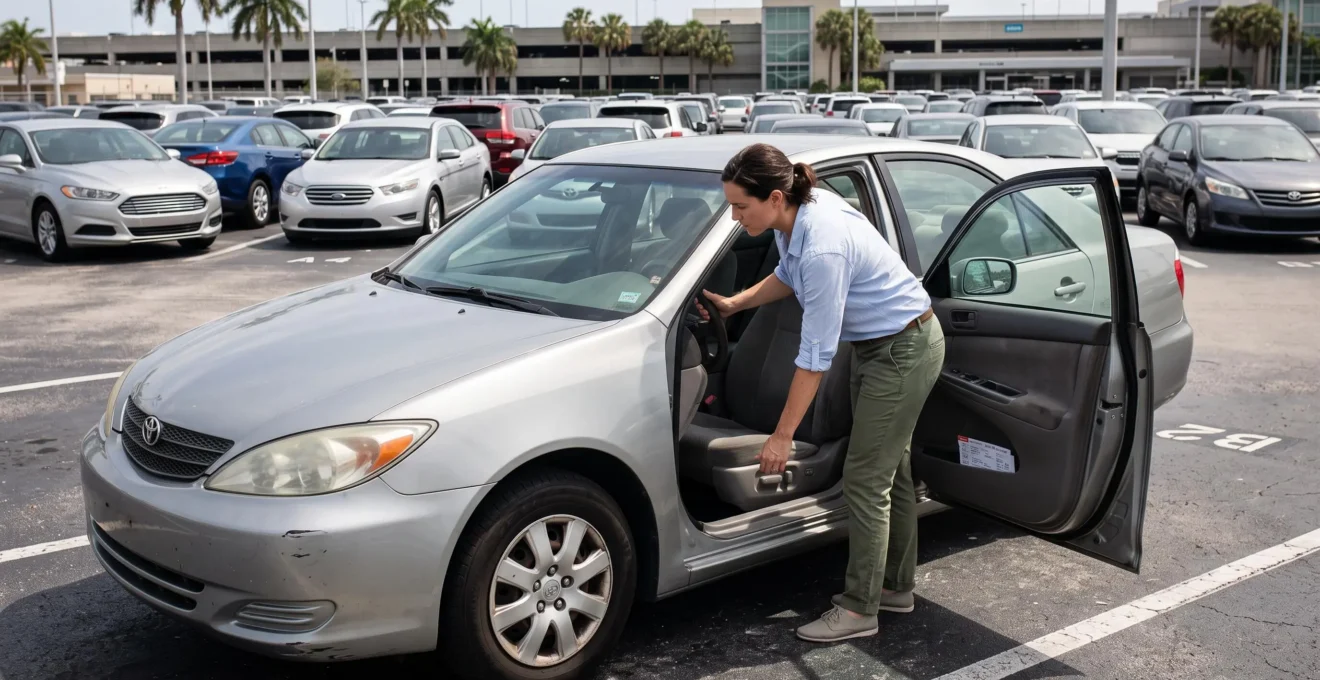
Check sedan seat comfort by evaluating thigh support, seat adjustment, steering-wheel reach, back support and passenger positioning before accepting the rental. A brief inspection is more useful when it goes beyond simply sitting in the driver’s seat. For a three-hour Florida journey, the objective is to find a position that remains comfortable after the initial novelty of the vehicle wears off.
Start with the seat cushion. Its front edge should support the thighs without pressing uncomfortably behind the knees. A cushion that is too short can leave taller drivers with insufficient support, while an excessively long or high cushion may restrict comfortable positioning for shorter occupants.
Next, examine the adjustment range. Check whether the seat moves sufficiently forward and backward, whether its height can be changed and whether the steering wheel adjusts for both reach and tilt. Being able to move the steering wheel toward the driver can prevent an otherwise suitable seat position from requiring an awkward arm posture.
The first few minutes can be misleading. A firm seat may initially feel supportive but become uncomfortable later, while a soft cushion can feel pleasant at pickup without providing enough structure over time. Seat depth, cushion angle and lumbar positioning become more noticeable as the journey progresses.
Rental availability adds another consideration. A booking usually guarantees a vehicle category rather than an exact seat design or trim. Familiar models such as the Toyota Camry, Honda Accord and Chevrolet Malibu can help travelers research likely seating characteristics in advance, but the actual vehicle supplied may differ. Requesting another car is most realistic when a specific comfort problem can be identified and an alternative is available in the same category.
Rear-seat comfort should also be checked when traveling with colleagues, clients or family. A driver may find a sedan perfectly comfortable while a taller rear passenger has insufficient legroom or an awkward seating position. The middle rear seat deserves particular attention when three adults will share the back row.
Use the following inspection points:
- Confirm that the seat cushion supports the thighs without restricting knee movement.
- Adjust the seat height and distance from the pedals.
- Position the steering wheel so the arms remain comfortably bent.
- Test backrest support and available lumbar adjustment.
- Sit in the rear seats and assess legroom for the tallest and shortest passengers.
When the vehicle cannot accommodate a comfortable driving position, changing cars before departure is preferable to relying on repeated adjustments during the trip. A suitable seat is a fundamental requirement rather than a feature that can always be compensated for with other equipment.
Midsize or Full-Size Sedan: Which Fits Four Adults With Luggage?
A full-size sedan is generally the more practical starting point when four adults are traveling with several substantial suitcases, but the category label alone does not guarantee sufficient space. A midsize sedan can work well for four travelers with compact luggage, provided its rear seating and trunk opening suit the group. The deciding factors are the actual bags, passenger dimensions and journey configuration.
Airport transfers in Miami (MIA), Orlando (MCO) and Fort Lauderdale (FLL) illustrate the problem. Four adults may need to travel together with checked luggage, carry-ons and personal items. Even when a sedan advertises five-passenger seating, that figure does not establish that four adults will have adequate comfort with every seat occupied and the trunk fully loaded.
Published luggage capacity provides a useful initial comparison. Enterprise‘s U.S. rental-car listings illustrate the distinction between its categories:
| Rental category | Example vehicle | Passenger capacity | Advertised bag capacity |
|---|---|---|---|
| Compact | Nissan Versa or similar | 5 | 2 bags |
| Midsize | Toyota Corolla or similar | 5 | 3 bags |
| Full Size | Nissan Altima or similar | 5 | 4 bags |
| Full Size | Chevrolet Malibu or similar | 5 | 4 bags |
These figures describe Enterprise’s advertised examples, not guaranteed physical suitcase dimensions or universal capacities across rental companies. The repeated designation « or similar » also means that the named model is not necessarily the vehicle supplied. The company’s Enterprise U.S. rental-car category comparison is useful for understanding its own classifications, but the actual vehicle should still be checked.
Trunk volume figures are only part of the assessment. A narrow opening, intrusive hinges or a shallow loading area can prevent larger suitcases from fitting efficiently. Golf clubs and unusually shaped equipment introduce further complications. Compare the opening width, available depth and loading height rather than assuming that an additional advertised bag represents a guaranteed improvement.
The following decision grid provides a practical starting point:
| Travel configuration | Midsize sedan | Full-size sedan |
|---|---|---|
| Two adults with carry-ons | Usually a practical option | Additional space may be unnecessary |
| Three adults with several bags | Check trunk opening and rear seating | More useful luggage capacity may justify the upgrade |
| Four adults with compact bags | Possible, depending on actual fit | More accommodating starting point |
| Four adults with full-size suitcases | Potentially restrictive | Preferable, but verify physical capacity |
| Four adults with golf clubs | Check dimensions and pass-through arrangements | Check dimensions and pass-through arrangements |
Rear-seat usability is equally important. Four adults may technically fit in either category, but the width and shape of the middle seat, available legroom and placement of the rear armrest can influence comfort considerably. A full-size upgrade is more defensible when passengers will spend substantial time together in the vehicle.
Calculate the total difference between the two rental categories rather than comparing only their initial daily rates. Multiply the additional daily cost by the rental duration and consider whether the larger trunk and more accommodating cabin solve an actual problem. Depending on availability and pricing, a suitable SUV or two smaller vehicles may also deserve comparison, particularly when luggage includes bulky equipment.
For four adults traveling with checked luggage, the full-size category is often the safer starting point. However, physical fit and total rental cost remain more important than the category name, particularly when a specific vehicle cannot be guaranteed.
Which Sedan Design Features Can Complicate Parking in Miami?
Long front overhangs, low bumpers, thick roof pillars and large wheels can make certain sedans less convenient in Miami’s tight parking environments. These characteristics matter in narrow garages, steep ramps and valet areas where drivers have limited room to maneuver. Parking sensors and cameras can improve visibility, but their usefulness depends on the equipment actually installed and the driver’s understanding of its limitations.
Miami presents a varied parking environment. Beach-area lots may have tight spaces, hotels and residential buildings frequently use valet arrangements, and paid garages can include narrow ramps and concrete pillars close to vehicle corners. A sedan that feels manageable on a wide interstate may require more care in these settings.
The front overhang deserves particular attention. A long nose combined with a low front bumper can make steep garage entrances and abrupt transitions difficult to negotiate without scraping. Thick A-pillars can also restrict visibility when approaching intersections or turning through narrow parking structures.
Wheel design is another practical consideration. Large wheels with low-profile tires offer less tire sidewall between the rim and the road surface. Contact with a curb can therefore damage a wheel, making careful positioning especially important in crowded parking areas.
Before leaving the rental facility, become familiar with the available visibility equipment:
- Adjust the side mirrors to understand the vehicle’s rear corners and surrounding traffic.
- Identify the rear camera display and its parking guidelines.
- Check whether front and rear parking sensors are installed.
- Learn how the sensor alerts sound and where their warning indicators appear.
- Understand any blind-spot monitoring indicators and their operating conditions.
NHTSA explains that backup cameras provide a view of the area behind a vehicle while reversing, but they do not replace mirrors or direct observation. The agency also emphasizes that driver-assistance technologies support rather than replace the driver’s responsibility. Its NHTSA explanation of driver-assistance technologies provides an authoritative overview of these systems.
There is also a financial reason to inspect the vehicle carefully. Existing scratches, wheel damage and bumper marks should be documented before departure. Photograph the front and rear bumper corners, all four wheels, the side panels and any visible damage. Keep the images with the rental documentation so that the vehicle’s condition at pickup is recorded. This is a sensible precaution, although it does not replace the rental company’s inspection and damage-reporting procedures.
A manageable vehicle does not eliminate the need for careful parking. A sedan with good visibility, appropriate proportions and familiar controls can make Miami driving less demanding, while a documented pickup condition provides an additional layer of protection when returning the rental.
Which Sedan Comfort Features Are Worth Checking Before Pickup?
The most valuable sedan comfort features for Florida travel are those that improve extended driving, cabin temperature and everyday usability. Adjustable lumbar support, effective air conditioning, ventilated seats, dual-zone climate control and convenient phone integration generally deserve more attention than decorative lighting or premium entertainment features. The right priorities depend on driving distance, passenger needs and the equipment fitted to the actual rental vehicle.
Adaptive cruise control can be useful on extended interstate journeys because it helps maintain a selected following distance from traffic ahead. However, it is a driver-assistance feature, not autonomous driving. The driver remains responsible for monitoring the road and controlling the vehicle.
Ventilated seats are particularly relevant in Florida’s hot climate. They can improve comfort after a car has been parked outdoors, although their performance depends on the system design and operating conditions. Dual-zone climate control is also valuable when front-seat occupants prefer different temperatures. Rear air vents can make a meaningful difference when colleagues or family members travel in the back.
Phone integration is another practical priority. Apple CarPlay and Android Auto can provide access to navigation, compatible communication applications and audio through the vehicle’s display. Wireless functionality is convenient, but wired connectivity may be equally effective when the appropriate cable is available.
Consider the following hierarchy when evaluating equipment:
| Feature | Primary benefit | Priority for extended travel |
|---|---|---|
| Adjustable lumbar support | More adaptable lower-back positioning | High |
| Effective air conditioning | Cabin temperature management | Essential |
| Ventilated seats | Improved seating comfort in hot conditions | High in hot weather |
| Dual-zone climate control | Independent front-seat temperature settings | Useful |
| Adaptive cruise control | Assistance with maintaining following distance | Useful on longer highway journeys |
| Apple CarPlay or Android Auto | Convenient navigation and phone integration | High |
| Rear USB ports and air vents | Better passenger convenience | High when carrying passengers |
| Ambient lighting | Interior appearance | Low |
| Premium audio | Enhanced entertainment experience | Secondary to core comfort needs |
The biggest rental-specific issue is the difference between a model’s maximum available specification and the equipment in the supplied car. A manufacturer’s website may list ventilated seats, adaptive cruise control and advanced parking assistance for a particular model, but those features may belong to higher trims or optional packages.
Where available, examine the rental listing for equipment details and ask the counter representative to confirm the actual vehicle configuration. If the exact vehicle has already been assigned, the VIN or vehicle documentation may help establish its identity and specification. A model name alone is not sufficient proof that an optional feature is present.
Passengers also require different equipment from drivers. A business traveler transporting colleagues or clients should consider rear USB charging, usable air vents, a central armrest and adequate legroom. A comfortable front cabin does not automatically make the rear compartment suitable for professional transportation.
Complete a short technology and comfort check before departing:
- Pair the phone and test navigation integration.
- Confirm that the air conditioning and fan controls respond correctly.
- Locate the seat adjustment and lumbar controls.
- Check whether the blind-spot monitoring indicators are present and functioning.
- Identify the rear USB ports, charging connections and passenger climate vents.
A well-chosen combination of climate control, supportive seating and practical connectivity can make a greater difference than an extensive list of premium features. The most useful equipment is the equipment that will actually be available and used throughout the journey.
Cloth or Leather Seats: Which Feel More Comfortable in Florida Heat?
Neither cloth nor conventional leather is universally more comfortable in Florida’s heat. Cloth generally feels cooler when first touched after a vehicle has been parked in the sun, while leather can become noticeably hot and retain heat. However, cloth can hold moisture during humid journeys, and ventilated leather can offer a different experience from conventional leather. The best choice depends on the seat construction, ventilation and travel conditions.
Florida’s combination of high temperatures, humidity and strong sunshine makes seat material a practical consideration. A sedan parked outdoors at MIA, MCO or FLL can develop an uncomfortable interior environment regardless of its upholstery. The surface temperature of a seat and the temperature of the cabin are related but separate comfort considerations.
Conventional leather can absorb heat when exposed to direct sunlight. Sitting down in shorts or lightweight clothing may therefore feel uncomfortable immediately after entering the vehicle. Cloth typically feels less hot to the touch, although it may retain perspiration and humidity during extended use.
Ventilated leather changes the comparison. Perforated seats with an active ventilation system can move air through or around the seating surface, depending on the manufacturer’s design. This makes the practical choice less about leather versus cloth and more about conventional upholstery versus a properly functioning ventilated seat.
| Seat type | Potential advantage | Potential drawback |
|---|---|---|
| Cloth | Often less hot to the initial touch | Can retain moisture and perspiration |
| Conventional leather | Smooth surface and straightforward cleaning | Can become very hot in direct sunlight |
| Ventilated leather | Active airflow can improve seating comfort | Depends on actual ventilation performance and availability |
Parking conditions also influence the experience. An open-air airport lot exposes the vehicle to direct sunlight, while a covered garage can reduce direct solar exposure. Neither arrangement guarantees a cool cabin, so allow the air conditioning to work before beginning a long drive. A suitable windshield sunshade can also help limit direct sunlight entering the parked vehicle.
Clothing matters as well. Travelers wearing business attire may appreciate a smooth, ventilated surface, while passengers in shorts may be more sensitive to hot upholstery. On longer journeys, contact with the seat, moisture retention and the ability to maintain a comfortable position matter more than the perceived prestige of the material.
When choosing a rental sedan, functioning ventilation and effective air conditioning deserve priority over upholstery branding. If the vehicle has conventional leather, practical measures such as shade and pre-cooling can help, while cloth may be a sensible alternative for travelers who prefer a less heat-sensitive initial seating surface.
Why Does Lumbar Support Matter During a Four-Hour Drive?
Lumbar support matters during a four-hour drive because it helps maintain a comfortable lower-back position while the body remains seated for an extended period. Without suitable support, some drivers gradually slump or adopt a posture that places additional strain on the lower back. The effect may become more noticeable as the journey progresses, making adjustable support a valuable consideration for extended Florida travel.
The lumbar region refers to the lower portion of the spine. In a driving position, the backrest should support the natural curve of this area without forcing the driver into an exaggerated arch. A seat that is too upright, too reclined or poorly matched to the driver’s body dimensions can make maintaining a comfortable posture more difficult.
Adjustable lumbar support allows the driver to position the support closer to the belt-line curve. Too much pressure, or positioning the support too high, can create discomfort rather than improve it. Begin with a moderate setting and adjust gradually until the back feels supported without being pushed forward.
Seat recline also matters. The driver should be able to reach the pedals and steering wheel comfortably without stretching or rounding the shoulders. Adjust the seat distance first, then the backrest and lumbar position, and finally the steering wheel.
Rental vehicles do not always offer adjustable lumbar support. Base trims may provide fixed backrests or limited manual adjustments. If a particular sedan does not have the required feature, consider the following alternatives:
- Adjust the seat cushion angle if the vehicle provides that function.
- Reposition the backrest to support a natural seated posture.
- Consider a small travel lumbar cushion if additional support is needed.
- Avoid placing bulky objects behind the back that force an unnatural position.
- Plan regular opportunities to stop, stand and change position.
For an extended journey such as Miami to Orlando, breaks should form part of the travel plan. A two-hour interval can serve as a practical reminder to stop and move around, although the appropriate timing depends on individual needs, road conditions and fatigue. It is not a substitute for stopping sooner when discomfort or drowsiness develops.
There is also an important distinction between ordinary driving-related postural fatigue and aggravation of an existing back problem. Better seat adjustment may improve comfort for some drivers, but it cannot be assumed to prevent or treat an underlying medical condition. Travelers with known back problems should give additional weight to adjustable lumbar support and a suitable seating position when selecting a rental vehicle.
For someone planning several hours of interstate driving, booking a category or confirmed model with suitable seat adjustment may be a more meaningful investment than choosing a vehicle solely because it has a larger engine or premium audio system.
Comfortable lumbar support contributes to a better driving position, but it works best alongside appropriate seat height, steering-wheel reach and rest opportunities. When lower-back comfort is a significant requirement, verify the feature before accepting the vehicle rather than assuming it is standard across the sedan category.
Key Considerations Before Choosing a Florida Rental Sedan
- Identify the minimum seating and luggage requirements before comparing vehicle categories.
- Prioritize quietness, adjustable seating and effective climate control when planning extended interstate journeys.
- Compare the complete rental cost and verify the actual vehicle’s equipment before accepting an upgrade.
How to Match a Florida Rental Car to Your Budget and Actual Needs?
Matching a Florida rental sedan to a budget starts with the journey rather than the advertised daily price. Passenger numbers, luggage, driving duration, parking conditions and required comfort features should determine the appropriate vehicle category. Once those requirements are clear, compare the total rental cost and choose the least expensive option that genuinely satisfies them.
A compact or midsize sedan may be entirely suitable for a solo business traveler spending most of the trip in urban areas. A full-size sedan may offer better practicality for several passengers and larger bags. However, paying for additional space makes little sense when the vehicle will carry only one person and a small suitcase.
Start by identifying the main requirements:
- Trip duration: Is the vehicle needed for a short airport transfer or several hours of interstate driving?
- Passengers: How many adults will travel, and will the rear seats be occupied regularly?
- Luggage: Are there carry-ons, full-size suitcases, golf clubs or other bulky items?
- Driving environment: Will the itinerary involve Miami garages, urban traffic or longer interstate journeys?
- Comfort expectations: Are adjustable lumbar support, ventilated seats or advanced driving assistance essential?
- Professional requirements: Does the vehicle need to provide a polished environment for colleagues or clients?
The next step is to examine the full rental bill. The base rate is only one component of the final cost. Florida travelers should pay particular attention to airport-related charges, toll arrangements, fuel policies, optional equipment, additional drivers and age-related surcharges where applicable.
Toll payments deserve specific attention because Florida’s Turnpike and other toll roads are relevant to many itineraries. Rental companies use different toll-payment programs, and the associated fees are not necessarily uniform. Florida’s Turnpike Enterprise advises rental customers to review the applicable arrangements and charges before driving. Its Florida’s Turnpike rental-vehicle toll guidance explains the importance of checking the rental agreement and the available payment options.
Compare the rental options using the following framework:
| Cost or requirement | What to verify | Why it matters |
|---|---|---|
| Base rental rate | Daily rate and total rental duration | Establishes the starting price |
| Airport charges | Applicable concession and facility-related fees | Can increase the final bill |
| Toll program | Daily fees, administrative charges and payment method | Important for toll-road itineraries |
| Fuel policy | Return requirements and refueling arrangements | Influences total trip expenditure |
| Driver-related charges | Additional-driver and age-related fees where applicable | May change the quoted total |
| Vehicle upgrade | Additional daily cost and confirmed benefits | Determines whether extra comfort is worth paying for |
| Equipment | Actual seat, climate and assistance features | Prevents paying for unavailable equipment |
An upgrade should be evaluated according to its total additional cost. For example, a hypothetical traveler comparing a midsize and full-size sedan should calculate the difference over the complete rental period, then assess whether the larger trunk, rear seating or additional comfort features justify that amount. This is a decision framework, not a claim about current rental prices.
Overbuying and underbuying both create avoidable problems. A solo traveler may gain little from a full-size sedan if parking convenience and price are the priorities. Conversely, four adults with several large suitcases may find a compact sedan uncomfortable regardless of how attractive its equipment list appears. No optional comfort feature can compensate for fundamentally insufficient passenger or luggage space.
Five Checks Before Confirming a Florida Sedan Rental
- Write down the passenger count and luggage inventory, including the approximate dimensions and number of large suitcases. Deliverable: a passenger-and-baggage requirements list.
- Identify the longest planned driving segment and the essential seating, lumbar and cabin-noise requirements. Deliverable: a prioritized comfort specification.
- Compare midsize and full-size rental categories using advertised capacity and the availability of the required equipment. Deliverable: a shortlist of suitable vehicle categories.
- Calculate the complete estimated rental expenditure, including applicable airport charges, toll programs, fuel arrangements and upgrade costs. Deliverable: a total-cost comparison.
- Before leaving the pickup location, inspect seating adjustments, air conditioning, phone connectivity, luggage fit and parking visibility aids. Deliverable: a completed vehicle pickup inspection record.
For travelers seeking a polished driving experience without choosing an oversized vehicle, a well-equipped midsize sedan is often a strong starting point. A full-size model becomes more compelling when passenger comfort and luggage capacity justify the additional expense. Before confirming a reservation, compare the complete costs, verify the likely equipment and keep the essential pickup checks in view. That approach helps secure a sedan suited to the journey rather than simply the most expensive category available.
Is a midsize sedan comfortable enough for driving across Florida?
A midsize sedan can be comfortable enough for extended Florida travel when it offers suitable seating, effective air conditioning, adequate cabin insulation and sufficient luggage capacity. The actual vehicle’s trim and condition matter more than the category name. Drivers should inspect seat adjustment, lumbar support and cabin noise before departure.
Is a full-size sedan worth the additional rental cost?
A full-size sedan can justify its higher cost when several adults need additional cabin space or when the luggage requirements exceed what a midsize model can comfortably accommodate. For solo travelers or couples with compact luggage, the upgrade may offer limited practical value. Compare the total rental difference with the specific benefits required.
Which sedan features are most important for Florida’s hot weather?
Effective air conditioning, ventilated seats and practical sun protection are among the most useful features in Florida’s hot climate. Dual-zone climate control can also improve comfort when front-seat passengers prefer different temperatures. The actual availability of these features should be confirmed because rental vehicles may have base-level equipment.
Should travelers prioritize leather seats or adjustable lumbar support?
For extended driving, adjustable lumbar support generally deserves greater priority because it helps accommodate different body shapes and seating positions. Leather upholstery does not automatically provide better comfort, particularly when exposed to direct Florida sunlight. Ventilated seats can improve the experience, but a suitable seating position remains fundamental.
What should travelers inspect before leaving a Florida airport rental location?
Inspect the seat adjustments, steering-wheel reach, air conditioning, phone connectivity, luggage fit, mirrors and available parking assistance systems. Photograph existing exterior damage, including bumper corners and wheels, and retain the documentation. Confirm the rental agreement’s toll and fuel arrangements before beginning the journey.