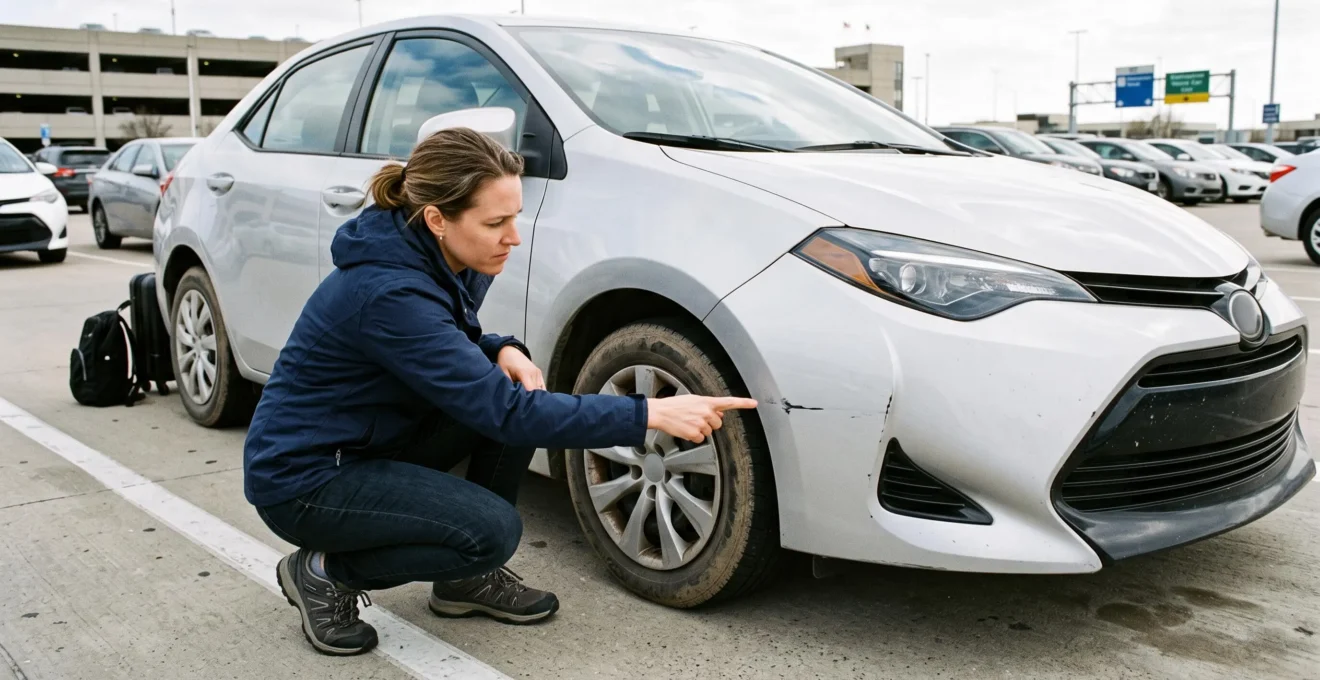
Rental cars experience gradual wear through everyday driving, repeated passenger use, and exposure to changing road conditions. A polished steering wheel, lightly scuffed bumper, or uniformly worn tire may reflect ordinary use. However, a deep scratch, damaged tire sidewall, malfunctioning seat belt, or developing brake problem deserves closer attention.
Recognizing rental car wear and tear means separating cosmetic deterioration from physical damage and potentially unsafe mechanical conditions. The distinction depends on observable characteristics, whether the condition affects vehicle operation, and the rental company’s applicable damage policy. Not every imperfection requires a repair, and not every newly discovered mark was necessarily caused during the current rental.
A practical inspection begins before leaving the pickup location and continues whenever the vehicle’s condition changes. Comparing photographs, checking tires and controls, and reporting significant concerns promptly can help renters address safety issues while maintaining a reliable record of the car’s condition.
Rental Car Wear and Tear: Essential Checks
- Identify ordinary wear: Uniform surface aging and minor cosmetic marks may reflect normal use, while tears, deep scratches, and broken components require separate assessment.
- Prioritize road safety: Uneven tire wear, severe vibration, braking problems, and critical dashboard warnings warrant professional attention regardless of the car’s appearance.
- Document condition changes: Photograph existing defects, compare pickup and return records, and report new damage or mechanical concerns through the rental provider’s designated channels.
- Why Do Regular Vehicle Inspections Matter for Rental Car Reliability?
- Why Do Rental Car Interiors Show Wear Faster Than Private Vehicles?
- How to Spot Uneven Tire Wear Before Driving a Rental Car?
- Normal Wear or Rental Damage: Which Scratches Might Trigger a Fee?
- Which Inspection Photos Help Document Existing Rental Car Damage?
- Which Early Wear Symptoms Should Never Be Ignored During a Rental?
- Which Mechanical Problems Make a Rental Car Unsafe to Drive?
- When Should You Report New Signs of Wear During a Long Rental?
Why Do Regular Vehicle Inspections Matter for Rental Car Reliability?
Regular rental car inspections help identify ordinary deterioration, detect visible safety concerns, and establish the vehicle’s condition before and after use. They allow renters to distinguish minor cosmetic imperfections from problems requiring professional attention. However, a visual inspection cannot establish complete mechanical reliability or replace the rental company’s maintenance responsibilities.
These inspections serve three distinct purposes. First, they identify expected deterioration, such as lightly worn controls or superficial exterior scuffs. Second, they reveal warning signs that could compromise road safety, including tire damage or malfunctioning safety equipment. Third, they create a condition record that can help clarify subsequent damage questions.
A useful approach divides the rental into three inspection stages:
- At pickup: Examine the exterior, tires, interior, dashboard indicators, and essential controls. Record existing defects before departure.
- During the rental: Observe changes in vehicle behavior, visible damage, tire condition, and warning indicators, especially before longer journeys.
- At return: Compare the vehicle’s condition with the pickup record and retain photographs or inspection documents.
Comparing these stages helps establish what was visible at different times. It does not automatically establish who caused a newly noticed defect or when that defect actually occurred.
Appearance alone is also an unreliable measure of mechanical health. A recently manufactured car with clean upholstery could still develop tire, brake, or steering problems. Conversely, a rental with polished interior surfaces and modest cosmetic wear may have received appropriate servicing.
Renters perform observational checks; rental companies remain responsible for the maintenance obligations applicable to their vehicles. Customers should identify visible concerns and request assistance rather than attempt to certify a vehicle as mechanically safe.
The next distinction is particularly useful inside the cabin, where frequent contact can create noticeable wear without necessarily affecting vehicle safety or usability.
Why Do Rental Car Interiors Show Wear Faster Than Private Vehicles?
Rental car interiors can show concentrated wear because different drivers repeatedly adjust seats, operate controls, load luggage, and use frequently touched surfaces. These conditions may accelerate visible deterioration compared with some privately owned vehicles, although actual wear depends on mileage, materials, cleaning practices, and how each vehicle has been used.
High-contact areas typically reveal the clearest patterns. Steering-wheel surfaces may become uniformly polished, seat cushions may lose some firmness, and frequently used buttons may develop a smoother finish. Repeated luggage handling can also create superficial marks near door openings or cargo-area trim.
Gradual deterioration usually follows a recognizable pattern across surfaces that experience repeated contact. Isolated damage is different: a torn seat bolster, cigarette burn, broken plastic fitting, or concentrated stain may indicate an identifiable incident rather than ordinary material aging.
Several practical distinctions help renters evaluate interior conditions:
| Interior component | Typical gradual wear | Condition requiring closer attention |
|---|---|---|
| Steering wheel | Even polishing or slight surface discoloration | Loose covering or deteriorating material that interferes with grip |
| Seats | Minor cushioning compression or uniform fabric fading | Tears, burns, broken adjustment mechanisms, or persistent staining |
| Controls and trim | Light surface scratches around frequently used buttons | Detached trim, broken switches, or obstructed controls |
| Floor and cargo area | Light scuffing from routine passenger and luggage use | Deep cuts, embedded stains, or damaged interior materials |
Function matters more than appearance when assessing safety. A worn-looking seat may remain usable, but a seat that does not lock securely into position requires attention. A frayed or malfunctioning seat belt should never be dismissed as ordinary interior aging.
Surface discoloration also differs from damage requiring specialized cleaning or repair. Marks that can be removed through routine cleaning may be treated differently from embedded stains, persistent odors, burns, or damaged upholstery.
For example, Dollar’s U.S. damage and ordinary-wear policy distinguishes ordinary deterioration from potentially billable damage. Its published criteria illustrate how a rental company can separate normal use from damage, but they do not establish universal standards for interior cleaning or repairs. The applicable rental agreement determines how particular conditions are treated.
Interior deterioration often develops gradually, but tires require a more urgent distinction: a relatively small visible irregularity can sometimes indicate a condition needing professional assessment before driving.
How to Spot Uneven Tire Wear Before Driving a Rental Car?
Uneven tire wear can be recognized by comparing tread depth and surface condition across each tire’s inner, middle, and outer sections. Look for one-sided wear, shallow grooves, isolated flat spots, and visible damage. These patterns can indicate problems requiring professional inspection, but they cannot establish an exact mechanical diagnosis on their own.
Inspect the vehicle while it is stationary in a safe parking area. Look at the accessible tread on each tire without reaching underneath the vehicle. Compare the visible shoulder areas with the central tread, then examine the front and rear tires for noticeable differences.
Several wear patterns deserve attention:
- One-sided wear: A noticeably worn inner or outer shoulder can be associated with alignment or suspension conditions.
- Center wear: Greater wear along the middle of the tread may be associated with inflation conditions.
- Both-edge wear: Heavier deterioration along both shoulders can indicate a different inflation or loading pattern.
- Localized flat spots: Concentrated wear in one area may be associated with irregular tire movement or other operating conditions.
These patterns are screening observations, not definitive diagnoses. Tire pressure history, driving conditions, wheel alignment, balancing, and suspension components may all influence tread condition.
Remaining tread depth is another important consideration. Built-in treadwear indicators appear as raised bars within the grooves. When the surrounding tread becomes level with these bars, the tire has reached its replacement threshold.
2/32 inch
The tread-depth threshold at which the National Highway Traffic Safety Administration recommends replacing tires. This minimum reference does not guarantee adequate wet-weather traction.
The NHTSA also describes the penny test: insert a U.S. penny into a tread groove with Lincoln’s head pointing downward. If the top of his head remains visible, the tire should be replaced. This is an approximate screening method rather than a precision measurement.
Importantly, tread depth is not the only safety consideration. Sidewall bulges, deep cuts, exposed reinforcing material, and significant cracking can make a tire unsuitable for continued use even when substantial tread remains. New vibration or unusual tire noise also deserves assessment.
If suspicious tread wear is discovered before departure, document it and request a professional inspection or replacement vehicle. Avoid assuming that a tire is safe simply because it is not completely worn down.
Once tire safety has been considered, exterior marks require a different evaluation: the central question is often whether a cosmetic imperfection falls within the rental company’s acceptable-wear criteria.
Normal Wear or Rental Damage: Which Scratches Might Trigger a Fee?
Rental car scratches may trigger damage charges when they exceed the rental company’s acceptable-wear criteria, penetrate protective paint layers, or accompany other physical damage. Small superficial scuffs or removable paint transfer may qualify as ordinary wear under some policies. The result depends on the mark’s characteristics and the applicable U.S. rental terms.
The first distinction concerns the nature of the surface mark. Removable paint or rubber transfer may leave the underlying finish intact. A shallow clear-coat scuff affects the upper protective layer, while a deeper scratch can penetrate the paint and reveal primer, metal, or plastic beneath.
Damage assessment should consider depth, length, location, affected material, and the combined condition of the surrounding area.
| Mark type | Observable characteristics | Potential assessment |
|---|---|---|
| Surface transfer | Transferred material without apparent paint penetration | May fall within ordinary wear criteria |
| Superficial scuff | Minor marks affecting the outer finish | May be acceptable depending on company policy |
| Deep paint scratch | Visible penetration into underlying paint layers or material | More likely to require damage assessment |
| Scratch with dent or broken trim | Surface damage accompanied by deformation or component damage | May be evaluated as a combined repair issue |
Dollar‘s published U.S. damage policy, revised in July 2025, provides a concrete example of company-specific thresholds. It uses the approximate dimensions of a standard credit card—2 × 3.5 inches—as a reference for certain body-panel scratches. A single scratch exceeding that reference may qualify as billable damage.
The policy also considers situations in which several scratches measuring at least one inch collectively extend beyond the reference area. However, Dollar describes its criteria as examples rather than an exhaustive classification of every possible defect.
These measurements are not universal industry rules. They should not be applied automatically to Enterprise, Hertz, or another rental company without reviewing that provider’s applicable terms.
Some situations resist simple measurement. A cluster of small scratches may be assessed differently from one isolated mark. Abrasions around panel edges, wheel-rim scuffs, bumper scrapes, or scratches accompanied by dents may involve different materials and repair requirements.
It is also essential to distinguish damage classification from financial responsibility. A scratch that meets a company’s damage criteria does not necessarily mean the renter personally owes the entire repair cost.
The FTC consumer advice on renting a car explains that personal auto insurance, certain credit card benefits, and rental-company damage waivers may affect protection. Actual coverage depends on the relevant policies, exclusions, contractual requirements, and circumstances.
Because borderline damage assessments depend on evidence, recording the vehicle’s initial condition is often as important as recognizing the scratch itself.
Which Inspection Photos Help Document Existing Rental Car Damage?
Effective rental car inspection photos show the vehicle’s identity, overall exterior condition, specific defects, wheels, and interior before departure. Each suspicious mark should be photographed both in context and close up. Original files, timestamps, and consistency with the rental company’s inspection report make the record more useful if damage is questioned later.
Begin with photographs that establish which vehicle is being inspected. Capture the license plate or another identifying detail, followed by wide images of the front, rear, both sides, and four exterior corners.
Photograph the wheels, visible tire condition, dashboard, seats, cargo area, and any existing interior damage. A dashboard photograph can also help record the displayed mileage and warning indicators at pickup.
For an individual scratch, use two complementary perspectives. First, photograph the affected panel with enough surrounding detail to identify its location. Then capture a sharp close-up showing the mark’s appearance and extent.
Photographing reflective paint can be difficult. Slightly changing the camera angle or using additional available lighting may reveal a mark more accurately. Avoid filters, digital retouching, or modifications that could compromise the credibility of the original image.
Photographs should complement the company’s official condition report. If an existing defect is missing from that report, request a correction or written acknowledgment before leaving the rental facility. Personal photographs alone do not guarantee acceptance in a subsequent dispute.
Rain, darkness, tight parking spaces, and automated scanning can create gaps in documentation. Digital vehicle inspections may provide useful exterior records at participating locations, but they should not be assumed to establish the condition of the entire interior, tire tread, or mechanical systems.
Five-Step Rental Car Condition Documentation Checklist
- Identify the vehicle: Photograph the license plate or another vehicle identifier and save one clearly identifiable image.
- Record exterior condition: Capture four corners, both sides, the front, and the rear, creating a complete overview photo set.
- Document specific defects: Take one context photograph and one close-up of each suspicious mark, producing paired visual evidence.
- Verify the pickup report: Compare recorded defects with the company’s inspection document and retain any written correction or acknowledgment.
- Preserve the comparison: Keep original pickup files and take comparable return photographs, creating a dated before-and-after record.
Store the original files in a way that preserves available timestamps and image information. Where practical, keep the official pickup and return records alongside the photographs so the documents can be reviewed together.
Photographic evidence is most valuable for visible conditions. Developing noises, vibrations, and changes in vehicle behavior require a separate process of observation and timely reporting.
Which Early Wear Symptoms Should Never Be Ignored During a Rental?
Early symptoms that should not be ignored include new vibrations, persistent unfamiliar noises, worsening steering behavior, repeated tire-pressure warnings, and changes affecting brakes, visibility, or essential controls. The most important distinction is whether a condition is new, getting worse, or interfering with safe operation, rather than whether it appears visually severe.
A stable, previously documented imperfection usually deserves a different response from a newly developing symptom. For example, an existing superficial bumper mark may remain purely cosmetic. A steering vibration that appears after several days of driving, however, represents a change requiring closer attention.
Three screening questions help determine the appropriate response:
- Is the symptom new? Compare the observation with the vehicle’s condition at pickup and any earlier records.
- Is it becoming more pronounced? Note whether the symptom is recurring, intensifying, or appearing under additional driving conditions.
- Does it affect essential operation? Consider steering, braking, visibility, tire condition, and the ability to operate safety equipment.
The combination of symptoms can be more concerning than one isolated observation. Steering vibration accompanied by directional pulling may indicate a developing vehicle-control issue. A repeated tire-pressure warning together with visible tire deformation deserves prompt attention. Increasing braking noise accompanied by reduced braking performance raises a more serious concern than a stable, unexplained sound alone.
These combinations are warning signs, not precise diagnoses. Different mechanical problems can produce similar symptoms, and determining their cause requires appropriate professional assessment.
Waiting for a condition to become severe can increase the risk of interrupted travel or further deterioration. It can also make it harder to reconstruct when a problem first became noticeable.
Record the initial observation, approximate circumstances, odometer reading, and any relevant changes. Contact the rental provider when the issue could affect operation, rather than attempting unauthorized mechanical repairs.
Some symptoms call for more than observation or routine reporting. When essential vehicle control or component integrity is compromised, the priority becomes stopping safely rather than continuing the journey.
Which Mechanical Problems Make a Rental Car Unsafe to Drive?
A rental car may be unsafe to continue driving when it has substantially impaired braking, unpredictable steering, severe tire damage, serious overheating, or another condition affecting essential vehicle control. Critical warnings and rapidly worsening mechanical symptoms also require immediate attention. If safety is uncertain, stop in a safe location and contact the rental provider’s roadside assistance service.
A vehicle does not need to become completely immobilized before it presents a serious risk. A car may still accelerate and turn despite deteriorating braking performance, a substantial fluid leak, or severe vibration.
Continued mobility does not prove that continued driving is safe. The relevant question is whether the vehicle can be operated reliably without exposing occupants or other road users to an unreasonable risk.
The following distinctions help renters decide when to stop:
| Observed condition | Potential concern | Appropriate response |
|---|---|---|
| Brake pedal response deteriorates or braking becomes substantially impaired | Reduced ability to stop or control the vehicle | Stop safely and obtain assistance; do not continue normal driving |
| Steering becomes unpredictable or severely restricted | Loss of reliable directional control | Move to a safe location if possible and seek roadside assistance |
| Tire develops a bulge, exposed reinforcement, or severe damage | Possible tire failure | Avoid further operation and request professional assistance |
| Engine overheating warning or visible steam | Potential overheating and mechanical damage | Stop safely, follow the vehicle’s instructions, and avoid handling hot components |
| Critical oil-pressure or brake-system alert | Potential serious mechanical or safety-system fault | Follow the vehicle-specific instructions and contact the rental provider |
Dashboard warning colors and symbols are not interpreted identically across every vehicle. An engine-temperature warning, low oil-pressure alert, or critical brake-system message may require immediate action according to the manufacturer’s instructions. A routine service reminder may require contacting the rental company to coordinate maintenance rather than an emergency stop.
When a serious problem occurs, reduce speed as safely as circumstances allow, avoid abrupt maneuvers, and move to a suitable stopping location. Protect occupants from traffic and seek emergency help if the situation presents an immediate danger.
After reaching safety, contact the provider’s designated roadside assistance channel. Explain the observed symptoms and ask whether the vehicle requires inspection, towing, or replacement.
Rental companies can have specific authorization requirements. For example, Dollar’s published roadside procedures instruct customers to contact its assistance service before arranging towing. Other providers may have different requirements, so the applicable agreement and current instructions matter.
Do not independently arrange non-emergency repairs or towing without checking authorization requirements. Immediate personal safety, however, takes priority over administrative procedures when danger is present.
Once an urgent issue has been addressed, accurate reporting becomes particularly important. During an extended rental, documenting less urgent changes also helps maintain a clear condition history.
Key Takeaways Before Continuing a Long Rental
- Classify each new observation as gradual cosmetic wear, potential damage, or a mechanical safety concern before deciding how urgently to act.
- Preserve the distinction between when a condition was discovered and when it may have occurred; the two are not necessarily the same.
- Obtain traceable instructions from the rental provider when a condition requires inspection, continued-driving authorization, or a vehicle exchange.
When Should You Report New Signs of Wear During a Long Rental?
New signs of wear should be reported according to their significance and the rental agreement. Routine gradual deterioration may only require documentation, while newly discovered cosmetic damage should be reported through the provider’s specified process. Suspected mechanical safety problems require prompt contact and, when continued driving could be unsafe, stopping vehicle use.
Extended rentals can make condition changes harder to track. Mileage accumulates, weather varies, and a vehicle may be used across different road surfaces and driving environments. A simple condition-change log helps separate observations from assumptions about their causes.
For each significant change, record the discovery date, odometer reading, affected component, observable symptoms, and relevant photographs. Note whether the condition appears stable or is getting worse.
Importantly, the discovery date identifies when a renter noticed a condition. It does not necessarily prove when or how that condition developed.
A reporting-priority framework can help avoid both unnecessary alarm and delayed action:
| Condition category | Typical example | Recommended action |
|---|---|---|
| Routine gradual wear | Increasing polish on frequently touched interior surfaces | Record if relevant and follow the rental’s normal condition-reporting requirements |
| New cosmetic damage | Fresh-looking bumper scrape or upholstery tear | Photograph and report according to the rental agreement’s notification procedures |
| Developing mechanical concern | Recurring vibration or unexplained tire-pressure warning | Contact the provider promptly and request an assessment or driving instructions |
| Potentially unsafe condition | Severely impaired braking or dangerous tire damage | Stop safely, avoid continued operation, and request assistance |
Before substantial journeys, recheck visible tire condition, windshield clarity, dashboard warnings, and any changes in steering or braking behavior. These observations are particularly useful after significant mileage or changing driving conditions.
They do not replace scheduled servicing. When an extended rental approaches a maintenance requirement or the vehicle displays a service notification, contact the rental company to coordinate the appropriate arrangements.
To maintain a traceable reporting record, use the designated support channel and retain a case or reference number when available. Request written instructions about whether continued driving is authorized, whether an inspection is needed, and how any replacement or return should be handled.
The provider’s applicable agreement determines reporting deadlines, repair authorization procedures, and potential damage charges. A report establishes a communication record but does not by itself determine financial responsibility.
Before the next long drive or final return, review the condition log, compare relevant photographs, and resolve outstanding mechanical concerns with the rental provider. A clear record and timely professional assessment offer a practical way to manage wear without mistaking every ordinary imperfection for damage.
Can a rental company charge for normal tire wear?
Ordinary tire tread deterioration resulting from normal use may be treated as acceptable wear. Dollar’s published U.S. policy, for example, includes regular tire wear within its ordinary-wear criteria. However, punctures, sidewall damage, or other abnormal conditions may be assessed differently. Whether a charge applies depends on the specific rental agreement, the condition involved, and any applicable protection.
What should you do if you discover damage that was missed at pickup?
Photograph the damage as soon as it is discovered, including both an overview and a close-up. Record the discovery time and contact the rental provider through its designated reporting channel. Explain that the condition was not included in the original report and request written acknowledgment. Avoid claiming certainty about when the damage occurred unless reliable evidence supports that conclusion.
Does a rental car with low mileage necessarily have less wear?
No. Mileage is only one indicator of vehicle use. Frequent short trips, repeated passenger changes, driving conditions, and previous maintenance can all influence wear patterns. A low-mileage vehicle can still have damaged tires or malfunctioning components, while a higher-mileage vehicle may remain in satisfactory condition when properly maintained. Visible condition and functional warning signs should be assessed independently of the odometer reading.
Are photographs enough to dispute a rental car damage charge?
Photographs can provide useful evidence, particularly when they show the same vehicle and affected areas at pickup and return. However, they do not automatically settle a dispute. Vehicle condition reports, inspection records, rental terms, timestamps, and correspondence may also matter. Preserve original image files and request supporting documentation if a charge appears inconsistent with the recorded condition.
Should you keep driving if a rental car’s tire-pressure warning disappears?
A warning light turning off does not independently establish that a tire is safe. Check for visible damage and follow the vehicle manufacturer’s instructions. If the alert recurs, tire pressure changes unexpectedly, or vibration or handling problems develop, contact the rental provider for guidance. If the tire is visibly damaged or the vehicle cannot be controlled safely, stop driving and request assistance.