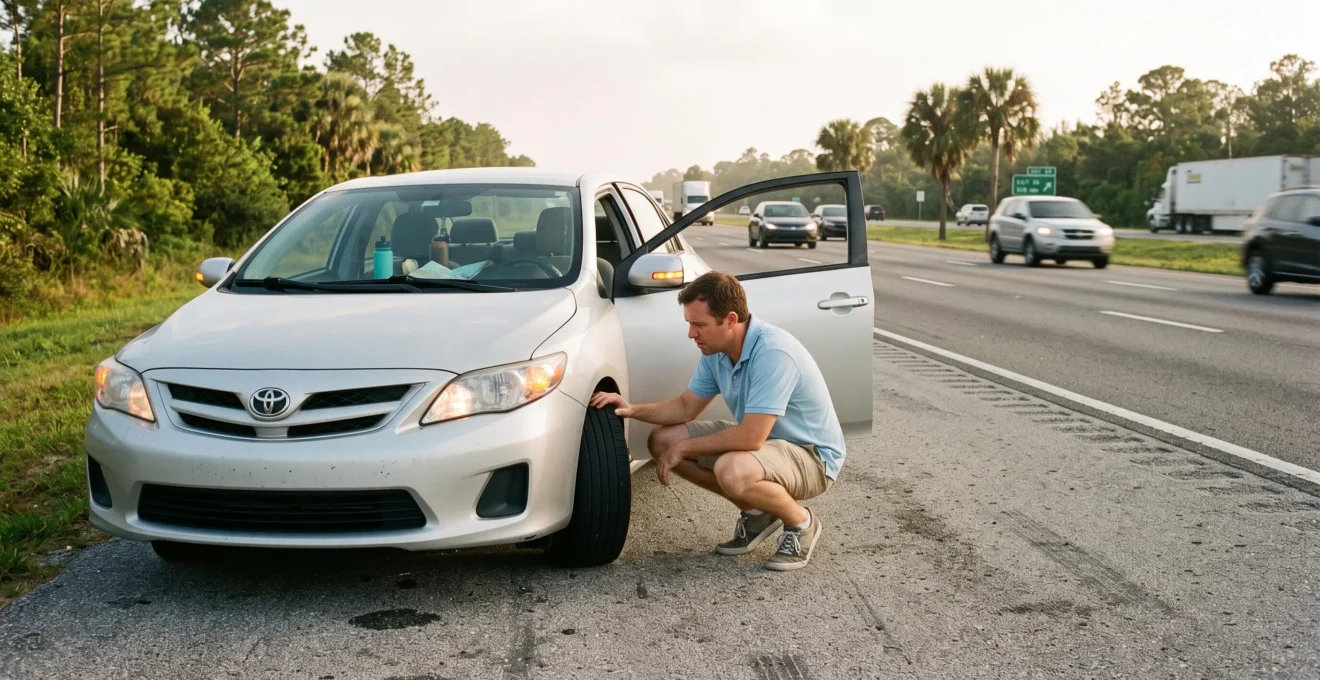
If your Florida rental car starts vibrating, displays an unfamiliar warning light, makes grinding noises, or handles unpredictably, treat the change as a potential safety problem. Reduce speed smoothly, assess whether the vehicle remains controllable, and stop somewhere safe before contacting the rental company’s roadside assistance service. Do not continue driving a vehicle with compromised brakes, steering, tires, or engine cooling.
The difficulty is distinguishing a minor mechanical irregularity from a fault that could suddenly become dangerous. A steady check-engine light does not necessarily mean an immediate breakdown, but a flashing warning, worsening vibration, or soft brake pedal demands a different response. Florida’s interstate journeys, heavy rainfall, and hot-weather driving conditions make timely decisions particularly important.
As a renter, you also need to preserve accurate information about what happened. Reporting the problem promptly, documenting visible symptoms, and obtaining authorization before repairs or towing can help prevent misunderstandings about responsibility and charges.
Florida rental car breakdown: Essential decisions
- Stop for critical symptoms: Brake failure, unpredictable steering, smoke, overheating, severe vibration, or a damaged tire can make continued driving unsafe.
- Document and report: Photograph relevant warnings or visible damage from a safe location, then contact the rental company’s roadside assistance service.
- Confirm your options: Ask whether the vehicle requires towing, inspection, or replacement, and obtain written confirmation of applicable charges and rental arrangements.
- Why Might a Rental Car Vibrate at Highway Speeds?
- How to React When an Engine Warning Light Appears in a Rental Car?
- Brake Noise or Steering Trouble: Which Symptoms Require Stopping?
- Which Mechanical Problems Make a Rental Car Unsafe to Drive?
- When Should You Ask for a Replacement After a Rental Car Malfunction?
- When Should a Rental Vehicle Be Checked After a Road Incident?
- Roadside Assistance or Travel Assistance: Which Helps in Each Situation?
- How to Assess Car Rental Customer Service Before Problems Arise?
Why Might a Rental Car Vibrate at Highway Speeds?
A rental car may vibrate at highway speeds because of unbalanced wheels, damaged tires, bent rims, or worn steering and suspension components. If the vibration mainly occurs during braking, the braking system may be involved. A sudden, worsening vibration or one accompanied by pulling, unusual noise, or a burning smell warrants stopping safely and requesting assistance.
Wheel imbalance is one possible explanation for shaking that becomes noticeable within a particular speed range. A tire with irregular wear, internal structural damage, or tread separation can produce similar sensations, sometimes with much greater consequences. A pothole or curb strike may also bend a wheel rim or damage suspension components without leaving immediately obvious external damage.
According to NHTSA‘s tire safety and maintenance information, wheel balancing helps prevent shaking and vibration. The agency also identifies tire cuts, bulges, irregular wear, and changing tire performance as reasons to seek professional inspection.
Drivers can gather useful diagnostic observations without tools or mechanical disassembly:
- Speed sensitivity: Note whether vibration occurs at a particular speed, while accelerating, or continuously.
- Where it is felt: Steering-wheel vibration may suggest a front-end source, while movement through the seat or floor may point toward another part of the vehicle. Neither observation identifies the defective component with certainty.
- Braking behavior: Pulsation that mainly appears while braking may indicate a brake rotor or related braking problem.
- Accompanying symptoms: Pulling, thumping noises, visible tire damage, or an unusual odor increases concern.
These observations are most useful when made during normal driving before reaching a safe stopping place. Do not accelerate deliberately to reproduce the vibration, perform abrupt braking tests, or inspect a wheel beside moving highway traffic.
Unlike the owner of a familiar personal vehicle, a rental driver usually cannot establish whether the vibration existed previously or followed an undisclosed impact. An unfamiliar symptom should therefore remain an unresolved mechanical concern until the rental provider or an authorized professional evaluates it.
If vibration develops suddenly, becomes severe, or affects steering control, ease off the accelerator and move toward a safe exit or stopping area without abrupt maneuvers. If the car cannot be controlled reliably, stop as safely as conditions permit and request recovery. A mild, stable vibration may allow travel only as far as a nearby safe stopping location when control remains normal; it is not proof that the vehicle is mechanically sound.
Vibration is a warning sign rather than a diagnosis. When the source is unknown, professional assessment is safer than assuming the problem is limited to wheel balancing. Dashboard warnings can provide additional clues about whether the vehicle should remain parked.
How to React When an Engine Warning Light Appears in a Rental Car?
When an engine warning light appears in a rental car, first identify its color and whether it is steady or flashing. A steady check-engine light generally requires prompt diagnosis, while a flashing light calls for stopping safely and avoiding further driving. Red oil-pressure or overheating warnings require immediate attention and may demand shutting off the engine.
A steady amber check-engine light can indicate a range of problems, including emissions-system faults or engine-management issues. It does not automatically require emergency towing, but it should not be ignored or treated as permission to complete a long journey.
A flashing check-engine light is more concerning because it can indicate a severe combustion problem, including an active misfire capable of damaging the catalytic converter. AAA‘s automotive guidance recommends avoiding further driving when this warning flashes.
Red warnings associated with oil pressure or excessive engine temperature are especially urgent. Continuing to operate an engine without adequate lubrication or cooling can cause serious mechanical damage. Stop as soon as safely possible and follow the vehicle manufacturer’s warning instructions. If there is steam, coolant loss, or overheating, shut off the engine once safely stopped and never open a hot cooling-system cap.
Florida’s high ambient temperatures can reduce the cooling margin available during sustained driving. On a long interstate journey, a rising temperature gauge, charging-system warning, or sudden loss of power deserves prompt attention, particularly when reaching the next service location would require substantial additional driving. A charging warning may indicate an electrical supply problem and should not be assumed to be harmless.
A practical response follows this sequence:
- Reduce speed smoothly and avoid unnecessary acceleration.
- Observe whether the warning is steady, flashing, or red, and check for steam, odors, abnormal engine sounds, or reduced power.
- Move to a safe stopping place. Do not continue driving if the warning or accompanying symptoms indicate immediate danger.
- Photograph the dashboard while safely parked, recording the warning indicator and any relevant gauge readings.
- Contact the rental company’s roadside assistance service and follow its instructions about inspection, towing, or replacement.
Avoid repeatedly restarting the vehicle merely to see whether the warning disappears. Some faults are intermittent, and a light going out does not establish that the problem is resolved. Although restarting does not necessarily erase stored diagnostic codes, it can change the symptoms available for observation.
Ignoring an important warning may also complicate a subsequent damage dispute. However, renter responsibility depends on the cause of the problem, the actual conduct involved, applicable contractual terms, and relevant law. A warning light alone does not determine liability.
“If your check engine light is flashing, avoid driving the vehicle further.”
The essential decision is not whether a dashboard warning eventually disappears, but whether continued operation could cause harm. Brake and steering symptoms require the same safety-first assessment, even when no warning light appears.
Brake Noise or Steering Trouble: Which Symptoms Require Stopping?
Brake grinding, reduced pedal resistance, a pedal sinking toward the floor, or unpredictable steering are reasons to stop a rental car as safely as possible and avoid driving it further. Occasional brake squealing or slight steering pull may have less serious causes, but new symptoms still require reporting. Any reduction in reliable stopping or directional control is urgent.
Brake sounds and pedal behavior should be considered together. A high-pitched squeal during otherwise normal braking may come from a wear indicator, moisture, or brake-surface conditions. Grinding can indicate metal-to-metal contact or another serious brake defect and should not be treated as routine wear.
A pedal that feels unusually soft, requires repeated pumping, or sinks farther than expected raises concern about the hydraulic braking system. Burning odors or smoke near a wheel can indicate overheated or dragging brakes and may present an additional fire risk.
The following comparison provides a practical severity guide rather than a mechanical diagnosis.
| Observed symptom | Possible concern | Recommended response |
|---|---|---|
| Light squealing with normal braking | Brake wear indicator, moisture, or surface noise | Stop somewhere safe, report the noise, and arrange assessment before substantial further driving. |
| Grinding during braking | Severe brake wear or component damage | Stop safely and request assistance; do not continue normal driving. |
| Soft, spongy, or sinking brake pedal | Potential loss of hydraulic braking effectiveness | Stop safely and arrange recovery rather than driving onward. |
| Minor steering pull only on a sloped roadway | Road crown, tire conditions, or alignment | Observe without performing risky tests and report persistent pulling. |
| Loose steering, clunking, or poor wheel return | Possible steering or suspension component problem | Stop safely and obtain professional assessment. |
| Steering that does not respond predictably | Potential loss of directional control | Do not continue driving; request emergency assistance if necessary. |
If normal braking is compromised while the car is moving, remain calm, release the accelerator, activate the hazard lights when appropriate, and look for a safe escape route. Maintain steering control and use available engine braking according to the vehicle’s operating instructions.
If the service brakes are failing, a parking brake may provide supplementary braking, but its operation varies significantly between vehicles. Apply a conventional hand-operated parking brake gradually when appropriate. Electronic parking brakes may require a different emergency procedure. Abrupt application can destabilize the car, so consult the manufacturer’s instructions whenever possible.
Avoid sudden steering corrections or aggressive braking maneuvers at highway speeds. If the vehicle cannot be stopped or controlled, call 911 when safe to do so. After stopping, do not attempt a test drive to confirm whether the problem has disappeared.
Florida’s generally flat highways may involve fewer prolonged downhill braking events than mountainous routes, but that does not prevent brake wear or failure. New grinding or pedal softness deserves immediate attention even if the vehicle seemed normal earlier in the journey.
The decision threshold is straightforward: an unfamiliar sound warrants investigation, while a symptom that compromises stopping or steering requires avoiding further driving. Other mechanical failures can be equally dangerous even when braking and steering initially feel normal.
Which Mechanical Problems Make a Rental Car Unsafe to Drive?
A rental car is unsafe to drive when a mechanical problem could suddenly prevent the driver from controlling its speed or direction, cause a tire failure, severely damage the engine, or create a fire risk. Brake failure, steering malfunction, overheating, serious tire damage, smoke, and fuel odors are major warning signs. Stop safely and arrange professional assistance.
The most important distinction is between a defect that mainly affects convenience and one that can compromise vehicle safety without warning. A cracked taillight, for example, may require repair and can create a visibility or legal compliance issue, but it does not present the same immediate mechanical risk as a damaged tire sidewall.
A slow tire leak is another example that requires caution. The vehicle may initially remain controllable, but continued pressure loss can cause overheating and tire failure. A tire-pressure warning, visible bulge, or damaged sidewall should never be dismissed solely because the car still moves normally.
Stop-driving conditions include:
- Braking failure: Substantial loss of stopping power, unusual pedal travel, or severe grinding.
- Steering failure: Sudden looseness, binding, unpredictable responses, or inability to maintain direction.
- Engine overheating: Steam, coolant leakage, an overheating warning, or rising temperature accompanied by abnormal operation.
- Severe tire problems: A blowout, major pressure loss, visible sidewall bulge, or suspected tread separation.
- Potential fire hazards: Smoke, strong fuel odor, visible leaking fuel, or electrical burning smells.
A useful question is: Could this fault suddenly prevent safe control of the vehicle? If the answer is yes, continued driving is not an acceptable way to reach a more convenient destination.
The stopping location matters as much as the mechanical diagnosis. A disabled car on the shoulder of I-75 or I-95 remains exposed to fast-moving traffic. When the vehicle is still controllable, prioritize reaching an exit, rest area, or another protected location if doing so does not add unacceptable risk. If it cannot safely reach such a location, stop as safely as possible.
Activate hazard lights, follow emergency-service instructions, and avoid standing near moving traffic. Depending on the position of the vehicle and surrounding conditions, remaining inside with a seat belt fastened or moving to a protected location may be safer. Do not attempt roadside inspections on the traffic-facing side of the vehicle.
If the vehicle is smoking, burning, or leaking fuel, stop, shut off the engine when safe, evacuate to a safe distance, and contact emergency services. Do not remain inside a vehicle presenting an immediate fire hazard.
Continuing to operate a visibly defective rental vehicle may contribute to additional damage and complicate contractual or insurance questions. It does not automatically make the renter financially responsible for every subsequent failure, nor does it universally invalidate roadside assistance. Those questions depend on the agreement, protections, circumstances, and applicable law.
Five actions to document a suspected unsafe rental car
- Stop and secure the vehicle: Reach the safest practical stopping place and record its location or highway mile marker.
- Identify the symptom: Write down what changed, when it began, and whether braking, steering, or engine operation was affected.
- Capture evidence safely: Photograph warning lights, visible damage, or fluid leakage without entering traffic or touching hot components.
- Notify the rental provider: Call its official roadside line and save the call time, representative’s name if provided, and incident reference number.
- Obtain the next-step decision: Request written confirmation of whether towing, inspection, or replacement is authorized and retain the message.
Once the immediate risk is controlled, attention shifts to restoring transportation. A replacement vehicle may be more appropriate than an attempted repair, particularly when the malfunction affects essential safety systems.
When Should You Ask for a Replacement After a Rental Car Malfunction?
Request a replacement rental car when the original vehicle has a serious brake, steering, tire, or overheating problem, cannot be assessed promptly, or may leave you stranded if driven further. Replacement availability and costs depend on the rental company’s policies and your agreement. Confirm the transport arrangements and replacement terms before accepting another vehicle.
A replacement is particularly appropriate when a malfunction cannot be resolved through a safe, authorized inspection. A recurring warning light, unresolved steering concern, or cooling-system failure may make continued travel unreasonable even if the engine restarts or the symptoms temporarily disappear.
The rental provider may arrange towing, direct you to an available branch, authorize an inspection, or coordinate another vehicle. However, a roadside vehicle swap is not automatically guaranteed. Delivery, location, timing, and vehicle class depend on the provider’s procedures and available inventory.
For example, Enterprise‘s official rental-car breakdown instructions direct U.S. customers whose vehicles become undrivable because of mechanical failure to reach a safe place away from traffic and contact roadside assistance. That instruction documents Enterprise’s procedure, not a universal policy for every Florida rental agency.
When requesting a replacement, explain the observable symptoms rather than claiming a diagnosis. State whether the vehicle is drivable, where it is located, whether anyone is in immediate danger, and whether an authorized recovery service is required.
Before accepting the proposed arrangement, clarify these questions:
- Will the replacement involve an additional rental charge, class change, or rate adjustment?
- Who is responsible for towing, recovery, or transportation to the replacement location?
- Will the original agreement continue, be amended, or be replaced by a new contract?
- How will fuel level, mileage, deposits, and prepaid charges be handled?
- What documentation will confirm the malfunction and the agreed resolution?
Ask for the terms in writing through the rental company’s app, email, or another available channel. Keep the original agreement, photographs, incident number, and any recovery paperwork. These records can help resolve later disputes about fuel, mileage, vehicle damage, or service charges.
If no replacement is available, request written confirmation of the alternatives. Continuing the original rental is appropriate only after the provider authorizes continued use and the vehicle has been assessed as safe. A different rental company may be an option, but do not assume the original provider will pay for it without explicit agreement.
Other possibilities include a different pickup location, alternate transportation, or requesting a refund for unused rental time. Any refund or reimbursement depends on the relevant contract and circumstances rather than arising automatically from the mechanical problem.
A successful replacement resolves the transportation problem without creating avoidable uncertainty about the original vehicle. The same documentation principles become especially important when a malfunction follows a pothole strike, collision, or other road incident.
When Should a Rental Vehicle Be Checked After a Road Incident?
A rental vehicle should be checked after any incident that may have damaged its tires, wheels, suspension, steering, brakes, or underside, even if it initially appears normal. Significant pothole or curb impacts, collisions, bottoming out, and driving through deep water all justify caution. If warning lights, leaks, unusual noises, or handling changes appear, stop driving and contact the rental provider.
Some damage is not immediately visible. A pothole can deform a wheel, damage a tire internally, or affect suspension alignment. Striking a curb may cause the vehicle to pull to one side, while bottoming out can damage components beneath the car.
Deep standing water presents a different risk. Florida’s heavy rainfall and flooding can expose vehicles to water deep enough to affect brakes, electrical systems, or the engine. If water may have entered the engine or the vehicle stalls in floodwater, do not attempt to restart it. Avoid entering or driving through flooded roadways.
A collision can also cause hidden structural or mechanical damage, regardless of whether the body panels look relatively intact. Following an incident, check for symptoms only from a safe location and without putting the vehicle back into dangerous traffic.
An initial visual assessment can include:
- Park on level ground in a safe location, turn off the engine when appropriate, and look for visible fluid leakage without crawling underneath the vehicle.
- Examine accessible tire sidewalls for cuts, bulges, or unusual deformation.
- Check whether a tire-pressure warning or another dashboard warning has appeared.
- Document visible scratches, wheel damage, underbody contact marks, and the circumstances of the incident with photographs.
- Notify the rental company when an impact was significant, visible damage exists, or any mechanical symptom develops, and ask whether inspection or recovery is required.
If the incident was minor and the rental provider confirms that the vehicle may be moved, remain alert to newly apparent sounds or handling changes during any authorized movement. Do not perform a test drive to investigate suspected brake, steering, tire, or suspension damage.
Reporting is financially important as well as mechanically sensible. Damage discovered at return may lead to questions about when and how it occurred. Timely photographs, an incident report, and a reference number help establish a factual record, although they do not guarantee protection from charges or determine responsibility.
Any collision may also trigger separate notification duties under the rental agreement, insurance arrangements, or applicable law. Obtain appropriate assistance for injuries and follow emergency reporting requirements where relevant.
When a technician arrives, explain the incident and symptoms, provide the rental agreement details, and retain any service documentation. Avoid authorizing repairs or towing independently unless the rental company has approved them or immediate emergency circumstances require action.
Not every road incident results in damage, but an absence of visible defects is not proof that essential components remain unaffected. Knowing which assistance service to contact is the next part of a safe response.
Roadside Assistance or Travel Assistance: Which Helps in Each Situation?
Rental car roadside assistance primarily addresses vehicle-related problems such as breakdowns, towing, tire trouble, and lockouts. Travel assistance focuses on the traveler and may help with interrupted journeys, alternative transportation, lodging, or other arrangements, depending on the policy. For a mechanical failure, contact the rental company’s roadside service first and verify which additional benefits apply.
These services can overlap in practice, but they have different purposes. Rental roadside assistance is linked to the vehicle and its rental agreement. Travel assistance may come from a motor club, travel insurer, credit card, or another membership program, and its availability and scope vary considerably.
The distinction matters because a renter who independently books a tow truck may encounter reimbursement or authorization problems. Similarly, a roadside service that recovers a vehicle may have no obligation to cover a hotel, missed flight, or another consequence of the interruption.
The following comparison shows which service is generally the appropriate starting point.
| Situation | Rental roadside assistance | Travel assistance or other coverage |
|---|---|---|
| Engine failure or undrivable vehicle | Primary contact for authorized recovery and vehicle arrangements | May help with onward travel if the benefit applies |
| Flat tire or dead battery | May arrange tire service or a jump-start, subject to terms | Motor club benefits may apply, subject to rental-vehicle eligibility |
| Lost keys or vehicle lockout | May provide access assistance or key-related services | Some memberships may provide supplementary assistance |
| Hotel required after a breakdown | Accommodation is not automatically included | Possible travel-interruption benefit, subject to coverage |
| Missed connection or changed travel plans | Usually outside ordinary vehicle recovery services | Possible assistance or reimbursement, depending on the policy |
Coverage should never be assumed from the name of a service. For example, Budget‘s U.S. rental terms and roadside-assistance provisions distinguish certain limited assistance from optional extended roadside services. Budget states that optional extended coverage may include lockouts, flat tires, jump-starts, towing, and emergency fuel delivery, with conditions and possible charges.
That example illustrates why the original rental agreement matters. Another provider may define assistance differently, and a credit card’s collision-damage coverage does not necessarily include roadside service, hotels, or trip-interruption expenses.
Before driving, verify whether roadside assistance is included, whether any optional daily fee applies, which problems may generate additional charges, and which telephone number should be used. The contact number may appear in the rental agreement, rental app, or accompanying vehicle documentation.
If a breakdown disrupts the rest of the journey, contact the rental provider about the vehicle and separately check any travel-assistance benefits. Retain receipts and written authorization before assuming additional expenses will be reimbursed.
Assistance is most effective when its limits and procedures are understood before an emergency. That makes a rental company’s breakdown response an important consideration when choosing where to book.
Key takeaways before choosing a rental provider
- Evaluate recovery support, not just vehicle availability: A breakdown policy matters most when the vehicle cannot safely continue.
- Verify the practical limits: Branch locations, after-hours procedures, replacement availability, and assistance charges can affect the outcome.
- Prepare the essential information: Having the agreement, roadside number, and relevant protection terms accessible reduces uncertainty during an interruption.
How to Assess Car Rental Customer Service Before Problems Arise?
Assess rental car customer service by examining how a company responds to breakdowns, not just its booking experience or vehicle condition. Look for clear roadside contact information, transparent assistance charges, practical replacement procedures, and recent reviews describing real mechanical problems. A slightly higher rental rate may be worthwhile when it provides more dependable support for your planned Florida journey.
A company with an efficient reservation website is not necessarily equipped to resolve a breakdown quickly. The relevant questions concern emergency access, recovery authorization, replacement logistics, and how the provider communicates when a vehicle becomes unusable.
Start with recent customer reviews that specifically mention mechanical failures. Searching for phrases such as « broke down, » « roadside assistance, » « replacement car, » or « stranded » can reveal experiences that ordinary star ratings conceal.
Read these accounts critically. A single complaint does not establish a company’s typical performance, and response times described in reviews may reflect local circumstances, vehicle availability, or conditions that differ from your trip.
For a Florida itinerary, check whether the provider has branches near the places you expect to visit and along your planned route. A company operating at a major airport may not have the same branch coverage in a rural area or on a long intercity journey.
Before booking, compare the following service characteristics:
- Roadside availability: Is there a dedicated breakdown number, and can assistance be requested outside normal branch hours?
- Replacement procedure: Does the company explain how an unusable vehicle is assessed and whether a replacement may be provided?
- Coverage transparency: Are included services, optional products, and potential charges explained before payment?
- Geographic support: Are relevant branches accessible along the planned Florida route?
- Documented experiences: Do recent reviews describe workable resolutions or repeated difficulties during breakdowns?
Before collecting the vehicle, photograph or save the rental agreement, store the official roadside number in your phone, and identify how mechanical failures must be reported. Check the pickup branch’s operating hours and whether after-hours assistance differs from ordinary customer service.
At collection, record existing damage and report unusual vehicle behavior before departing. Ask about any unexplained dashboard warnings rather than accepting an informal assurance that they can be ignored. If the vehicle already has a serious mechanical symptom, request another vehicle before beginning the journey.
A well-prepared renter should also know which assistance benefits come from the rental provider and which, if any, come from a separate credit card, insurer, or motor club. This avoids relying on services that may not apply to rental vehicles.
The true cost of a mechanical breakdown can include lost travel time, additional transportation, and disputed expenses. None of these outcomes can be predicted from the advertised daily rental price alone.
Before leaving the rental lot, confirm that the vehicle operates normally, save the roadside contact details, and understand the breakdown procedure. If a mechanical warning appears during your Florida trip, prioritize a safe stop, accurate documentation, and authorized assistance rather than trying to complete the journey in a potentially unsafe car.
Should you call 911 if your rental car breaks down on a Florida highway?
Call 911 when a breakdown creates an immediate danger, someone is injured, a fire is suspected, or the vehicle is in a hazardous position requiring emergency intervention. For a mechanical failure where everyone is safe and the vehicle is away from traffic, contact the rental company’s roadside assistance service. Do not approach moving traffic to inspect or repair the vehicle.
Can you take a malfunctioning rental car to your own mechanic?
Do not independently authorize repairs or arrange a workshop visit without checking the rental agreement and obtaining the rental company’s approval. The provider may require a designated repair facility or arrange its own inspection and recovery. Unauthorized work can complicate billing, reimbursement, and responsibility for subsequent damage.
Who pays for towing when a Florida rental car breaks down?
Responsibility depends on the rental contract, the cause of the breakdown, the assistance package, and any applicable protections. A mechanical failure does not automatically mean that every towing expense is free, and purchasing optional roadside coverage does not necessarily eliminate all possible charges. Contact the rental provider before arranging towing and request confirmation of the cost allocation.
What should you do if a rental car breaks down at night and the branch is closed?
First reach a safe location and protect everyone from traffic-related hazards. Use the rental company’s official roadside assistance contact rather than relying solely on the branch telephone number. Ask where the vehicle should be recovered, how a replacement will be arranged, and what to do if transportation is unavailable until the next day. Keep records of instructions and any additional expenses.
Does a mechanical breakdown automatically entitle you to a rental refund?
No universal automatic refund can be assumed. Eligibility depends on the rental agreement, the circumstances of the failure, the provider’s response, and applicable law. If the car cannot be used and no satisfactory replacement is available, request a written explanation of the available refund or adjustment options, including treatment of unused rental time and any additional transportation expenses.