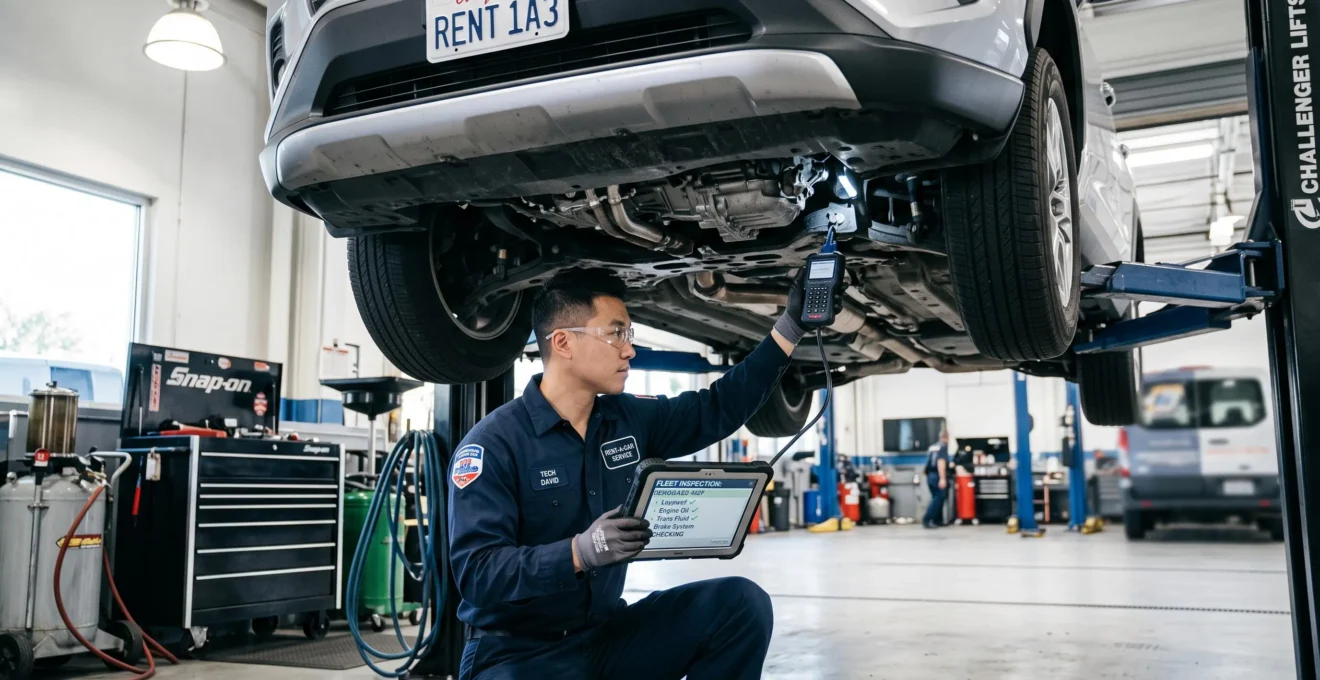
Scheduled mechanical checks help keep rental cars roadworthy by identifying wear, confirming that safety-critical components remain serviceable, and addressing developing faults before they become serious problems. For rental fleets, this requires more than responding to dashboard warnings. Vehicles need planned maintenance based on manufacturer recommendations, actual driving conditions, accumulated mileage, and elapsed time.
Long-term rentals introduce a particular challenge: a vehicle may reach its next service interval while still assigned to a customer. Fleet operators must therefore coordinate maintenance without unnecessarily disrupting the rental, while drivers need clear instructions for reporting warnings and arranging authorized service.
In the United States, maintenance schedules are primarily vehicle-specific rather than governed by one universal rental-car service interval. Understanding the distinction between inspections, scheduled servicing, and urgent mechanical repairs helps renters recognize what requires attention and helps fleet customers assess vehicle reliability.
Rental Car Maintenance: Essential Points
- Maintenance follows vehicle-specific requirements. Manufacturers establish mileage, time, and operating-condition triggers. Fleets must track these requirements throughout the vehicle’s service life.
- Routine inspections and scheduled servicing perform different functions. Quick checks identify visible problems, while more extensive mechanical services address components that require periodic professional attention.
- Long-term renters should report maintenance needs rather than authorize repairs independently. The rental company should coordinate servicing, documentation, and any necessary vehicle exchange under the rental agreement.
- Why Do Regular Vehicle Inspections Matter for Rental Car Reliability?
- Why Do Rental Vehicles Need Maintenance Checks at Specific Mileage Intervals?
- Time-Based or Mileage-Based Service: What Determines the Next Check?
- How to Arrange Scheduled Maintenance Without Interrupting a Long Rental?
- Why Should Rental Cars Be Inspected Between Customer Bookings?
- What Can Happen When Required Vehicle Servicing Is Postponed?
- When Might Heavy Stop-and-Go Driving Require Extra Maintenance?
- Why Might a Rental Car Vibrate at Highway Speeds?
Why Do Regular Vehicle Inspections Matter for Rental Car Reliability?
Regular vehicle inspections matter because they reveal developing mechanical problems, verify essential safety systems, and establish a documented picture of a rental car’s condition. Unlike a brief exterior walkaround, a structured multi-point inspection examines components that may show no obvious symptoms during ordinary driving. This helps fleet operators make informed maintenance and availability decisions.
A visual walkaround can identify body damage, visible tire problems, fluid leaks, or broken lights. However, it cannot reliably establish remaining brake-pad thickness, detect every suspension defect, assess hidden fluid contamination, or verify the condition of components underneath the vehicle.
A documented multi-point inspection goes further. Depending on the manufacturer’s requirements and the inspection’s purpose, qualified personnel may examine brake components, tires, steering and suspension parts, fluid conditions, battery connections, and diagnostic warnings. Recording the findings makes it possible to distinguish normal wear from a defect requiring repair.
Rental vehicles also experience variable operating conditions. Successive customers may use the same car for highway travel, short urban journeys, or prolonged idling. Different driving behaviors can change wear patterns, making mileage alone an incomplete indicator of mechanical condition.
Inspection histories help fleet managers identify deterioration between scheduled services. They also support decisions about whether a car can remain available, needs additional diagnostic work, or should be removed temporarily from service.
In typical U.S. rental arrangements, the rental company or fleet operator manages scheduled mechanical servicing and repair authorization. Renters are generally expected to operate the vehicle responsibly, report problems, and follow their agreement’s procedures. Specific obligations and liability depend on applicable law, contractual terms, and the circumstances.
Documented inspections also have a legal and safety dimension. Federal rules address certain rental-vehicle hazards, particularly unrepaired safety recalls. The NHTSA enforcement announcement concerning Zipcar describes a 2023 action involving rentals of vehicles with outstanding safety recalls. This recall prohibition is distinct from ordinary maintenance scheduling.
For fleet operators, inspection records demonstrate what was checked and what action followed. For customers, they support confidence that vehicle suitability was assessed rather than assumed.
Inspections establish the vehicle’s condition, but scheduled maintenance determines when specific components must receive service. That distinction becomes particularly important as rental mileage accumulates.
Why Do Rental Vehicles Need Maintenance Checks at Specific Mileage Intervals?
Rental vehicles need mileage-based maintenance because components deteriorate through use, even when no warning light or noticeable symptom appears. Manufacturers specify service intervals to address predictable wear, lubrication needs, and operating conditions. Rental fleets track these thresholds so vehicles receive appropriate attention before accumulated mileage creates avoidable mechanical risks.
Engine oil, filters, tires, brakes, and other serviceable components are affected by vehicle use. However, manufacturers do not prescribe identical intervals for every component or model. The correct schedule depends on the vehicle’s maintenance guide and, where specified, its operating conditions.
For example, the 2023 Lexus RX 350h Warranty and Services Guide recommends scheduled maintenance every six months or 5,000 miles, whichever comes first.
5,000 miles or 6 months
The scheduled maintenance interval specified for the U.S.-market 2023 Lexus RX 350h. This is a model-specific example, not a universal maintenance requirement for rental vehicles.
Lexus, 2023 RX 350h Warranty and Services Guide.
Some manufacturers distinguish between normal operating conditions and special or severe service. Examples may include repeated short trips in cold weather, extensive idling, extended low-speed operation, towing, or dusty environments.
Severe-duty maintenance is determined by actual use, not rental status alone. A rental car used primarily for steady highway travel may face different maintenance requirements from a vehicle operating repeatedly in heavy city traffic.
Fleet managers must also coordinate service across vehicles with different acquisition dates, mileages, specifications, and operating histories. Fleet-management systems can consolidate odometer readings, manufacturer schedules, service records, and maintenance alerts, reducing reliance on manual tracking.
A practical system links each vehicle to its applicable service requirements, records completed work, and flags upcoming or overdue maintenance. This helps prevent a vehicle from being assigned to a lengthy booking without considering whether its next service will become due.
Maintenance documentation matters beyond immediate reliability. The Federal Trade Commission advises retaining records such as oil changes, tire rotations, inspections, and brake repairs because warranty providers may request evidence of proper maintenance. Missing records or maintenance-related damage can complicate claims, although a missed interval does not automatically invalidate every warranty.
Consistent service histories can also support used-vehicle condition assessments when fleet vehicles are eventually sold, without guaranteeing a particular resale value.
Mileage is only part of the scheduling process. A rental car that accumulates relatively few miles can still require maintenance because some components deteriorate with age or elapsed time.
Time-Based or Mileage-Based Service: What Determines the Next Check?
The next scheduled maintenance check is determined by the manufacturer’s applicable service instructions, often using whichever threshold comes first: elapsed time or accumulated mileage. Mileage reflects vehicle use, while time captures age-related deterioration and service deadlines that continue even when a vehicle is parked. Modern monitoring systems may also influence specific maintenance decisions.
Mileage-driven maintenance addresses wear associated with driving distance. Tire rotation schedules, certain fluid services, and inspections of wearing components may be tied to odometer readings. Brake and tire replacement, however, also depend on measured condition rather than mileage alone.
Time-based maintenance addresses processes that may continue independently of distance traveled. Batteries age, rubber components deteriorate, and some fluids require replacement or evaluation after specified periods.
When a manufacturer defines both thresholds, the first one reached controls that maintenance event.
| Criterion | Mileage-Based Service | Time-Based Service |
|---|---|---|
| Primary trigger | Accumulated driving distance | Elapsed calendar time |
| Common applications | Scheduled tire rotation, specified fluid services, and periodic component inspections | Calendar-limited fluid services and age-related component assessments |
| Typical fleet concern | High utilization reaches mileage thresholds rapidly | Low utilization does not stop age-related deterioration |
| Required decision | Compare odometer reading with the manufacturer’s schedule | Compare the service date with the applicable calendar interval |
Consider a hypothetical rental car whose applicable service schedule requires a check every 5,000 miles or six months. If it travels 5,000 miles in three months, the mileage threshold determines when service becomes due. If it travels only 2,000 miles over six months, the time threshold applies instead.
This example illustrates the scheduling principle, not a universal service interval.
Drivers and fleet customers can identify applicable requirements by checking the owner’s manual or manufacturer maintenance guide for the exact model, model year, and powertrain. The maintenance section should identify service items, intervals, special operating conditions, and any inspection or replacement requirements.
Many newer vehicles also use oil-life monitoring systems that estimate oil service needs based on operating conditions. These estimates can be useful, but they should be interpreted alongside the manufacturer’s instructions. A fleet may use additional scheduling controls for operational consistency without disregarding the applicable maintenance requirements.
A dashboard reminder is not the complete maintenance schedule. Tires, brakes, fluids, and age-related items may require separate attention even when the oil-life display indicates that an oil change is not yet due.
Once a service requirement is identified, the operational challenge becomes arranging it at the right time, especially when the car is already committed to a long-term rental.
How to Arrange Scheduled Maintenance Without Interrupting a Long Rental?
Scheduled maintenance during a long rental should be coordinated directly with the rental company. When a service reminder appears or an interval approaches, the renter should report the vehicle’s mileage, location, and dashboard message before arranging any work. The company can then authorize service, select an approved facility, or organize a replacement vehicle.
Rental fleets ordinarily try to perform scheduled servicing when vehicles are not assigned to customers. Turnover periods, planned downtime, and maintenance reservations offer opportunities to complete work without interrupting an active rental.
Long-term bookings make this more complicated. A vehicle may leave the branch below its next maintenance threshold but reach that threshold several weeks later, particularly when the renter travels extensively.
Fleet operators can reduce interruptions by considering anticipated mileage before assigning a vehicle to a long booking. Nevertheless, unexpected changes in travel distance or operating conditions can still create a mid-rental service requirement.
Depending on company policy, the vehicle’s condition, and local service availability, the practical options may include an approved workshop appointment, a vehicle exchange at a rental branch, or coordinated servicing at an appropriate point in the rental. Deferring service until return is suitable only if consistent with the manufacturer’s instructions and the vehicle’s condition.
Drivers should distinguish a routine service reminder from a warning suggesting an immediate mechanical or safety concern. A scheduled maintenance notification may permit coordinated service, while symptoms such as overheating, braking problems, or an oil-pressure warning may require stopping as soon as it is safe and contacting roadside assistance.
Repair authorization and billing should be confirmed before work begins. A renter who independently purchases maintenance services may face reimbursement complications if the rental agreement requires prior approval.
For drivers far from the original branch, the rental company’s roadside assistance or customer support channel is generally the appropriate starting point. The renter should record the warning message, odometer reading, vehicle location, and any instructions received.
Five Steps to Coordinate Maintenance During a Long Rental
- Record the service indicator. Photograph the dashboard message and current odometer reading to establish what the vehicle displayed.
- Contact the rental company. Report the vehicle’s location, rental agreement reference, and warning details; retain the support case number or written acknowledgment.
- Confirm the service arrangement. Obtain written instructions identifying the approved workshop, branch exchange, or other authorized solution.
- Clarify practical arrangements. Confirm who authorizes payment, where the vehicle should be taken, and whether a replacement is available; keep the written confirmation.
- Preserve completion records. Request confirmation of the completed service or vehicle exchange and retain it with the rental correspondence.
Written confirmation reduces misunderstandings about who approved the service, how costs will be handled, and whether the vehicle should remain in use.
The easiest maintenance interruption to manage is one prevented before the rental begins. That is why checks between customer bookings remain an important complement to scheduled servicing.
Why Should Rental Cars Be Inspected Between Customer Bookings?
Rental cars should be inspected between bookings to identify new damage, visible mechanical problems, and warning indicators before another customer receives the vehicle. These quick turnover checks complement scheduled mechanical servicing by focusing on changes that may have occurred during the previous rental. Any concern affecting safe operation should be resolved before the car is reassigned.
A typical turnover inspection may cover exterior body condition, lights, windows, interior damage, visible tire condition, obvious fluid leaks, and dashboard warning indicators. The precise procedure depends on the rental operator’s inspection program and the vehicle’s condition.
Turnover inspections are usually designed to be relatively quick. They are not substitutes for comprehensive mechanical servicing because many faults require workshop equipment, component measurements, or professional diagnosis.
For example, an inspector may notice a tire bulge, damaged wheel, fluid stain beneath the vehicle, or persistent warning light. Each observation creates a reason for further assessment rather than an automatic diagnosis.
If the issue could compromise safe operation, the fleet operator should remove the vehicle from customer availability until the problem has been properly assessed and addressed. Fleet systems may designate this status as grounded, unavailable, or out of service.
Turnover checks and scheduled servicing answer different questions. A turnover inspection asks whether the vehicle has developed an observable issue since its previous assignment. Scheduled servicing asks whether maintenance required by the manufacturer or vehicle condition has been completed.
| Characteristic | Turnover Inspection | Scheduled Servicing |
|---|---|---|
| Timing | Between customer bookings | According to mileage, time, condition, or manufacturer requirements |
| Primary purpose | Identify new damage and observable faults | Perform required maintenance and detailed mechanical assessment |
| Typical activities | Visual condition checks and warning-light review | Specified fluid services, measurements, component inspections, and repairs |
| Documentation | Condition and damage records | Service history, inspection results, and repair records |
Condition records also protect customers against disputes over pre-existing damage. Renters can complement the company’s documentation by photographing the exterior, wheels, interior, and any existing defects at pickup and return.
Photographs should be sufficiently clear to show the condition and location of relevant damage. A renter should also report discrepancies in the vehicle condition record before leaving the pickup location when practicable.
Even with frequent inspections, maintenance can occasionally become overdue. Understanding the consequences of postponement explains why inspection findings and service deadlines must lead to timely decisions.
What Can Happen When Required Vehicle Servicing Is Postponed?
Postponing required vehicle servicing can increase component wear, allow developing defects to worsen, and create avoidable breakdown or safety risks. The consequences depend on which maintenance item is overdue and the vehicle’s actual condition. For rental fleets, deferred work can also increase repair costs, vehicle downtime, warranty disputes, and operational uncertainty.
Different maintenance omissions produce different risks. Delayed engine-oil replacement can reduce lubrication effectiveness as oil deteriorates or becomes contaminated, potentially accelerating internal engine wear.
Neglected brake maintenance may allow worn friction components or other defects to affect braking performance. Depending on the problem, braking distance, control, noise, or component reliability may be affected.
Incorrect tire pressure, excessive tread wear, and damaged tire structures can increase the risk of tire failure or reduced traction, particularly in demanding driving conditions.
The NHTSA TireWise tire safety recommendations emphasize inspecting tires for inflation pressure, tread wear, and damage. The agency identifies 2/32 of an inch as a replacement threshold for tire tread, while also recognizing that tire damage, aging, and other conditions may require earlier action.
A tire therefore cannot be judged safe solely because its remaining tread exceeds that threshold.
Mechanical deterioration can also generate escalating costs. A relatively straightforward maintenance requirement may become more expensive if continued operation damages other components. Fleet operators can then face both repair expenses and periods when the vehicle cannot generate rental revenue.
These outcomes are possible consequences, not inevitable results of every delayed service appointment. A short scheduling delay does not automatically establish that a vehicle is unsafe, but it should not be accepted without considering the applicable maintenance requirements and observed condition.
From a fleet-management perspective, deliberate postponement and accidental neglect require different responses. A planned decision should involve a qualified assessment of the vehicle, applicable manufacturer instructions, and operational risks. A missed service caused by inaccurate mileage records or failed scheduling controls calls for improvements to the tracking process.
Maintenance documentation also matters when assessing warranty coverage. The FTC’s information on auto warranties and service contracts explains that maintenance records may be requested to evaluate whether a vehicle has been maintained properly. Coverage decisions depend on the warranty terms and relevant facts; missing an interval does not automatically void an entire warranty.
In the United States, a maintenance-related defect that contributes to an accident may also raise questions about inspection practices, repair decisions, and liability. Specific responsibilities depend on the circumstances and applicable law. Federal safety recall restrictions should not be confused with a nationwide rule that every overdue routine service automatically makes a rental illegal to operate.
Renters should report warning signs including visibly damaged tires, persistent fluid leaks, unusual braking behavior, unexplained vibration, abnormal noises, or unresolved dashboard warnings.
Maintenance urgency also depends on how a vehicle is used. Heavy urban driving can accelerate certain types of wear, requiring operators to evaluate whether the normal service schedule remains appropriate.
When Might Heavy Stop-and-Go Driving Require Extra Maintenance?
Heavy stop-and-go driving may require additional maintenance when the vehicle manufacturer’s schedule identifies frequent idling, short trips, or prolonged low-speed operation as special service conditions. These patterns can increase demands on brakes, engine oil, cooling systems, and transmission components. The need for extra service depends on the specific vehicle and its actual operating environment.
During repeated urban journeys, brakes are applied more frequently than during steady-speed highway travel. This can increase brake-pad wear and generate heat through repeated deceleration. The degree of wear depends on driving conditions, vehicle weight, driving technique, and braking-system design.
Frequent short trips can also prevent an engine from consistently reaching normal operating temperature. Under certain conditions, moisture and combustion byproducts may accumulate in engine oil, making operating patterns relevant to oil-service requirements.
Extended idling and low-speed travel can create engine operating hours without equivalent odometer mileage. This helps explain why distance traveled does not always capture the full mechanical demands of urban fleet use.
Automatic transmissions may also experience repeated shifts and thermal loads in congested traffic, although maintenance requirements differ substantially across transmission designs.
The Lexus maintenance guide discussed earlier identifies extensive idling or low-speed driving over long distances, including taxi and delivery operations, as special operating conditions. For the specified 2023 RX 350h, certain special operating conditions require engine oil and filter replacement every six months or 5,000 miles, even if the oil maintenance reminder has not appeared.
This does not mean every rental car used in traffic requires that exact interval. Each vehicle must be evaluated against its own manufacturer’s guidance.
Rental applications that may merit closer review include repeated airport-to-city trips, dense urban driving, and authorized commercial passenger or delivery use. The last category also depends on whether the rental agreement permits that activity.
Drivers should report symptoms such as persistent brake squealing, reduced braking effectiveness, unusual transmission hesitation, burning odors, or warning messages. These symptoms may indicate developing problems, but they do not establish a diagnosis by themselves.
Additional maintenance should be condition- and schedule-driven, not assumed merely because a rental operates in a city. Fleet managers should consider actual usage records, manufacturer guidance, and mechanical inspection findings.
Renters planning extensive urban driving can ask the rental company whether the assigned vehicle is suitable for the intended usage. Maintenance authorization and servicing decisions remain with the operator under the applicable agreement.
Operating conditions are only one source of maintenance information. Certain symptoms experienced behind the wheel, particularly persistent vibration at highway speeds, warrant attention even when the next scheduled service is not yet due.
Key Takeaways Before Your Next Highway Trip
- Driving symptoms can override routine scheduling. A car may need immediate assessment even if its next scheduled maintenance interval is weeks or miles away.
- Tire and wheel condition affects both comfort and safety. Persistent vibration should not be treated as an ordinary characteristic of a heavily used rental vehicle.
- Prompt reporting is preferable to self-repair. A rental company can coordinate professional diagnosis and determine whether the vehicle should be exchanged.
Why Might a Rental Car Vibrate at Highway Speeds?
A rental car may vibrate at highway speeds because of wheel imbalance, tire damage, uneven tire wear, a bent wheel, or faults involving suspension and driveline components. The location and behavior of the vibration can help technicians narrow down potential causes, but the symptom alone cannot identify the fault. Persistent or worsening vibration warrants professional assessment.
Wheel imbalance is one possible explanation. If mass is distributed unevenly around a wheel-and-tire assembly, rotating forces can produce noticeable shaking at certain speeds.
Tire irregularities can create similar symptoms. Uneven tread wear, internal tire damage, or wheel deformation following a pothole impact may cause vibration that becomes more apparent as road speed increases.
Steering and suspension problems are additional possibilities. Worn components can affect wheel control, while alignment problems may contribute to uneven tire wear. Alignment itself should not automatically be assumed to be the direct cause of every vibration.
Brake-related vibration often becomes more noticeable during deceleration or brake application rather than during steady cruising.
The location of the vibration provides useful clues:
- Steering-wheel vibration: May point toward a front wheel, tire, steering, or suspension issue.
- Seat or floor vibration: May suggest a rear wheel, tire, driveline, or another source transmitting movement through the vehicle body.
- Vibration increasing with road speed: Can be consistent with wheel or tire problems, although other causes remain possible.
- Vibration mainly during braking: May indicate a braking-system concern requiring inspection.
These patterns are diagnostic clues rather than definitive tests. A professional may need to inspect tire condition, measure wheel runout, assess balance, check suspension components, or perform other procedures before identifying the cause.
Rental cars are exposed to multiple drivers and changing road conditions. Curbs, potholes, and unfamiliar driving environments create opportunities for wheel or tire damage that may not be immediately reported. However, this does not establish that rental vehicles experience more vibration-related failures than privately owned cars.
The National Highway Traffic Safety Administration identifies wheel imbalance as a possible source of shaking or vibration and advises professional attention when unusual tire-related noise or vibration occurs.
For renters, the response should depend on severity. If vibration is accompanied by abnormal steering, visible tire damage, vehicle instability, or rapidly worsening symptoms, reduce speed safely and stop in a suitable location. Contact the rental company’s roadside assistance service and avoid continuing the journey until appropriate guidance is provided.
Even when vibration is relatively mild, notify the rental company promptly and request an inspection. If a safety-critical problem is suspected or the vehicle is not suitable for continued use, request an authorized vehicle exchange.
Do not attempt wheel balancing, tire repairs, or suspension adjustments independently during the rental unless the company has specifically authorized the work.
Before continuing a long journey, record the speed range and driving conditions in which the vibration occurs, report the observations to the rental provider, and obtain instructions for professional assessment. For fleet customers, this same reporting process creates useful maintenance information and helps keep vehicles with unresolved safety concerns out of service.
Can a rental company charge a customer for a routine scheduled oil change?
Routine scheduled maintenance is generally coordinated by the rental company rather than independently purchased by the renter. Whether any cost can be charged to a customer depends on the rental agreement and circumstances. Before authorizing an oil change or other service, request written confirmation of the provider’s instructions and billing arrangements.
Does a maintenance reminder automatically mean a rental car is unsafe to drive?
No. A routine maintenance reminder may simply indicate that a scheduled interval has been reached. However, it should not be ignored, and some dashboard warnings indicate more urgent faults. Report the exact message to the rental company and follow the vehicle manufacturer’s instructions, particularly when warning lights are accompanied by abnormal operation.
Can a long-term renter check the vehicle’s maintenance history?
A renter can ask the rental company to confirm that required maintenance is current and whether any service is expected during the booking. Access to detailed workshop records depends on company policies and contractual arrangements. Fleet customers may have additional reporting arrangements covering service status, vehicle availability, and maintenance compliance.
Should tire pressure be checked even when the dashboard shows no warning?
Yes. A tire pressure monitoring system does not replace regular tire maintenance, and underinflation may not be obvious from appearance alone. NHTSA recommends checking tire pressure at least monthly when tires are cold. For a long-term rental, use the vehicle manufacturer’s specified pressure and report persistent pressure loss or visible tire damage to the rental company.
Is every rental vehicle required to follow a severe-duty maintenance schedule?
No. Severe-duty or special operating-condition requirements depend on the vehicle manufacturer’s instructions and how the car is actually used. Frequent short trips, extensive idling, and certain demanding environments may trigger additional maintenance, but rental status alone does not automatically establish that the vehicle qualifies. Fleet operators should evaluate operating conditions against the applicable maintenance guide.