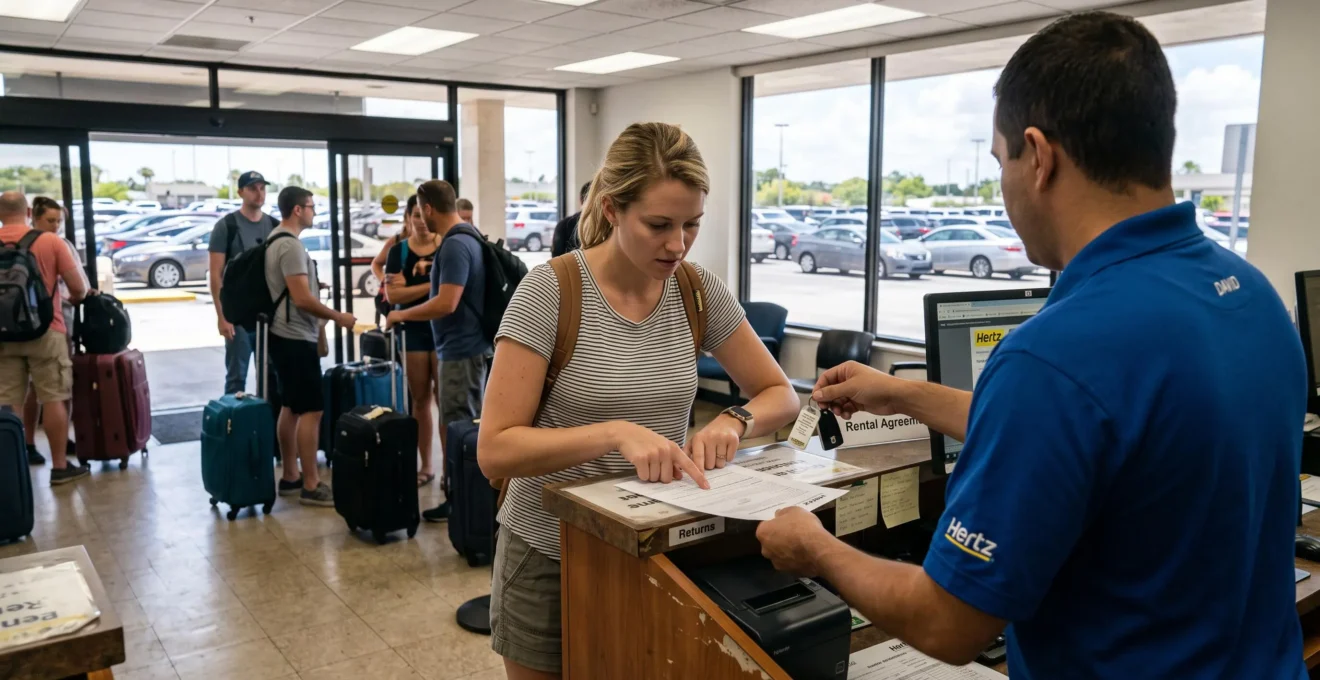
Collecting a rental car in Florida involves more than presenting a driver’s license and receiving the keys. Before leaving the rental facility, travelers should verify their reservation, payment authorization, insurance arrangements, rental agreement, and the vehicle’s actual condition. Completing these checks in the right order helps prevent avoidable delays, disputed charges, and problems at return.
The process can differ substantially between an airport rental facility in Orlando, Miami, or Tampa and a smaller neighborhood branch. Counter opening hours, shuttle transfers, payment restrictions, and vehicle collection procedures are not necessarily identical, even within the same rental company.
A reliable handover therefore has three stages: prepare the documents before arrival, verify the contractual details before accepting the vehicle, and record its condition before driving away. Florida-specific considerations, including electronic toll collection, intense sunshine, heavy rainfall, and potentially long highway journeys, make a few additional checks worthwhile.
Florida rental car pickup: the essentials
- Confirm the branch’s opening hours, late-arrival rules, required identification, and accepted payment method before traveling to the collection point.
- Compare the written agreement with the reservation, including the vehicle class, fuel policy, coverage, deposit authorization, and return arrangements.
- Inspect and photograph the vehicle, report discrepancies before departure, and retain the updated condition report and rental agreement.
- Why Do Rental Car Collection Times Vary Between Locations?
- How to Prepare Your License and Reservation Details for Rental Pickup?
- Rental Counter or Contactless Pickup: Which Is More Convenient?
- Which Handover Details Should You Confirm Before Signing?
- When Should You Request a Correction Before Leaving the Rental Lot?
- How to Complete a Rental Car Walkaround Before Departure?
- Which Payment Restrictions Can Prevent a Rental Car Pickup?
- How to Make a Florida Car Rental Trip Less Stressful and More Predictable?
Why Do Rental Car Collection Times Vary Between Locations?
Rental car collection times vary because each Florida location has different staffing, customer volumes, transport arrangements, and vehicle preparation procedures. Airport facilities may experience concentrated arrival periods, while smaller branches can have shorter queues but more limited opening hours. The total collection time includes reaching the desk, completing the agreement, receiving the vehicle, and inspecting it before departure.
At an airport, collecting checked luggage and reaching the rental facility can take considerable time before the rental process begins. Some facilities are accessible through airport transportation systems, while others require a shuttle transfer. Flight delays may also concentrate customers into unexpected arrival periods, placing additional pressure on available staff.
Off-airport branches may offer a quieter collection experience, but they can operate with fewer employees and less flexibility around closing times. An available vehicle does not necessarily mean it is ready for immediate release.
The most practical approach is to divide pickup into separate operational stages:
- Access: Travel from the terminal or arrival point to the rental facility.
- Verification: Present identification, confirm payment eligibility, and complete the contract.
- Assignment: Receive the allocated vehicle or select one where the rental program permits.
- Departure: Inspect the vehicle, document discrepancies, and complete the exit procedure.
Pickup timing should reflect both flight arrival and the branch’s operating conditions. The following grid provides a practical planning comparison, not a guarantee of queue length.
| Pickup situation | Operational consideration | Recommended action |
|---|---|---|
| Midday airport arrival | May coincide with concentrated flight arrivals and counter demand. | Allow flexibility for luggage collection, transfers, and verification. |
| Early evening airport arrival | Potential overlap between arriving travelers and reduced later staffing. | Check the branch’s evening hours and delayed-flight procedure. |
| Off-peak airport arrival | Queues may be shorter, although vehicle readiness still varies. | Choose a realistic pickup slot rather than assuming immediate collection. |
| Late-night or off-airport collection | Fixed closing times may limit or prevent collection after delays. | Verify the reservation-hold deadline and after-hours arrangements. |
Late arrival rules deserve particular attention. According to Hertz rental qualifications and reservation requirements, its off-airport locations generally hold reservations for two hours after the scheduled pickup time unless the customer contacts the reservation center to change that time. The company also specifies separate conditions for prepaid reservations, including location closing times.
These are Hertz-specific conditions, not universal Florida rules. Other companies and booking channels may apply different deadlines or cancellation charges. A late arrival can affect vehicle availability, and a reservation classified as a no-show may have financial consequences under the applicable terms.
Before departure, save the branch’s direct contact information and confirm whether providing a flight number changes its delayed-arrival arrangements. A realistic pickup window protects the reservation more effectively than simply arriving at the airport early.
How to Prepare Your License and Reservation Details for Rental Pickup?
Prepare your rental documents by checking that your driving license is valid, your reservation matches your identity, and your payment card meets the pickup location’s requirements. International visitors should also check whether the rental company requires an International Driving Permit or a translation. Keep the confirmed rental rate and booking conditions available offline to resolve discrepancies immediately.
Florida generally permits qualifying nonresidents to drive with a valid noncommercial license issued by their home state or country, subject to statutory conditions. The Florida Statutes § 322.04 on nonresident driving-license exemptions establishes the relevant legal framework.
However, legal permission to drive is not identical to rental-company eligibility. Rental providers can impose additional documentation requirements, particularly for licenses issued outside the United States.
Bring your original physical driving license in readable, undamaged condition. A photograph stored on a phone should not be treated as a substitute for the original. Digital license acceptance is provider-specific, and the required identification should be confirmed before pickup.
International visitors should determine whether an International Driving Permit is needed under their rental provider’s rules. An IDP is a supporting document and does not replace the underlying driving license. Requirements may depend on the issuing country, license language, and rental conditions.
Before arriving at the counter, reconcile four details:
- The primary driver’s name on the booking and driving license, including spelling and surname order.
- The payment card and whether it must physically belong to the primary driver.
- The confirmed rate, pickup and return details, vehicle category, and included services.
- The booking channel responsible for amendments, cancellations, and refunds.
Save the confirmation email and a screenshot of the final booking price. Record which charges are prepaid and which remain payable locally. If the counter presents a different price, these documents provide a specific reference for clarification.
Additional drivers require separate attention. Some rental programs waive additional-driver fees for spouses or domestic partners, but eligibility may depend on membership, jurisdiction, and rental terms. For example, Hertz publishes a spouse or domestic-partner fee exemption for qualifying Gold+ members in the United States.
Do not assume that a fee exemption removes identification requirements. Confirm which additional drivers must appear at the counter, present their licenses, and be recorded in the agreement.
Third-party reservations introduce another potential complication. The intermediary may control cancellation or modification rights, while the rental location can usually act only within the booking details and permissions available in its own system.
Keep the required originals in hand luggage rather than checked baggage. Once identity, booking authority, and payment eligibility are confirmed, the next decision is whether to complete the handover at a staffed counter or through a contactless service.
Rental Counter or Contactless Pickup: Which Is More Convenient?
Contactless rental pickup can be more convenient when identification, payment, and vehicle assignment have already been approved. A staffed counter is often preferable when the booking requires clarification, additional drivers, or changes to the agreed terms. The better option depends on the complexity of the reservation and the support available if the assigned vehicle is unsuitable.
Contactless pickup may involve mobile check-in, app-based vehicle access, a designated pickup area, or a streamlined exit procedure. Availability and the exact steps depend on the rental company, branch, and customer eligibility.
The trade-off is not simply speed. A counter offers direct assistance when the reserved vehicle class is unavailable or a charge appears incorrect. Contactless pickup can reduce routine interactions but places greater importance on checking digital records and reporting vehicle damage promptly.
| Decision factor | Staffed rental counter | Contactless pickup |
|---|---|---|
| Collection speed | Depends on queues and staff availability. | May be faster after successful advance verification. |
| Billing questions | Immediate opportunity to discuss discrepancies. | May require app support, phone assistance, or a later review. |
| Vehicle selection | Staff may help locate an alternative vehicle. | Depends on the program’s available selection features. |
| Condition documentation | Staff can explain or amend condition records. | Renter must follow the digital reporting process carefully. |
| Technical problems | Direct assistance may be available during operating hours. | Dependent on account access, connectivity, and support channels. |
Choose a staffed counter when the reservation involves a prepaid third-party rate that needs clarification, a new additional driver, insurance questions, or an upgrade discussion.
Contactless pickup is particularly useful when the booking is straightforward, the driver has completed all necessary verification, and the location supports the service for the reserved vehicle category.
Unpredictable flight arrival times can make contactless collection attractive, but contactless does not necessarily mean collection is available around the clock. Access to vehicles, parking facilities, and support remains subject to local arrangements.
Before traveling, install the required app, create the account, verify the license, and confirm that the reservation appears correctly. Download relevant instructions where possible. Relying entirely on airport Wi-Fi to complete unfamiliar identity checks can erase any time advantage.
If a vehicle problem appears during contactless collection, use the provider’s designated reporting channel before departure. Keep the submission confirmation and follow the instructions for changing vehicles when necessary.
Regardless of the collection method, the agreement must accurately reflect the vehicle and services supplied. A fast pickup provides little benefit if an unnoticed contract error becomes a billing dispute later.
Which Handover Details Should You Confirm Before Signing?
Before signing a Florida rental agreement, verify the assigned vehicle category, total charges, fuel policy, mileage allowance, insurance or waiver selections, deposit authorization, and return arrangements. Compare every material term with the reservation confirmation. Any difference should be explained and corrected in writing before acceptance, because the final agreement usually becomes the central reference for subsequent billing disputes.
Start with the assigned vehicle. Confirm that its category matches what was reserved or that an acceptable replacement has been agreed upon. Check whether an upgrade carries an additional charge and whether any promised inclusion appears in the final contract.
Next, read the fuel and mileage terms. A full-to-full agreement generally requires the car to be returned with the agreed starting fuel level. A prepaid fuel option follows different charging and refund conditions. Mileage may be unlimited or restricted depending on the rental product.
Verify the return branch, date, and time. An incorrect return location can create unexpected fees, while returning after the contracted deadline can trigger additional charges under the provider’s rules.
Insurance and damage waivers require a separate review. Distinguish among protection included in the booking, any applicable personal insurance, benefits offered by a credit card, and optional products presented at pickup.
Credit card collision coverage often has eligibility conditions, including payment with the qualifying card and declining the rental company’s collision damage waiver. Coverage may be secondary, exclude certain vehicle categories, or have territorial and duration restrictions. Confirm the actual card benefit terms and avoid treating all credit card products as interchangeable.
Likewise, rental-company collision damage waivers are contractual arrangements rather than necessarily conventional insurance policies. They may limit financial responsibility for specified losses, subject to exclusions and compliance with the rental agreement.
Accepting overlapping products can create unnecessary costs; declining coverage without confirming an alternative may leave an exposure. The contract should identify the selections actually made.
Review the payment authorization as carefully as the rental price. A security deposit or authorization hold can temporarily reduce the available balance on the payment card. The amount depends on the company, branch, vehicle, and renter’s circumstances.
For example, Enterprise publishes a deposit range of $200 to $850 under certain conditions involving renters without a ticketed return travel itinerary. This is a conditional Enterprise policy, not a standard deposit for all rentals in Florida.
Ask for the exact amount to be authorized, whether further holds may apply, and the process for release after return. A release initiated by the rental company may not become available on the customer’s account immediately; timing also depends on the card issuer.
Finally, confirm that the condition report corresponds to the vehicle physically supplied. Existing damage not recorded in the report should be documented and reported before departure, rather than assumed to be covered by an informal verbal acknowledgment.
Keep the signed or digitally accepted agreement in an accessible location. If the contract, vehicle, or equipment does not match what was agreed, the best opportunity for correction is usually before leaving the rental facility.
When Should You Request a Correction Before Leaving the Rental Lot?
Request a correction before leaving the rental lot whenever the vehicle, condition report, charges, equipment, or rental terms differ materially from the agreed booking. Errors are generally easier to resolve while the vehicle and rental staff are still available. Obtain an updated agreement or documented acknowledgment rather than relying exclusively on a verbal promise.
The rental lot exit is an important operational checkpoint. Once the vehicle leaves, resolving a discrepancy may involve returning to the facility, contacting a support team, or contesting a charge after the rental has ended.
Not every issue requires replacing the vehicle, but every material discrepancy should be recorded.
- Incorrect vehicle category: Ask whether the assigned vehicle meets the reservation and request an appropriate alternative or written adjustment.
- Missing equipment: Report an absent child seat, navigation device, or other reserved item before departure.
- Fuel discrepancy: Photograph the gauge and have the starting fuel level corrected in the rental record.
- Unrecorded damage: Request an updated condition report or use the approved digital damage-reporting process.
- Incorrect charges: Ask staff to reconcile the amount against the booking confirmation and issue the applicable revised documentation.
A superficial cosmetic mark may not require changing vehicles if it is properly recorded and does not affect safe operation. However, photographs alone should not replace reporting through the rental company’s designated process.
A safety-related defect calls for a different response. A damaged tire, malfunctioning seatbelt, defective lighting system, or another condition affecting safe operation should be reported before the vehicle is driven. Request a suitable replacement rather than accepting an unsafe vehicle.
When requesting a correction, identify the exact discrepancy and refer to the written agreement. For example, state that the contract records a full fuel tank while the dashboard indicates a lower starting level.
Ask the representative to issue a revised agreement, amend the condition report, or provide an acknowledgment through the company’s approved system. Retain the updated document and any associated case or reporting reference.
For contactless pickup, record the issue through the app or designated customer support channel before leaving. Save confirmation that the report was successfully submitted; drafting a message without sending it does not establish that the company received it.
A corrected agreement and an accurate condition record establish a consistent starting point for the rental. The next step is a methodical physical inspection to confirm that nothing important has been overlooked.
How to Complete a Rental Car Walkaround Before Departure?
Complete a rental car walkaround by inspecting the exterior in a fixed sequence, photographing existing damage, checking the tires and essential equipment, and recording the fuel level and odometer. Compare your findings with the rental company’s condition report. Report discrepancies before leaving so the official record and your supporting photographs describe the same vehicle condition.
Start at the front bumper and move around the car in one direction: front, driver’s side, rear, and passenger’s side. This consistent sequence reduces the chance of overlooking a panel when the pickup area is busy.
Take an overview photograph of each side, followed by closer views of visible scratches, dents, cracked lights, chipped glass, or wheel damage. Two angles can help show marks that disappear in reflective paintwork.
Florida’s strong sunlight may make fine scratches difficult to distinguish against reflections or faded paint. Change your viewing angle when necessary and avoid relying only on photographs taken directly into bright sunlight.
Rain is another practical consideration. Florida’s frequent thunderstorms make tire condition, windshield visibility, and functional wipers particularly important before a highway journey.
Check the visible tire tread, sidewalls, and obvious signs of damage or underinflation. If a tire appears unsafe, ask the rental company to inspect or replace the vehicle rather than attempting to diagnose the problem yourself.
Inside the vehicle, photograph the odometer and fuel gauge. Check the seats, dashboard, windows, and cargo area for damage or missing equipment. Verify that the air conditioning cools properly, an especially useful precaution in Florida’s warm climate.
Test the seatbelts, horn, headlights, turn signals, brake lights where safely practical, and windshield wipers. Identify the location of the spare tire or manufacturer-provided tire inflation kit if the vehicle is equipped with one, and check that required emergency equipment is present under the rental provider’s policy.
The documentation hierarchy matters. The company’s condition report is a primary contractual record of the vehicle’s condition at handover. Personal photographs support that record and can help resolve disagreements, but they do not automatically establish that the company accepted a reported defect.
Make the condition report and photographs consistent. Where possible, show the condition report alongside the damage and preserve the original image files with their capture information. Use the provider’s official reporting process to create a corresponding acknowledgment.
Five-Step Rental Car Walkaround Checklist
- Inspect the front, driver’s side, rear, and passenger’s side; save a complete set of exterior overview photographs.
- Photograph every existing scratch, dent, glass defect, or wheel mark; save close-ups linked to the relevant vehicle panel.
- Check the tires, lights, wipers, horn, seatbelts, and air conditioning; record any defects requiring attention.
- Photograph the dashboard fuel gauge and odometer; retain images showing their pickup readings.
- Compare findings with the condition report and submit missing damage through the approved channel; save the amended report or reporting confirmation.
If a mechanical or safety-related problem is found, stop the handover and request assistance. A replacement vehicle may be necessary when the defect cannot be resolved safely before departure.
Once the vehicle inspection is complete, make sure the payment authorization has also been accepted. Even a confirmed reservation and available vehicle cannot overcome a card that fails the rental location’s payment requirements.
Which Payment Restrictions Can Prevent a Rental Car Pickup?
Rental car pickup can be refused when the payment card is not accepted, does not belong to the primary driver, lacks sufficient available funds, or fails the location’s identification requirements. Debit cards, virtual cards, and prepaid cards may face additional restrictions. Acceptance depends on the specific rental company, pickup branch, vehicle category, and applicable reservation conditions.
A successful online booking payment does not necessarily mean the same card will be accepted at the rental desk. Booking platforms may process prepaid charges separately from the security authorization required when collecting the vehicle.
Most conventional rental arrangements are easier to complete with an eligible physical credit card in the main driver’s name. Debit card acceptance is less predictable and may depend on whether the branch is located at an airport.
For a concrete example, Enterprise‘s accepted rental car payment methods and deposit policy states that its US airport locations accept debit cards at pickup only with a ticketed return travel itinerary, subject to additional conditions.
At non-airport Enterprise branches, debit card acceptance and supporting documentation may differ by location. The company also states that online-only virtual credit cards and single-use card numbers are not accepted for rental transactions.
These restrictions are Enterprise-specific. They should not be presented as rules followed identically by Hertz, Avis, Budget, or other rental providers.
Before booking, verify the actual branch policy for:
- Accepted credit and debit card networks and whether a physical card is required.
- The requirement for the cardholder’s name to match the primary renter.
- Additional identification, travel itinerary, and address verification rules.
- Vehicle categories excluded from debit card rentals.
- The amount of the deposit or authorization hold and any applicable additional security conditions.
Available credit is not the same as the rental price. The initial authorization may include the rental cost, security deposit, or other amounts specified by the provider. A customer whose card covers only the advertised booking price may still fail the authorization check.
If relying on a debit card, obtain confirmation from the specific pickup branch rather than assuming a nationwide brand policy applies unchanged. Ideally, retain written confirmation of any exceptional arrangement.
Travelers without an eligible conventional credit card can research providers that explicitly accept their available payment method or offer alternative deposit arrangements. Verify those terms directly and assess the total price before making a nonrefundable reservation.
A refused card does not automatically create the same no-show outcome everywhere. The booking’s cancellation terms, prepaid conditions, and rental provider’s procedures determine whether charges are retained or a refund is available.
Where permitted, bringing a second eligible payment card in the main driver’s name provides an additional safeguard. A companion’s card should not be assumed acceptable unless the rental company has expressly authorized that arrangement.
Confirming payment eligibility before travel eliminates one of the most disruptive pickup failures. With the reservation, contract, vehicle, and card aligned, the remaining task is to anticipate the conditions that may affect the wider Florida trip.
Key Takeaways Before Your Florida Road Trip
- A complete handover record should connect the reservation, signed agreement, vehicle condition report, and accepted payment authorization.
- Florida toll arrangements and weather-related travel disruptions deserve decisions before the first highway journey, not after charges or delays occur.
- Plan the vehicle return with the same attention as collection: condition evidence, return confirmation, and invoice review protect the final stage of the rental.
How to Make a Florida Car Rental Trip Less Stressful and More Predictable?
A Florida car rental trip becomes more predictable when booking conditions, documentation, insurance decisions, toll arrangements, and return procedures are checked in advance. The aim is to eliminate preventable uncertainties before each stage of travel. A simple timeline covering booking, departure, pickup, driving, and return helps travelers manage both contractual obligations and Florida-specific driving conditions.
At booking, confirm the pickup branch’s operating hours, late-arrival policy, payment restrictions, driver eligibility, and cancellation conditions. Check whether the return location differs from the pickup location and whether additional charges apply.
Before departure, organize the required physical documents, payment card, booking confirmation, and coverage details. Complete any digital identity verification needed for contactless collection. Save relevant customer service contact information offline.
At pickup, reconcile the agreement with the reservation, inspect the assigned vehicle, report discrepancies, and preserve the resulting documents. This establishes a reliable record for the remainder of the rental.
Florida toll payments require a separate decision. The state has electronic toll facilities, and many rental companies offer programs that bill toll charges through the rental agreement, sometimes with additional service fees.
According to SunPass information on paying Florida tolls with rental vehicles, rental-company toll programs can combine toll charges with administrative or service fees. Eligible prepaid toll arrangements may also allow renters to register a rental vehicle’s license plate and rental dates.
Do not assume that a personal transponder can be used without coordination with the rental company’s toll program. Compatibility, duplicate billing prevention, and account registration requirements should all be checked before entering toll roads.
The cheapest toll arrangement depends on the route, number of toll transactions, rental duration, and provider’s current fees. Some facilities do not offer cash payment, so relying on cash alone is not a reliable statewide strategy.
Travel conditions also affect predictability. Florida’s afternoon thunderstorms can reduce visibility and complicate highway driving. Allow flexibility in the itinerary and avoid scheduling every transfer around an optimistic minimum driving time.
During Atlantic hurricane season, disruption can involve airport operations, road conditions, rental branch closures, or altered return arrangements. Check the rental company’s weather-related cancellation and extension conditions before travel, and contact the provider if an emergency affects the agreed return.
Long journeys between cities such as Miami, Orlando, Tampa, and Jacksonville should account for traffic, fuel stops, rest periods, and potential weather delays. At major tourism destinations, verify parking availability, hotel parking fees, and any restrictions before arriving.
The return is part of the same documentation process. Photograph the exterior, interior, dashboard, and fuel gauge at the return location. Use the designated return procedure and request a receipt or electronic confirmation showing the return date and time. Where available, obtain a record of the vehicle’s accepted condition.
Review the final rental invoice once issued. Some toll charges and related fees may appear after the initial rental closing statement because toll processing can occur separately. Compare any later charge with the contract and available transaction records.
Keep the reservation, agreement, condition reports, original photographs, fuel receipts where relevant, return confirmation, and invoices until outstanding charges are resolved.
Before your next Florida rental, confirm the branch’s conditions, prepare your documentation, and save a compact pickup checklist on your phone. At the counter and in the parking lot, verify each item before accepting the vehicle and driving away.
Can someone else collect a rental car booked in my name?
Not automatically. Rental companies generally require the primary renter named in the agreement to satisfy identification, license, and payment requirements at pickup. If another person needs to collect the vehicle, contact the rental provider before arrival to determine whether the reservation can be changed and what documentation is required. Being listed as an additional driver does not necessarily authorize someone to collect the vehicle independently.
What should I do if my rental car is not ready at the scheduled pickup time?
Ask the rental representative to confirm vehicle availability and explain the available options. Depending on the reservation and fleet conditions, the company may offer a different vehicle, arrange an alternative collection time, or propose another solution. Confirm any additional charge or contractual adjustment before acceptance. If the delay materially affects the booking, retain the original confirmation and written records of the proposed resolution.
Can I add another driver after collecting my Florida rental car?
Some rental companies allow additional drivers to be added during the rental, subject to eligibility checks, documentation, possible fees, and a contract amendment. Contact the rental provider to learn whether the additional driver must visit a branch in person. Do not assume an unregistered driver is covered under the agreement simply because that person holds a valid driving license.
What if I notice existing damage shortly after leaving the rental facility?
Contact the rental company promptly through its designated reporting channel. Photograph the damage, retain the original image files, and request written confirmation of the report. Explain when and where the issue was first noticed. Reporting after departure may make it harder to establish the vehicle’s condition at pickup, so follow the company’s instructions and preserve all correspondence.
When should I expect the rental car deposit hold to disappear?
The timing depends on when the rental company releases the authorization and how quickly the card issuer processes that release. Credit and debit card transactions may be handled differently. A released authorization is not necessarily the same as a refund of a completed charge. If the hold remains longer than the stated processing period, contact the rental company and card issuer with the rental agreement and return receipt.