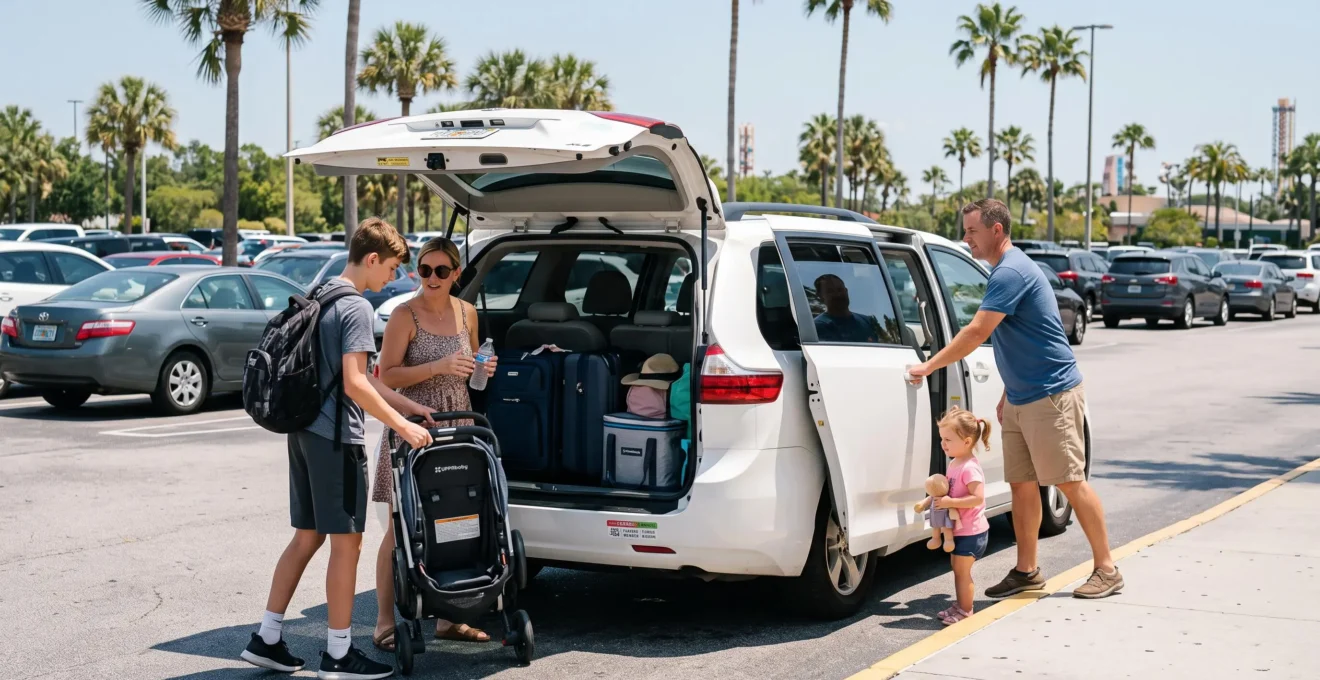
Multipurpose vehicles (MPVs), commonly called minivans in the United States, are often a practical rental choice for large families and small groups traveling through Florida. Their main advantages are adaptable seating, wide sliding doors, and relatively easy passenger access. However, a seven-passenger capacity does not automatically mean enough room for seven travelers and their vacation luggage.
For families visiting Orlando theme parks, traveling between Miami and the Gulf Coast, or sharing a vehicle across multiple generations, convenience depends on how passengers actually use the cabin. Child restraints, third-row access, stroller dimensions, and the amount of luggage can matter more than the vehicle’s advertised maximum capacity.
A minivan is particularly attractive when passengers frequently enter and exit in crowded parking lots or when older relatives need a manageable step into the vehicle. A three-row SUV may be preferable for certain road conditions or equipment requirements, but its higher ride height and seating layout are not automatic advantages.
The right rental is the one that accommodates every passenger safely while leaving sufficient usable cargo space with the required seats upright.
Florida MPV rentals: What families should know
- Passenger access: Sliding doors, lower floors, and accessible second-row seating make minivans particularly convenient for children and older travelers.
- Real luggage capacity: Compare cargo space behind the third row, not maximum cargo volume with seats folded.
- Child safety: Confirm compatible child restraint positions, inspect rental car seats, and follow Florida requirements alongside federal safety guidance.
- Why Are Sliding Doors Useful When Traveling With Young Children?
- How to Organize Seats and Luggage in a Seven-Passenger Minivan?
- Minivan or Three-Row SUV: Which Works Better for Six Travelers?
- Why Can a Seven-Seat Minivan Still Have Too Little Cargo Space?
- Which Minivan Features Help Older Passengers Enter and Exit Safely?
- Hatchback, SUV, or Wagon: Which Fits Sports Equipment Best?
- Which Child Car Seat Installation Errors Can Reduce Protection?
- How to Rent the Right Child Car Seat for Your Family Trip to Florida?
Why Are Sliding Doors Useful When Traveling With Young Children?
Sliding doors make traveling with young children easier because they provide a wide opening without swinging outward into adjacent parking spaces. Parents can reach child restraints, assist toddlers, and manage bags in confined areas. Their greatest advantage is practical access, although safe supervision, traffic awareness, and correctly operated child locks remain essential.
At Florida hotels, theme parks, and busy gas stations, parking spaces may leave limited room beside the vehicle. A conventional SUV rear door needs a clear arc to swing open. A sliding door moves along the minivan’s body, allowing passengers to enter or exit even when another vehicle is parked close by.
This difference becomes particularly useful when an adult must lean into the second row to fasten a child restraint. The wider opening also makes lifting a toddler into a seat more manageable than maneuvering around a partly opened hinged door.
Rental minivans may have manual or power-operated sliding doors. Power doors can be convenient when carrying a child, stroller, or shopping bags. They may also include obstacle-detection functions, depending on the model. However, these systems still require supervision, and automatic doors should never be assumed to eliminate pinch hazards.
Manual sliding doors have simpler operation and may appear on less expensive vehicle configurations. They avoid reliance on a powered opening mechanism but can be heavy for some users. Rental companies may not guarantee either system unless the feature is explicitly confirmed.
Before leaving the rental lot, locate the rear-door child lock controls using the vehicle manual or the rental representative’s instructions. Depending on the model, these may be physical switches or electronic settings. Engage the appropriate child locks and verify that the doors cannot be opened from inside by a child. Also identify the power-door disabling control, if equipped.
During pickup and drop-off, position children on the sidewalk or safest available passenger side, away from moving vehicles. In American parking lots, the safest exit side depends on the actual traffic and parking arrangement, not simply whether the door is on the right.
Door convenience is only part of the decision: the next challenge is arranging passengers and luggage without sacrificing safe seating positions.
How to Organize Seats and Luggage in a Seven-Passenger Minivan?
Organize a seven-passenger minivan by assigning child restraints to compatible seating positions first, placing adults where they can assist children, and allocating the remaining seats according to comfort and accessibility. Next, measure luggage capacity with those seats in use. Folding one rear seat can create extra storage, but only when the remaining seats safely accommodate everyone.
Start with the vehicle’s actual seating configuration. Many seven-passenger minivans have two front seats, two second-row captain’s chairs, and a three-person third row. Other seating layouts exist, including eight-passenger configurations, so the rental category alone does not establish the seating arrangement.
For a hypothetical family with two adults, three children, and one grandparent, one possible arrangement is:
- Place younger children in compatible second-row child restraint positions.
- Assign the accompanying adult a seat from which assistance can be provided safely when the vehicle is stopped.
- Give the grandparent a convenient second-row position if entry and exit are difficult.
- Use the third row for older children or more agile passengers, provided the seats and belts fit them properly.
Never treat the second-row center as automatically suitable for a child seat. Many seven-passenger layouts have no center seat in that row. Even where one exists, LATCH anchor and top-tether availability varies by seating position. Confirm permitted installation locations in the vehicle and child restraint manuals.
Next, assess the luggage before committing to the configuration. A large suitcase per traveler is not a reliable universal packing allowance. Seven bulky suitcases, a stroller, and a cooler may exceed the available storage even when the manufacturer publishes a substantial cargo-volume figure.
With fewer than seven occupants, folding part of the third row may improve the balance between people and bags. For example, a six-person group may be able to use a split-folding rear bench while retaining six approved seating positions. This depends on the vehicle’s exact folding arrangement and seat-belt locations; some layouts cannot accommodate six people with a third-row section folded.
Keep heavy luggage low, maintain clear rearward visibility where possible, and secure items so they cannot become projectiles during sudden braking. Never place bags across passengers’ feet, obstruct seat belts, or use cargo areas as passenger seating.
For long drives such as Orlando to Miami, test third-row legroom before departure rather than assuming every adult will be comfortable for several hours.
Once the seating plan is established, comparing a minivan with a similarly sized SUV becomes much more straightforward.
Minivan or Three-Row SUV: Which Works Better for Six Travelers?
A minivan is often the more convenient choice for six Florida travelers when the priorities are easy third-row access, passenger comfort, and luggage loading. A three-row SUV can be equally suitable if its rear seats accommodate the group and its cargo area meets their needs. Ground clearance and specific road conditions may favor an SUV, but vehicle dimensions should decide the comparison.
The most important structural difference is how passengers reach the rear seats. Minivans commonly have sliding doors and a relatively accessible walkway between second-row seats. Many three-row SUVs require passengers to slide, tilt, or fold a second-row seat to enter the back.
For six adults, third-row headroom, legroom, seat width, and the ability to reach the rear seats comfortably may be decisive. Some SUVs have compact rear rows best suited to smaller passengers or shorter trips. Large SUVs can offer more generous accommodation, so this is not a universal difference between vehicle categories.
The following comparison focuses on typical layouts rather than assuming that every minivan or SUV performs identically.
| Decision criterion | Minivan | Three-row SUV |
|---|---|---|
| Third-row entry | Sliding doors and a possible walk-through aisle simplify access. | May require moving a second-row seat; captain’s chairs can improve access. |
| Third-row comfort | Often designed for regular passenger use, but dimensions vary. | Ranges from compact occasional-use seating to spacious full-size layouts. |
| Cargo with all rows upright | Often provides a deep rear luggage well. | Highly model-dependent; some SUVs have limited rear storage. |
| Highway travel | Family-oriented seating and loading convenience. | Comfort depends on suspension, seating, and vehicle size. |
| Fuel consumption | Depends on drivetrain, including hybrid availability. | Varies widely with size, engine, and drivetrain. |
| Ground clearance | Generally oriented toward paved-road use. | Some models offer greater clearance for uneven surfaces. |
For a group of two adults and four children, an SUV with an appropriately sized third row may work well. For six adults or a mixed-generation family, repeated entry and exit can make minivan access particularly valuable.
Rental costs also deserve a direct comparison. Minivans and large SUVs can overlap in quoted rental prices, but availability, location, travel dates, insurance options, and fees affect the final price. An SUV should not be assumed to cost more, nor should a minivan be assumed to save fuel.
Compare the full rental quote and the published fuel economy of the actual models offered, if known. Comfort differences should be established from dimensions and seating layouts rather than appearance or vehicle-class marketing.
For excursions involving uneven, unpaved access roads, a suitable SUV may provide a useful clearance advantage. However, greater ground clearance does not automatically permit off-road driving. Rental agreements and local road restrictions still apply. Florida beaches, protected areas, and park trails may have specific vehicle-access requirements.
Regardless of the preferred category, luggage capacity with every required passenger seat occupied can be the deciding constraint.
Why Can a Seven-Seat Minivan Still Have Too Little Cargo Space?
A seven-seat minivan can lack sufficient luggage space because its maximum advertised cargo volume generally assumes that one or more passenger rows are folded or removed. When all seven seats are occupied, only the compartment behind the third row remains available for conventional trunk storage. Large suitcases, strollers, and Florida vacation equipment can quickly fill that space.
The distinction is visible in the manufacturer’s published measurements for the 2026 Toyota Sienna. Its cargo space changes significantly depending on which seating rows are available for passengers.
33.5 cu ft
Cargo volume behind the third-row seats in the 2026 Toyota Sienna, compared with 75.2 cubic feet behind the second row. These figures apply to this model, not every rental minivan.
That difference explains why a vehicle can look exceptionally spacious in photographs with the rear seats folded but feel restrictive at full passenger capacity.
More importantly, cubic-foot figures measure total volume, not how many particular suitcases will fit. The shape of the cargo well, opening width, height beneath the rear window, and luggage dimensions all affect loading efficiency.
Before booking, create a luggage inventory containing the actual number and dimensions of large suitcases, cabin bags, strollers, mobility aids, and recreational equipment. Compare it with the cargo space behind the third row of the offered model.
Florida vacations can create additional storage demands. Beach umbrellas, folding chairs, coolers, inflatable pool toys, and snorkeling equipment may take up substantial space despite being relatively light. A family’s luggage may also increase during the trip as souvenirs and shopping purchases accumulate.
Consider a hypothetical group of seven with several large suitcases, a double stroller, and a rigid cooler. The correct approach is not to assume the luggage will fit because the vehicle has seven seats. Instead, ask whether the rear compartment can accommodate those specific objects while maintaining access to all passenger restraints.
If the answer is uncertain, possible solutions include using smaller bags, renting equipment at the destination, selecting a larger passenger vehicle, or choosing a different seating arrangement when fewer people are traveling.
Roof-mounted cargo may seem attractive, but rental minivans frequently arrive without suitable carriers. Roof rails alone do not guarantee compatibility with a cargo box. External storage also introduces height restrictions, loading challenges, and the need for properly secured equipment.
Check the rental company’s written equipment policy and vehicle availability before booking. Never assume a roof carrier can be added at the airport counter.
When luggage needs are settled, the next important question is whether each passenger can enter and exit the vehicle comfortably and safely.
Which Minivan Features Help Older Passengers Enter and Exit Safely?
Minivans can be easier for older passengers to enter and exit because they commonly have lower floors, wide sliding-door openings, and accessible second-row seats. Grab handles and adjustable seating can provide additional support. However, vehicle dimensions, individual mobility, and door operation vary, so a real-world entry and exit test is preferable to relying on the vehicle category alone.
Seat height affects both directions of movement. A tall SUV may require a substantial upward step, while a low passenger car may require an uncomfortable descent into the seat. A minivan can provide a useful middle ground for someone with reduced knee mobility or difficulty balancing.
The most relevant features to verify include:
- Low step-over height: A manageable distance between the ground, floor, and seat reduces awkward movement.
- Wide sliding-door opening: More room allows passengers to turn and position themselves before sitting.
- Well-positioned grab handles: Secure handholds may help with controlled entry and exit.
- Adjustable second-row seats: Fore-aft movement can improve legroom and the passage toward the third row.
- Easy door operation: Power-operated doors may be preferable when manual sliding doors require considerable force.
For mixed-generation groups, give the passenger with the greatest mobility limitations an accessible second-row seat near a sliding door. Reserve third-row seating for passengers who can comfortably move through the cabin and step around seats or footwells.
Do not assume that a captain’s chair provides the same accessibility features as a specialized mobility seat. Travelers who need transfer assistance, wheelchair access, or adaptive equipment should confirm whether a properly equipped accessible vehicle is necessary.
At pickup, open and close the doors, inspect the available handholds, and have the passenger test entry and exit while the vehicle is parked on level ground. If the sliding door is powered, verify that it functions correctly. If manual, check whether the passenger or accompanying caregiver can operate it comfortably.
These checks are particularly useful before committing to a long Florida itinerary involving restaurants, sightseeing stops, and attractions where passengers may enter and exit repeatedly.
Once passenger accessibility is confirmed, families carrying recreational equipment should evaluate how the vehicle handles unusually long or bulky items.
Hatchback, SUV, or Wagon: Which Fits Sports Equipment Best?
The best vehicle for sports equipment depends on the dimensions and loading requirements of the gear rather than the body style alone. Wagons can offer long, relatively flat loading areas, SUVs may provide taller cargo compartments and greater ground clearance, and hatchbacks can work for compact equipment. A minivan is another strong option when passengers and bulky equipment must travel together.
Florida activities introduce different cargo challenges. Golf clubs need sufficient compartment length, fishing rods may require a long protected space, bicycles take up considerable volume, and surfboards can exceed the interior length of many passenger vehicles.
Start by measuring the longest item, the widest item, and any rigid case that cannot be compressed or disassembled. Then compare these measurements with the vehicle’s usable interior cargo dimensions, not only its advertised volume.
| Vehicle type | Practical advantage | Main limitation |
|---|---|---|
| Hatchback | Easy to park and practical for compact sports bags or smaller gear. | Limited interior length and space when rear passengers are present. |
| Wagon | Longer, often flatter load floor with rear seats folded. | Lower roof height may restrict tall or bulky equipment. |
| SUV | Variable cargo height and potentially greater ground clearance. | Higher loading floor can complicate lifting heavy equipment. |
| Minivan | Flexible seating and substantial enclosed space when seats are folded appropriately. | Full passenger occupancy limits the space available for equipment. |
A wagon may outperform a compact SUV when transporting a long object that fits along its load floor. Conversely, a taller SUV can be helpful for equipment that must stand upright or cannot be laid flat.
A minivan becomes particularly attractive for families transporting several golf bags, beach equipment, or disassembled bicycles alongside conventional luggage. Its usable capacity can expand considerably when fewer passengers allow part of the rear seating area to be folded or otherwise reconfigured.
However, equipment must not interfere with seat belts, child restraints, airbags, or passenger access. Heavy objects should be secured appropriately, and long equipment should remain inside the intended cargo area unless an approved external carrying system is available.
Roof transport requires compatible racks or carriers and permission under the rental agreement. Improperly secured items create serious risks, while external loads may increase wind noise, fuel consumption, and overall vehicle height.
For surfboards or bicycles, confirm the specific vehicle’s loading dimensions and approved carrying options before reserving. A rental category description rarely guarantees compatibility with specialized sports equipment.
When children are among the passengers, cargo arrangements must also preserve the vehicle seating positions needed for correctly installed child restraints.
Which Child Car Seat Installation Errors Can Reduce Protection?
The most consequential child car seat installation errors include securing the seat too loosely, routing a seat belt incorrectly, misusing lower anchors or tether straps, and positioning harness straps incorrectly. These mistakes can reduce the restraint’s intended protection. Rental vehicles require particular attention because parents may be unfamiliar with both the seat and the vehicle’s anchoring system.
A properly installed car seat should be secure at its designated belt path. According to NHTSA’s car seat installation tips, the restraint should not move more than one inch from side to side or front to back when tested at that location.
This measurement is specific: pulling the top of a child restraint is not the correct way to evaluate installation tightness, because some movement there can occur even when the seat is installed properly.
Common errors to avoid include:
- Loose installation: The seat moves more than one inch when pulled firmly at the belt path.
- Incorrect belt routing: The vehicle belt passes through the wrong rear-facing or forward-facing path.
- Unlocked seat belt: The vehicle belt is not secured according to its required locking procedure.
- Incorrect harness height: Rear-facing straps are above the shoulders or forward-facing straps are below them.
- Loose harness or misplaced chest clip: Excess shoulder webbing can be pinched, or the chest clip is not at armpit level.
- Incorrect tether use: A forward-facing seat’s required top tether is omitted, incorrectly attached, or left loose.
Rear-facing seats also require the recline angle specified by the child restraint manufacturer. An incorrect angle can affect how the restraint supports the child, particularly for infants.
Forward-facing too early is a separate safety concern. Children should remain rear-facing for as long as permitted by their car seat’s height and weight limits, rather than moving to the next stage simply because they reach a particular birthday.
At rental pickup, time pressure can encourage shortcuts. Parents should read the child restraint instructions and relevant vehicle manual sections, identify compatible seating positions, and complete the full installation procedure before departure.
A quick tug test is valuable but cannot confirm every aspect of an installation. It does not replace checking belt routing, tether use, harness fit, and the manufacturer’s instructions.
Families who are uncertain about their installation can seek help from a certified Child Passenger Safety Technician. Some Florida inspection locations, including participating public safety agencies, offer checks without charge, although appointments and availability vary.
Correct installation begins with selecting an appropriate child restraint, which should be arranged before arrival rather than left to availability at the rental counter.
Key takeaways before reserving
- Confirm the vehicle’s child restraint compatibility before choosing seats for the rest of the group.
- Decide whether renting or bringing a familiar car seat offers the better balance of convenience, verified history, and cost.
- Allow enough time at pickup to inspect and correctly install every required restraint before driving.
How to Rent the Right Child Car Seat for Your Family Trip to Florida?
Rent the right child car seat for a Florida family trip by selecting a restraint that matches the child’s height, weight, and developmental stage, confirming availability with the rental company, and inspecting it before use. The choice between renting and bringing your own seat depends on travel logistics, costs, compatibility, and how confidently the seat’s history can be verified.
Rental companies may offer infant seats, convertible or toddler car seats, and belt-positioning boosters. Those categories are useful for booking, but they do not guarantee that a particular restraint will fit an individual child.
Provide the child’s current height and weight when asking about suitable equipment. If a rental supplier cannot confirm the exact model in advance, request its eligibility criteria and determine what alternatives are available if the supplied seat is unsuitable.
Rear-facing seats are generally appropriate for infants and for older children who remain within their restraint’s rear-facing limits. Forward-facing harness seats become relevant once a child has outgrown the rear-facing limits. Booster seats help position the vehicle’s lap and shoulder belts correctly after a child outgrows an appropriate forward-facing harness restraint.
Florida law establishes minimum child restraint requirements. Under Florida Statutes section 316.613 on child restraints, children aged five or younger generally must be secured in an approved child restraint.
For children aged three or younger, the statute specifies a separate carrier or a vehicle manufacturer’s integrated child seat. For ages four and five, a booster is also among the permitted options, subject to the law’s specific provisions and exceptions.
The statute includes exceptions for certain transportation arrangements, including specified chauffeur-driven compensated services. These exceptions should not be interpreted as a blanket exemption for self-drive rental cars or all rideshare journeys. Responsibility for appropriate child restraint arrangements remains important even where a particular statutory exception applies.
Legal compliance is only the starting point. A child older than five may still need a booster until the vehicle’s seat belt fits correctly. Follow the child’s restraint limits, vehicle manufacturer instructions, and recommended child passenger safety practices rather than relying on age alone.
Renting a seat can reduce airport baggage handling, but daily fees may accumulate during longer stays. Bringing a personally owned seat provides familiarity with its installation and history, while requiring suitable protection during air travel and ground handling.
A rental-supplied seat’s appearance cannot establish its complete crash history. NHTSA’s used car seat safety checklist recommends checking identification labels, recall status, missing parts, instruction availability, and whether a seat has been involved in a moderate-to-severe crash. These criteria are useful when evaluating rental equipment, even though the checklist is not a rental-industry inspection standard.
Five checks before leaving the Florida rental counter
- Confirm the correct seat category. Compare the child’s height and weight against the supplied seat’s permitted limits; record the model and eligibility information.
- Check identification and history. Locate the manufacturer, model, and manufacture-date labels; confirm recall status, service-life guidance, and available crash-history information.
- Inspect completeness. Verify that required components are present, look for visible damage, and obtain the manufacturer’s instructions; request a replacement if suitability cannot be established.
- Install in an approved position. Use the child seat and vehicle manuals to identify the proper belt path, locking method or lower anchors, and any required top tether; verify the installation at the belt path.
- Check the child’s final fit. Confirm harness height, snugness, chest-clip position, and rear-facing recline where applicable; complete a final check before driving.
If the provided restraint is unsuitable, damaged, missing essential parts, or cannot be installed according to its instructions, do not use it. Request an appropriate replacement or arrange another verified restraint before transporting the child.
Before confirming a Florida rental, compare the actual vehicle seating layout, cargo measurements, child seat arrangements, and accessibility needs. Request written confirmation of important equipment where possible, and leave time at pickup to inspect the vehicle and safely install the restraints before beginning the trip.
Is a seven-passenger minivan large enough for seven adults?
A seven-passenger minivan has seven designated seating positions, but comfort depends on the actual vehicle’s third-row dimensions and passenger sizes. Seven adults may fit legally while still having limited luggage space. Compare rear-seat legroom, seat width, and the cargo compartment behind the occupied third row before booking.
Can a family request a specific minivan model from a Florida rental company?
Rental reservations commonly specify a vehicle category rather than guaranteeing a particular model. A model-specific guarantee depends on the rental company’s booking conditions. Families needing a particular seating layout, power sliding doors, or compatible child restraint positions should request confirmation before paying and check the substitution policy.
Can luggage be placed on an empty passenger seat in a rental minivan?
Loose luggage on passenger seats can move during sudden braking or a collision. Use designated cargo areas and appropriate restraints for luggage, following the vehicle manufacturer’s instructions. Do not allow luggage to interfere with seat belts, child seats, airbags, or passenger entry and exit.
Is a minivan suitable for a Florida vacation involving beach trips?
A minivan is generally practical for paved-road trips to beaches, hotels, and attractions because it combines passenger seating with adaptable storage. However, bulky beach equipment can reduce luggage capacity. Driving directly on sand or restricted beach-access roads is a separate issue and depends on local rules, vehicle suitability, and the rental agreement.
Should families book an eight-passenger minivan instead of a seven-passenger model?
An eight-passenger minivan can provide an additional approved seating position, but it does not necessarily provide more luggage space or easier access. The extra seat may change the second-row layout and child restraint options. Choose it when the additional position is genuinely needed and the complete passenger and cargo arrangement remains suitable.